
Pakistan and India hint at imminent military action over Kashmir. A look at the nuclear rivals
Tensions flare as South Asia's nuclear-armed neighbors edge closer to conflict over the disputed Kashmir region.
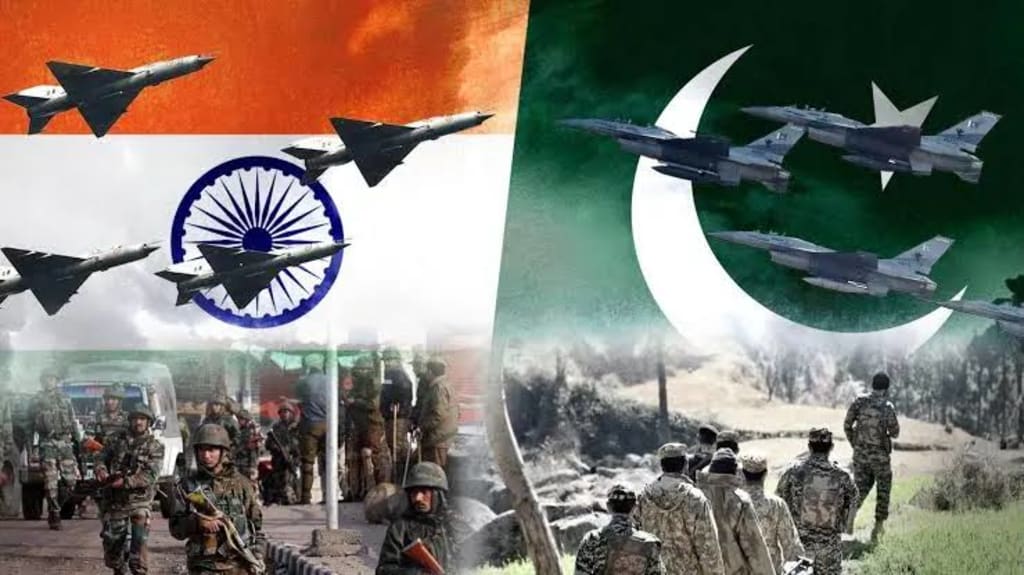
**Pakistan and India Hint at Imminent Military Action Over Kashmir: A Look at the Nuclear Rivals**
In the heart of South Asia lies a region that has ignited wars, fueled nationalistic fervor, and driven two nuclear-armed nations to the brink of catastrophe. Kashmir, often referred to as “Heaven on Earth,” continues to be the flashpoint between India and Pakistan. Recent developments, inflammatory rhetoric, and cross-border skirmishes have once again raised alarms over potential military escalation between these long-time adversaries.
As both nations signal heightened readiness and hint at imminent military action over Kashmir, the international community watches with bated breath. This article delves into the current tensions, the historical context, and the grave implications of a conflict between two nuclear powers.
---
### The Latest Provocations
In recent weeks, officials from both India and Pakistan have exchanged strong words over the ongoing unrest in Jammu and Kashmir. The uptick in ceasefire violations across the Line of Control (LoC), reports of militant infiltration, and political changes in Kashmir’s administration have all contributed to the mounting tensions.
India has accused Pakistan of harboring and supporting militant groups operating in the Kashmir Valley, particularly Jaish-e-Mohammed (JeM) and Lashkar-e-Taiba (LeT). In response, Pakistani military spokespersons have warned India of “serious consequences” for any military aggression, stating that Pakistan is “fully prepared” to respond to provocations.
The situation has worsened since India’s abrogation of Article 370 in August 2019, which revoked the special status of Jammu and Kashmir. Pakistan strongly condemned this move, downgrading diplomatic ties and halting trade with India. The most recent developments seem to be part of a dispute that has been going on for a long time and is now getting close to boiling over. ---
### A History of Conflict
The roots of the India-Pakistan conflict over Kashmir trace back to 1947, the year of Partition. The princely state of Jammu and Kashmir, which had a Muslim majority but was ruled by a Hindu maharaja, had the option of joining either India or Pakistan. Maharaja Hari Singh made the decision to join India after tribal militias from Pakistan invaded, which led to the first war between India and Pakistan. Since then, India and Pakistan have fought three wars (1947–48, 1965, and 1971), and had a limited conflict in Kargil in 1999 — all but the last centered on Kashmir. Multiple peace initiatives, ceasefires, and talks have failed to resolve the issue, and periodic flare-ups are common.
What makes the current situation particularly dangerous is the presence of nuclear weapons. Both nations conducted nuclear tests in 1998, establishing themselves as de facto nuclear powers. This has altered the strategic calculations on both sides, but it hasn’t eliminated the risk of conflict. In fact, the existence of nuclear weapons has, at times, emboldened each side to engage in limited military actions, believing the threat of full-scale war might deter the other.
---
### The Kashmir Conundrum
Kashmir is not just a territorial dispute. For India, it is an integral part of the nation — both politically and symbolically. Any concession on Kashmir is seen as a threat to its sovereignty. For Pakistan, Kashmir represents unfinished business from Partition and a humanitarian cause, particularly as it claims to represent the interests of the region’s Muslim majority.
The region remains heavily militarized. India has deployed hundreds of thousands of troops in Jammu and Kashmir, making it one of the most militarized zones in the world. Pakistan administers Azad Jammu and Kashmir (AJK) and Gilgit-Baltistan, though it maintains that the entire region should be allowed to determine its future through a plebiscite — a demand India has consistently rejected.
In the meantime, the civilian population suffers. Restrictions on movement, periodic internet shutdowns, curfews, and violence have marred everyday life in the Valley. Over the years, the rise of militancy and counterinsurgency operations have created a humanitarian crisis that often gets overshadowed by strategic posturing.
---
### Military Capabilities: A Dangerous Balance
India maintains one of the largest and most modern militaries in the world, with significant conventional superiority over Pakistan. Its defense budget and arms procurement dwarf that of its western neighbor. However, Pakistan has invested heavily in asymmetric warfare and tactical nuclear weapons to counterbalance India’s conventional edge.
Both countries have developed second-strike capabilities — a key component of nuclear deterrence. India adheres to a “No First Use” (NFU) nuclear policy, while Pakistan has refused to adopt such a policy, citing its smaller conventional forces.
What complicates matters further is the possibility of miscalculation or accidental escalation. In 2019, following a terrorist attack in Pulwama that killed over 40 Indian paramilitary personnel, India launched an airstrike into Balakot, Pakistan. Pakistan responded with airstrikes of its own, and in the aerial skirmish, an Indian fighter pilot was captured and later returned. The crisis was defused, but it showed just how close the two nations came to the edge — and how quickly things could spiral out of control.
---
### Diplomatic and Global Implications
A war between India and Pakistan, especially one that could turn into a nuclear conflict, is not something the world can afford. The monetary, human, and environmental costs would be catastrophic not only for South Asia but for the entire world. Studies have shown that even a limited nuclear exchange between the two nations could lead to severe climate disruptions, famine, and massive loss of life.
China, a regional superpower and Pakistani ally, has stakes in the region, particularly in Gilgit-Baltistan, where the China-Pakistan Economic Corridor (CPEC) runs. Meanwhile, the United States, Russia, the Gulf states, and the United Nations have all periodically called for restraint, dialogue, and de-escalation.
Despite these calls, diplomatic efforts have been inconsistent. The Composite Dialogue process, Track II diplomacy, and backchannel talks have seen limited success. Domestic politics in both nations often hinder meaningful engagement, as hawkish positions tend to gain popular support.
---
### A Way Forward?
Despite the tensions, war is not inevitable. Both nations have rational leadership that understands the devastating consequences of military escalation. There are still opportunities for diplomacy, particularly through international mediation, people-to-people engagement, and confidence-building measures (CBMs) like cross-LoC trade and communication channels.
Restoring political freedoms in Kashmir, reducing military footprints, and engaging in genuine dialogue are essential steps. The international community must also play a more active role in facilitating peace without infringing on sovereignty.
What’s most needed is political will — on both sides — to prioritize peace over populism, and to recognize that the future of nearly 20 million Kashmiris, and potentially billions more in the region, depends on restraint and reason.
---
**Conclusion**
The current war of words and military readiness between India and Pakistan over Kashmir has pushed the region once again to a dangerous precipice. While history suggests cycles of tension often end in temporary calm, the stakes are higher than ever in the nuclear age. As both countries continue to assert their claims and prepare for potential conflict, the rest of the world can only hope — and push — for a path that leads to dialogue, not disaster.
About the Creator
Keep reading
More stories from Praloy Rakshit and writers in Unbalanced and other communities.
Microsoft’s AI Secretly Copies Your WhatsApp, Signal Messages
A draft of the article "Microsoft's AI Secretly Copies Your WhatsApp, Signal Messages" can be found here: Microsoft’s AI Secretly Copies Your WhatsApp, Signal Messages: Privacy Concerns Ignite Global Backl A new wave of privacy concerns has emerged as reports indicate that Microsoft’s AI systems have been secretly accessing and copying messages from encrypted messaging apps like WhatsApp and Signal. According to whistleblowers and recent cybersecurity investigations, Microsoft's AI models, which are a part of the Windows ecosystem and cloud services, have been quietly scanning user data in a variety of applications, including supposedly secure platforms. These revelations have sparked alarm among privacy advocates, governments, and tech users around the world. How did it occur? Microsoft's Copilot AI and its integration with Windows system-level permissions, according to reports, are the source of the problem. Copilot reportedly logged user interactions, including messages sent or received via WhatsApp Desktop, Signal, and other encrypted communication tools, when granted broad access to device activity and app usage. Although these applications claim to use complete encryption, the security flaw appears to be outside of the encryption itself. Through clipboard monitoring, keystroke logging, or background process reading—capabilities users unknowingly authorized during setup—Microsoft's AI may have had access to messages viewed or typed in Windows. Official Responses and Denials According to Microsoft's statement, their AI "only collects data with user consent to improve experience" and "no encrypted data is decrypted or used without permission." Microsoft denies any intentional violation of user privacy. However, critics argue that the company has failed to clearly inform users of what permissions they grant during installation. The possibility of a breach has been criticized by both WhatsApp and Signal, with Meredith Whittaker, CEO of Signal, describing it as "a disturbing overreach that undermines the very principles of encryption and privacy." Global Reaction and Investigations European regulators, already critical of American tech giants’ data practices, have opened formal investigations under the General Data Protection Regulation (GDPR). A number of senators in the United States have requested hearings on AI oversight and digital privacy. “This could be the Cambridge Analytica moment for AI,” warned Eva Galperin, Director of Cybersecurity at the Electronic Frontier Foundation. “We cannot allow AI systems to become Trojan horses for mass surveillance.” What You Can Do Experts recommend that users review app permissions, disable unnecessary Copilot features, and consider using operating systems or privacy tools that limit background access to encrypted communications. Conclusion As AI becomes increasingly embedded in everyday technology, the balance between innovation and privacy grows more fragile. The alleged data harvesting by Microsoft’s AI serves as a stark reminder that privacy in the age of AI is not guaranteed—even on platforms built to protect it.
By Praloy Rakshit9 months ago in Wander
Wild Card Weekend Recap: What Happens Now?
I think I figured out why I love Wild Card Weekend so much. It's because it's the first playoff anything of the calendar year. The NFL season starts in the fall, and once upon a time, the champion was crowned either on or slightly before New Year's. The evolution of the NFL schedule has resulted in the playoffs starting just into the New Year, and currently, the final week of the season falls on the first weekend of the New Year, with Wild Card Weekend coming a week after that. So yes, chronologically, the NFL's Wild Card Weekend serves as the first playoff anything of the calendar year.
By Clyde E. Dawkins7 days ago in Unbalanced



Comments (1)
Okk