
NOT the Ultimate Guide to Recurve Archery Equipment 4
Handle and Limb. This is NOT the ultimate guide to choosing your first bow. Instead, it is written to explain the details one must pay attention to when selecting their equipment. So yes, this is a piece of the puzzle that helps you in choosing suitable equipment. Mismatched or poorly set-up equipment may lead to bad habits, wrong moves to compensate for the problem with equipment, and worst increase the potential of injuries.

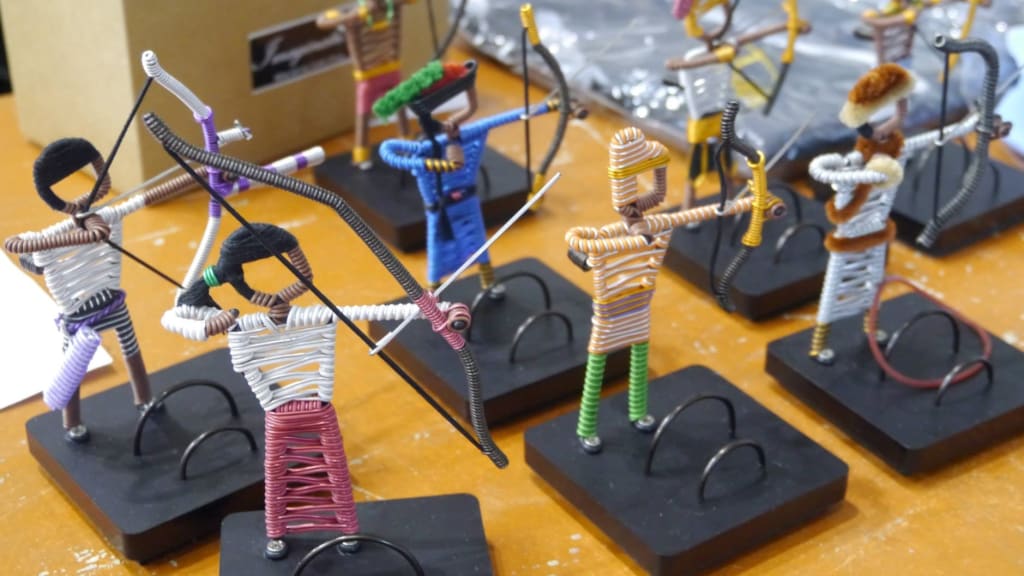
Usually archers would like to buy a better handle and use it for a longer period of time, but it is not the case for limb. It is more important for archers to gradually increase draw weight, which leads to the need to frequently change limbs.
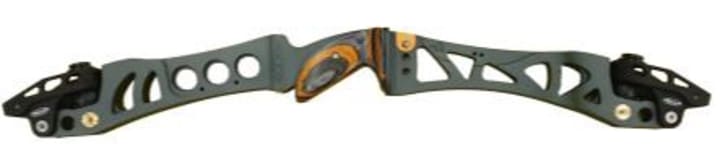
Handle / Riser
Here we are the main part of the bow, after the accessories and personal gears. I avoid going for it first simply because I found it one of the most challenging pieces of equipment to talk about. There are multiple factors affecting the choice and the considerations are complicated. What's worse is that there is usually no easy access for a try out before buying the handle.
The first thing to decide is the length of handle to buy. For beginners, your coach should have taken the responsibility to decide it. There are many references discussing the length. I am not going to touch it here. I would like to discuss three other points I believe are of high importance: appearance, weight and the grip. One may also consider if it is good value. Unexpectedly, it usually turns out not to be the high end top model to buy after considering all these three factors. Choosing the most expensive one in the market once for all is invalid for buying a handle.
Face-Judger (Idiom in Cantonese 外貌協會). Appearance is important, possibly the most important. If you do not love your bow, it is simply demotivating to practice or to continue the sport. It is personal preference and I am sure every archer can do a very good job choosing the correct one handle. Some may be concerned about the holes on the handle. I cannot say the holes are totally decorative but there is not much to do with skill and technique or performance. The holes are meant to make the handle less affected by wind and to reduce the mass weight. However different models of handles can weigh similar with or without holes.
It is the same case for color to be of personal preference, for example whether the color is metallic or pastel, dark or light. Be aware that finishing can be painted or anodized. Usually anodized finishes are expected to be stronger and heavy duty while painted ones would have a higher risk of damage with careless users. To be frant painted finishes nowadays are pretty durable so I do not see it a big concern. Usually entry level bows all come painted. Top of the line models may be anodized or painted. Usually light colors are painted as it would be very difficult, if not impossible, to be anodized. A funny piece of personal experience of which I have no way to validate. For the same model of handle with both anodized and painted finishes, I found painted ones give a slightly more controlled feel and absorb vibrations better, while anodized piece delivers a slightly more solid feel.
If you are not impressed by the models available in the market, here is a very special piece of handle you want to take a look at. Or you can find a lot of funny shape and design handles in the website Archery History.
Another funny fact. Once a very shiny silver anodized handle was being complaint by archers in competition. The surface of the handles are reflective and cause disturbance to other archers on the shooting line. That particular color of the handle was available only for a very short time in the market of half a year. The early discontinuation of the color could be related to the complaints.
The Straw that Broke the Camel's Back. The weight of a handle usually ranges from 1,000 to 1,300g. Surely there are some out of norm models. Beginners bow or youth bows are usually lighter in weight. Wood take-down bow handles you may find in your club are roughly around 800g. Do not underestimate the power difference made by say 100g or so. Consider one stabilizer weight which is usually 28g (1oz). If an archer is not having good strength to control his bow, adding one tiny extra weight at the far end of the stabilizer can lead to a total deform.
Another consideration shall be related to the draw weight. Draw weight and bow mass has to be balanced. The draw force will assist lifting of the bow. There should be nothing more than push pull balance at the full draw position. The set-up is unbalanced if the archer needs to intentionally hold the bow to avoid it from falling . Beginners shall be drawing something between 10-30lb when they are getting their very first bow. The handle mass weight shall be light for the good of balance at full draw. It shall not be imposing extra stress on the archer so he can focus on acquiring the correct skill and technique. One must not go for a heavy handle if having difficulty to keep the bow shoulder low. In fact too heavy set-up is always the reason leading to archers to fail to achieve good solid bow shoulder position.
Grip. Whenever it is available, have a try with the grip before buying the handle. Letting the palm rest on the grip and trying to push the handle is the minimal requirement, even if drawing or shooting is not available. If you find the hand slipping to the side when drawing the string back or at full draw position, probably the grip is not for you. Of course It can be skill and technique problems leading to the slide. It is possible to adapt to the new grip by achieving better alignment or changing the gripping position through practice. However it is always easier and reasonable to pick the equipment which is suitable instead of trying to adjust the shooting style to cope with it.
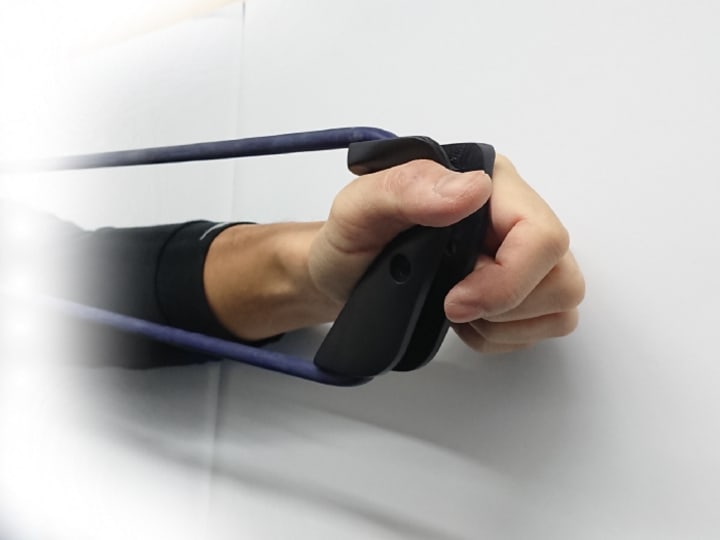
Grips from older model handles are generally thicker at the throat and round. The shelf and thumb side are level, rarely do they process an angle. They are usually low to medium grip with a smaller wrist angle. Newer models' bow grips may have a gradual slope from shelf to thumb side. The slope allows the thumb to reach towards the target, giving the bowarm a solid connection to the bow, and facilitates bow arm rotation.
European and US bows are designed with westerners in mind. Considering the difference in grip size between westerners and easterners, Asian brands might have bows with grips more readily suitable for Asian archers. Some grips have the thumb side more contoured. This may lead to a higher chance of abrasion of the thumb.
Grip wrist angle affects gripping skill and execution of shot. In general, a high grip with a larger grip angle encourages the bow arm to rotate and the elbow to point out, hence a better support to the bow and higher precision. It is, however, more challenging to control. It stresses the wrist more hence a higher risk of injury in case the archer is not gripping it correctly.
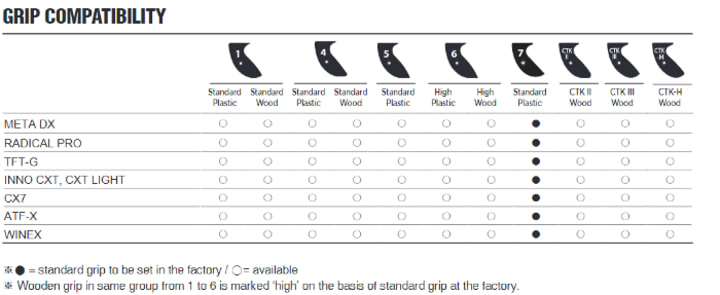
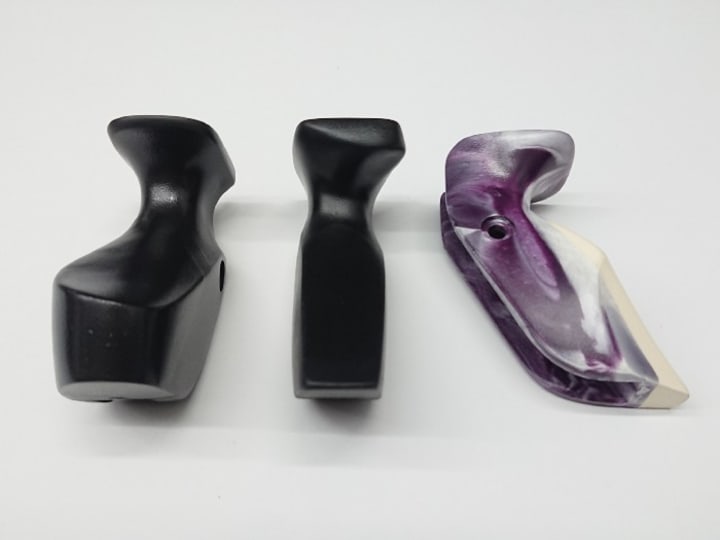
If it is really necessary to use a handle with factory grip being not suitable, for any reason, it is possible to change the grip. Big brand manufacturers usually provide two or three options in grips for their own handles. There are more options if going for third party products. Brands like Jager Grip or R Core have a massive collection of grips for different brands and models. However third party grips are usually pricey. It will cost half of an entry level handle.
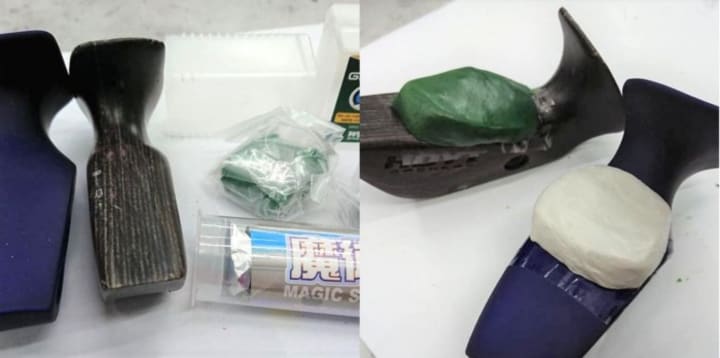
Using metal epoxy putty to add-on the grip is a common method used by many high performance coaches or archers to customize the grip according to individual needs. One should be very careful in doing so as it risks shifting the pressure point away from the central plane or pointing it away from the target. It is not easily recognized but you definitely do not want it to happen as it messes up everything. Only go for such modification if you have a very experienced coach working closely with you, understanding your shooting style and need.
Plastic molding or 3D printing are good ways to produce identical grips. However it requires a totally different set of skills and resources to bring it into action. It is not something very new. It was back in 2012 when Olympian fencers reported to apply 3D scanning and printing technology to produce identical spare fencing hilt. To my knowledge I do not see companies officially providing similar services in archery.
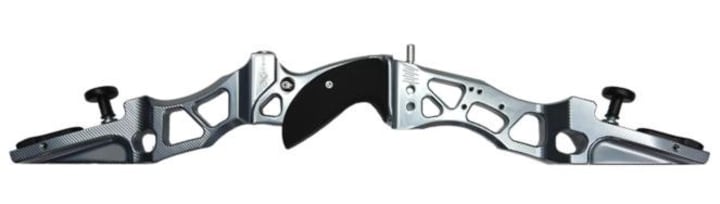
Homogamy (Idiom in Cantonese 竹門對竹門). ILF stands for International Limb Fitting. It is how limbs are attached to the handles. It is some kind of mutual agreement by manufacturers to make limbs and handles. Following the system makes limbs and handles of different brands interchangeable. THIS IS A LIE. Well yes you can plug the limb in but there are potential problems. It is always better to stick to the same brand unless you are experienced. If you need to mix and match different brands' handles and limbs, try avoid unfamous small brands or something very new. The supposing compatible limbs and handles have little variation, resulting in many different potential problems:
- Altering the poundage. Increase or decrease in draw weight as of the limb marked weight. Due to difference in design of handles, the angle of pocket connecting the limbs and handles varies, making the limb angle not the same when putting on different handles;
- Due to the change in limb angle, string length and brace height requirement will no longer be the same;
- Limbs cannot plug into handles, or cannot be pushed all the way in. Some handles have too narrow pockets and cannot allow the limb to fit in. If limbs must be used on such handles, one must file both sides of the limb making it slimmer. However it may damage the limbs.
- Limbs fit in but cannot stay firm on the handles. The dovetail spring pin of the limb is not fitting in the handle. It is usually fine after the bow is stringed but it is quite a danger to string the bow without having the pin fitting in the socket. This problem, sadly, has been seen even between limbs and handles of the same brand ‘W’ of Korean. I am amused by how bad big brands are doing their job in product quality control.
Other Concerns. On top of the three main concerns above, there are some others points to consider.
Formula System. Formula system is another system of limbs fitting handles beside the ILF. Formula system is not compatible to ILF. There are adaptors for ILF limbs to fit in formula handles in the market.
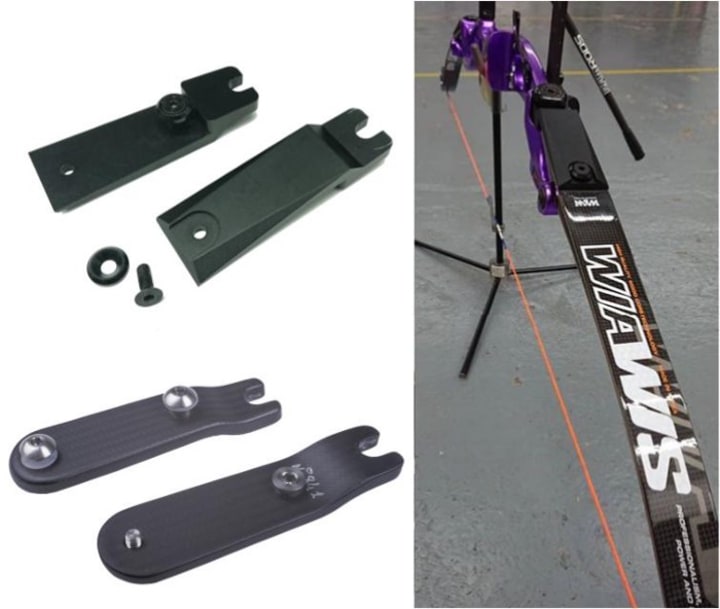
There are less options in formula limbs in the market, due to the fact that fewer companies are manufacturing formula limbs and / or handles. Examples of brands making formula system limbs are Hoyt, MK Korea, Border and Gillo etc. The main concern shall be the fewer choices and less compatibility with other brands and models.
Another point one shall be aware of in buying formula system equipment is that formula handles have a much shorter window, as formula limbs are longer and extend further into the handle and IFL limbs. This results in problems for some archers while shooting close distances like 18m indoor. The sight pin might be totally blocked by the handle. This is for sure more likely to be an issue for archers with long draw length, heavy draw weight, have a long face, and a using finger tab platform etc. I would not recommend beginners to buy formula bows as their very first purchase.
System to Centering Limb Alignment. This is actually more a concern for team coaches rather than archers. I would like to put limb adjustment systems into three categories: not adjustable, adjustment made by changing the number of washers in the adjustment block, adjustment made by loosing and tightening screws to move the adjustment block.
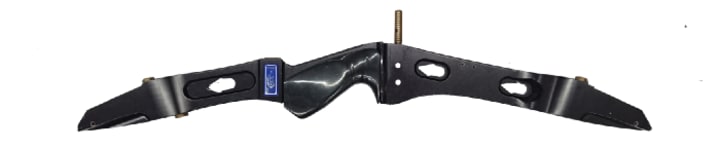
Some entry level handles and very old models do not allow limb alignment adjustment. Most, if not all, metal handles nowadays include a limb centering system. Do not consider handles with no limb alignment adjustment feature. There was once high end competition level bows with no limb alignment adjustment available for archers. It is because the alignment has been factory set perfectly. They have great confidence in their limbs to be straight.
This is the minimum you need to know. You may want to skip the rest for the system to centering limb alignment if find it too boring or complicated.
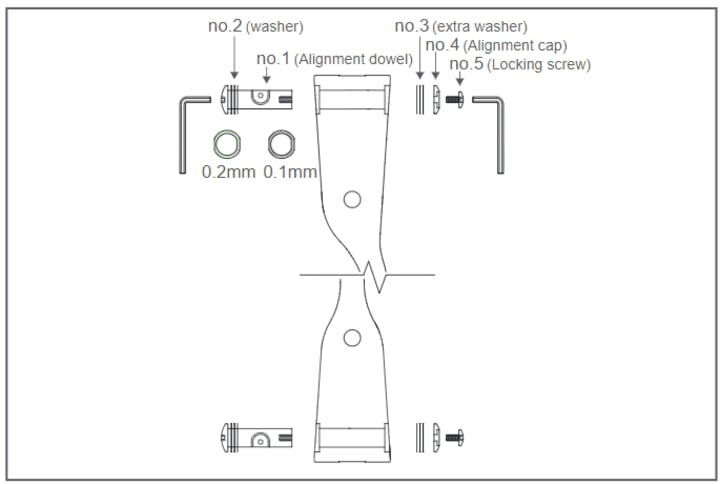

The second category of limb alignment adjusting system handles are a nightmare for coaches. The inevitable endless string and unstring, limbs plugging and unplugging steps throughout the attempt to center the limbs makes it extremely time consuming to set or tune a bow, unless you do not care about limb alignment. It is always trial and error during adjustment. No one can be sure to make it perfect in one shot. Consider a team coach in school with athletes frequently changing limbs to increase draw weight, it is impossible for the team coach to spend the already very limited training hours for bow set-up or tuning. My experience is usually having around 20 archers per team and having only around 4-6 hours training time per week. I actually forbid my school team members to buy these types of handles.
The system is totally fine in function and does a good job in centering limb alignment. As the alignment is adjusted by moving washers of fixed thicknesses. The number of washers used and their thickness can be quantized. This makes adjustment repeatable and easy to record. Hoyt has been using this style of solid limb adjustment system in their top model handles for many years but changed to the third style, which is to be covered below, in 2019. MK Korea is still applying this style of limb adjustment system.
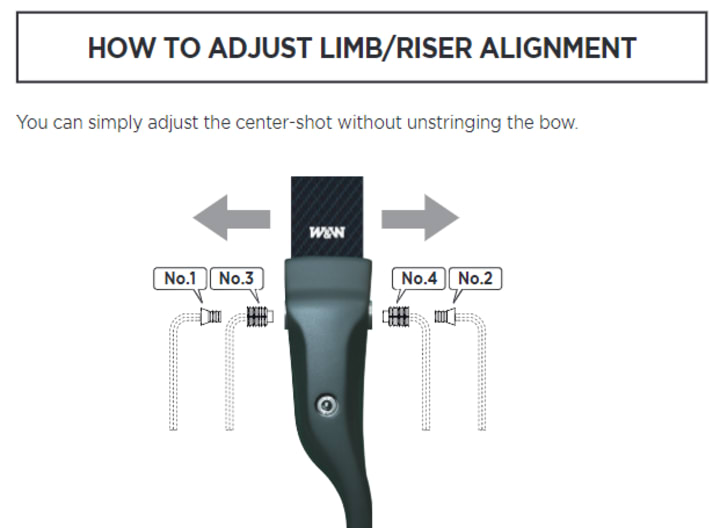
The third category of limb centering system allows adjustment without unstringing the bow, which helps save much time when setting or tuning a bow. WARNING: some brands' user manual required the user to unstring the bow and remove the limb before adjusting the blocks while some stated clearly such adjustment can be done without unstringing the bow. Check your handle’s user manual and do it at your own risk. I never unstring the bow to adjust if it is with this style of centering system, no matter what the user manual says. Never have a problem with it. The downside of this style of adjustment system is that it is not repeatable and can hardly be quantized for record. It also relies much on the user's experience in making correct adjustment, since a very little turn in the screw, say ⅛ turn, will significantly shift the limb alignment.
There are two main concerns with this style of adjustment system. First is if the adjustment block can be locked firmly on the handle. Some models have far too tiny adjustment screws which are too weak to hold the block shots after shots. Some models employ locking screws outside the adjustment screws to keep them in place. These are much more preferred models over those with no locking screws.
The second concern is related to the quality control of production. There are many handles seen with moving blocks not resting firm and fit in the handle. It can be because the handles or blocks' surfaces are not being smooth and flat, or they are not precisely parallel to each other. It is also possible when the adjusting screw touches the moving block, it pushes the block upwards leaving a tiny gap between the block and the handle. All these faults can not be easily notified while making adjustments. These lead to a false belief that the limbs are not centered or at worst the limbs are twisted, making adjustment very difficult to perfect. To avoid this, some models employ a screw fixing the block onto the handle perpendicularly. This also helps prevent it from getting loose and dislocated after shots.
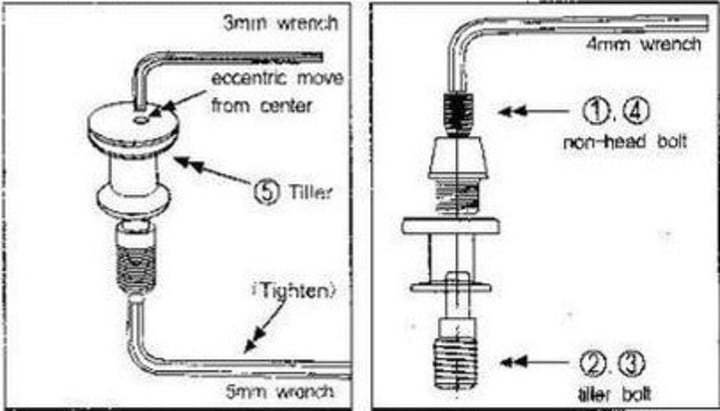
Something extra in the following picture. You may come across this system in some old club equipment but I do not think there are new models having this.
Limb
For beginners level archers, limbs are not supposed to be used for a long time as the archer is expected to gradually build up strength and increase the draw weight. It is unnecessary to go for high end top models.
Price. Get something cheap, say below 200USD is decent enough. It is totally OK to look for used second hand items too. Even if you have the budget, I do not recommend spending too much money on limb. There is no way one can get top model too, as top models usually start from over 30lb marked weight which exceed the poundage most beginners archers should be going for.
The concern with cheap models and used items shall be quality and durability. Poorly made limbs have a higher risk of twisting (also higher risk that manufacturers refuse to make replacement). Twisted limbs not only affect performance, it also severely affects archers' learning process as the bow is not giving correct feedback and it leads to a much bigger risk to have string hitting the bowarm. Sadly, twisted limbs are not something one can avoid easily. Even mid-price range limbs are always found twisted, maybe just a little bit less often than cheap models.
Breakage is the worst we can get with limbs. Misuse may lead to higher risk of breakage e.g. inappropriate storage, mismatched string used, and poor tuning making the bow vibrate a lot etc. But it comes down to luck after all. Even top model limbs break occasionally. It is virtually impossible for users to conclude the breakage is because of design fault or productional defect. It is sometimes difficult to claim the manufacturer for replacement even if it is within warranty period too.
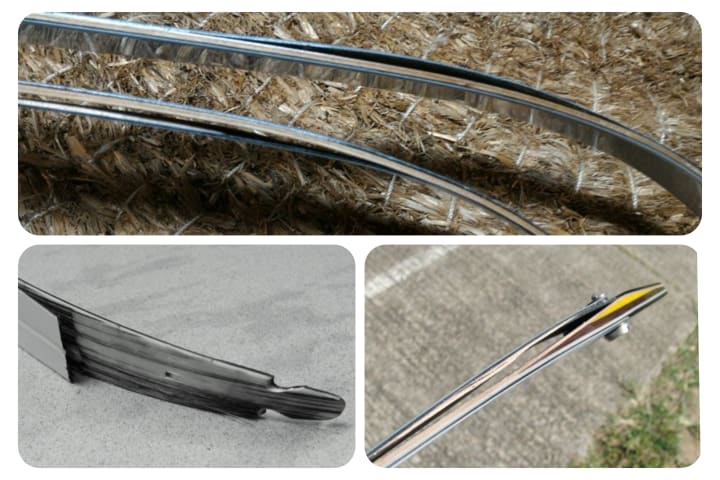
Considering going for cheap models, one shall pay attention to the limb tip where the string loop is touching. It is very common to see poorly made limbs with sharp edges at the tips which cut strings and servings. There is no way you can have strings last long on such limbs. It is not easy to file the limb tip round and smooth for better contact with the string.
Material. Limbs are made with layers of different materials. The core layer is of most concern. Some believe that wood core limbs are difficult to draw and are more susceptible to weather changes. Foam or carbon (whatever you name it, with new technology and structure) core limbs are usually believed to be smooth drawing and are less susceptible to weather changes. To my knowledge I never see strong evidence or proof supporting such beliefs, especially for the smooth feeling of draw which is a combined result of different factors. Hence I would suggest these are not very important considerations beginners archers shall be paying attention to.
Feel of Draw. Usually we describe the easy-to-pull limbs to be smooth drawing, while being hard in the opposite. This is unrelated to draw weight at full draw. Instead, it is the rate of increase in draw weight during the draw matters. If the poundage increases sharply it would feel hard i.e. difficult to pull. If the slope is more gentle on the graph it will feel more smooth during the draw. The change in weight is not uniform throughout the draw from brace height to full draw position. Another term some people may use to describe the limb is stacking, which means the increase in draw weight is exponential beyond the optimal draw length.
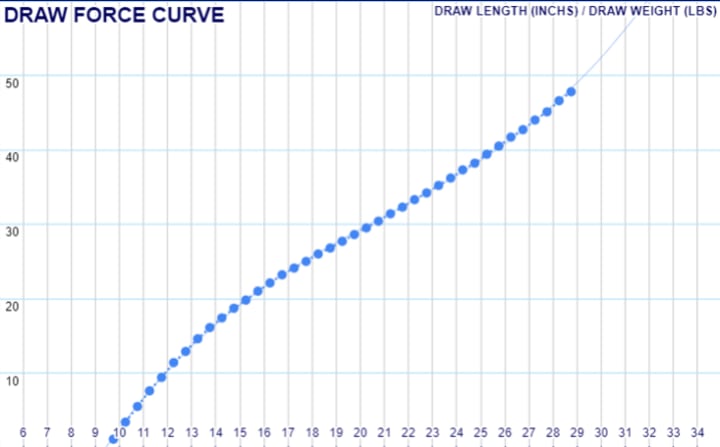
Above is theoretical, which I am not an expert in. I hope I am not putting it wrong nor inducing much confusion. In a real life situation, attempting to plot the draw force curve by using a simple draw machine and digital scale fails. The difference is too small to be recognized. No significant results can be found by drawing different combinations of models of handles and limbs nor by altering the brace height. Despite the differences being so minor to be precisely recorded or shown in figures or graphs, it can easily be noticed by a leisure archer. If the increase in weight is quick early in the draw, one may find it difficult to pull a heavy pair of limb. If the increase in weight is fast near full draw, one may find it OK to draw at the beginning but difficult to expand through clicker. It is more a personal preference as some may prefer it smooth at the beginning of draw while others prefer it smooth at full draw position. Before commenting if a pair of limb is smooth drawing, first it is necessary to define which part of the draw curve we are talking about.
If you have the resources and access, it is always better to try it out before buying. Borrow the limb and put it into your handle for test shots, or at least try pulling it.
Weight. Instead of the marked draw weight, I am meaning the physical weight, or mass, of the limb. This data is not always shown in the catalog specification. However this is quite an important factor in middle to high end models. The heavier the limb is, the more energy is wasted. Less energy to be transferred to the arrow means slower arrows speed at the same draw weight. The less efficient limb of no doubt leads to a drop in sight mark in long distances as well as affects the choice of arrow spine matching the bow.
Length and Marked Weight. Ask your coach.
That's all for handle and limb. Not trying to cover e.g. their lengths and its relation with draw length, 23 inches handle + medium limb or 25 inches handle + short limb etc. There are much references readily available covering those areas. The next article will be the last one for the equipment selection guide. We will go for the arrows and accessories.
About the Creator
Calvin Lee
2020 Tokyo Paralympics Hong Kong Team Coach
2012 London Olympics Olympian
25+ years experience in target archery, both recurve and compound
15+ years in coaching. From entry level to elite training. 500+ beginners per annum at peak.
Keep reading
More stories from Calvin Lee and writers in Unbalanced and other communities.
NOT the Ultimate Guide to Recurve Archery Equipment 3
Stabilization No Golden Rules There are tons of choices in stabilizers and dampers in the market. There is no simple answer to which model is better nor a golden rule in choosing the correct length. Whether the stabilization equipment works well depends heavily on the interaction with the choice of other pieces of equipment and the set-up.
By Calvin Lee4 years ago in Unbalanced
Lou Holtz
Few figures in college football have left as broad and lasting an impact as Lou Holtz. Known for his disciplined coaching style, motivational speeches, and unmistakable voice, Holtz built a career defined not only by wins but by principles. Over decades in the sport, he became more than a sideline strategist; he became a symbol of resilience, faith, and structured leadership.
By Saboor Brohi 8 days ago in Unbalanced
Kentucky Basketball: Passion, Pressure, and a Proud Legacy
In some places, sports are entertainment. In others, they become part of everyday life. In the state of Kentucky, basketball holds that deeper meaning. For generations, families have gathered around televisions, filled arenas with blue and white, and celebrated the achievements of young athletes who wear the university jersey. Kentucky basketball is more than a college team. It represents pride, tradition, and the belief that hard work on the court can create unforgettable moments. Every season carries hope, excitement, and sometimes heartbreak. Fans expect greatness because history has shown it is possible. From legendary players to dramatic tournament victories, Kentucky basketball continues to shape the identity of a community that lives and breathes the game.
By Muqadas khanabout 2 hours ago in Unbalanced
Early March 2026: 4 Goals Accomplished
It's early March and I've now accomplished my 4th writing goal for the year of 2026. Before diving into the behind-the-scenes of it... why not tell you up front what that accomplishment was? I was published in a 2nd publication for this year. Published in Helix Literary Magazine out of Central Connecticut State University. You can read it for free right now!
By Stephen Kramer Avitabile7 days ago in Writers



Comments
There are no comments for this story
Be the first to respond and start the conversation.