
How the Ohio State–Michigan Rivalry Became My Annual Reckoning
Every November, the world narrows to a hundred yards and a lifetime of emotions. For me, Ohio State vs. Michigan isn’t just a football game—it’s a test of memory, identity, and belonging.

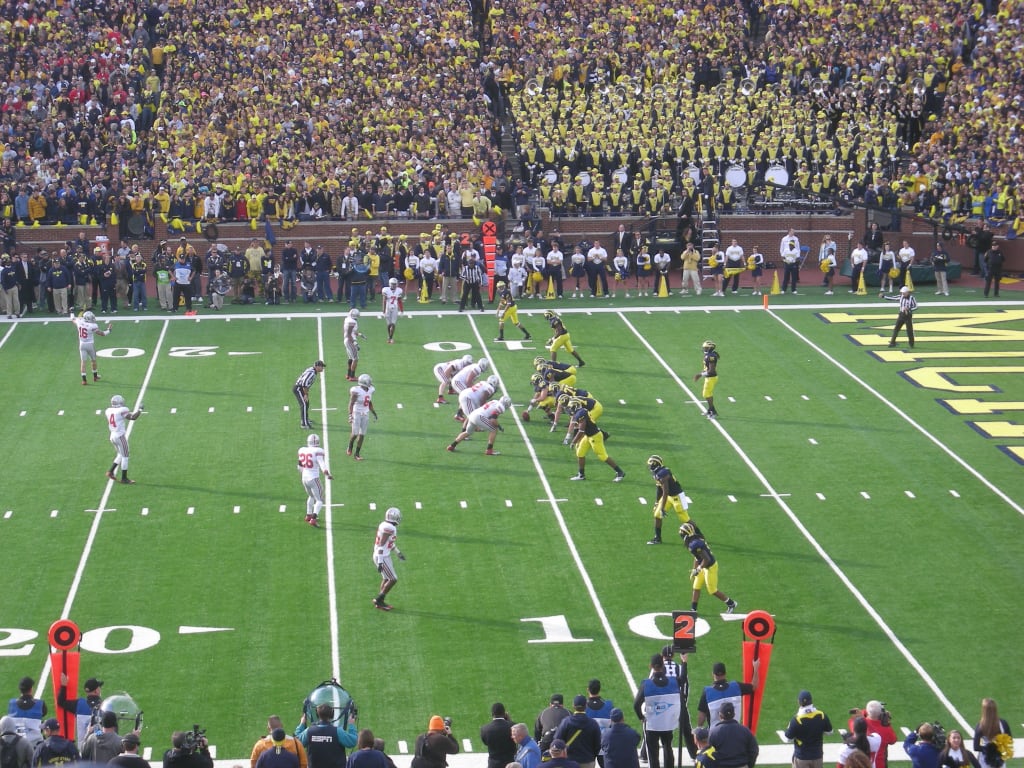
I grew up in a house where autumn meant two things: raking leaves and preparing emotionally for the last Saturday in November. My father was a loyal Buckeye, his loyalty stitched deep into the fabric of our weekends. His radio would blare “O-H!” chants through the kitchen while I sat at the table, pretending to do homework but secretly eavesdropping on his commentary. For him—and, eventually, for me—the Ohio State–Michigan game wasn’t a sporting event. It was something closer to liturgy.
Over the years, I started to understand that this rivalry carries the weight of something far greater than football. When I first visited Ann Arbor, it felt like stepping behind enemy lines. Every maize-and-blue sweatshirt was a taunt, every banner a reminder of all those close losses that my dad still dissected like open wounds. Yet there was also admiration in his voice when he spoke about Michigan’s precision, its pedigree. Rivalry, I realized, works best when respect and resentment share the same room.
As a kid, I believed the outcome of the game could shift the emotional tides of an entire state. When Michigan won, the atmosphere back home felt subdued, like a gray post-storm sky. When Ohio State prevailed, people honked in traffic, and strangers in grocery stores exchanged knowing nods. College football in the Midwest isn’t background noise—it’s civic theater. The rivalry between these two teams has become the heartbeat of an identity that defines generations.
In college, I met friends who self-identified by their colors before their majors. My roommate was from Detroit, a lifelong Wolverine who saw my scarlet hoodie as an open invitation for banter. We debated quarterbacks as if they were philosophers, exchanged YouTube clips the way others traded study notes. When Ohio State beat Michigan in 2018, he refused to leave his dorm for two days. But when the roles reversed in 2021, he taped the final score to our door. I didn’t tear it down. Rivalry isn’t just opposition—it’s the ritual of remembering where you come from.
There’s a generational texture to this game that fascinates me. My father still curses Jim Harbaugh the way his own father used to curse Bo Schembechler. Meanwhile, the younger fans treat Ryan Day’s play-calling like scripture under revision. When I watch the game now, I can see all of us reflected in the stands—students screaming, retirees tearing up, children pretending to be the next Archie Griffin or Charles Woodson. The matchup is like a mirror, showing our ages, our allegiances, the way time both divides and unites us.
It’s strange to think how football, in all its collisions and pageantry, can hold that kind of emotional gravity. But Ohio State vs. Michigan does because it isn’t just about sport. It’s about geography, class, family tradition, and—let’s be honest—resentment born from repetition. Every new generation inherits the feud, reshaping it with memes and social media barbs, yet the core remains the same: pride disguised as hatred.
When Michigan triumphed again in 2023, I didn’t react with the fury of younger years. Instead, I found myself nodding, recognizing the poetry in balance. Rivalries need both sides to win sometimes, or they lose their tension, their meaning. Watching the Wolverines celebrate, I understood my father’s old grudging respect. It takes both sides to make the myth work.
The thing about the Ohio State–Michigan rivalry is that it doesn’t end when the clock hits zero. It lingers. It reshapes your week, dictates your Monday small talk, and determines whether your local bar feels like a homecoming or a courtroom. For those of us who’ve grown up inside it, the game is both anchor and mirror—it tells us who we are and reminds us who we’re not.
Now, as an adult living away from the Midwest, I still block off that Saturday in November. I stream the game from my couch, miles from Columbus, yet the old nerves remain. I make the same halftime phone call to my dad, even when we don’t have much to say. We talk about missed tackles, questionable calls, and players’ names that sound too modern for our comfort. The connection isn’t about agreement; it’s about continuity.
Each year, as the final whistle blows, I realize I’m less interested in victory and more in the ritual itself. The rivalry has outgrown the scoreboard—it’s become a language I share with people I love, even when we’re on different sides. Sometimes I think the real scoreboard measures something deeper: how willing we are to keep showing up, wearing our colors, believing that this one Saturday still matters in a world that moves too quickly to care about much else.
So yes, the Ohio State–Michigan game is still my reckoning. Not because of what happens on the field, but because of everything it recalls—the voices, the laughter, the faces in living rooms long gone quiet. The rivalry reminds me that belonging often comes dressed in competition, that identity can be built on both pride and pain. Every November, I return to it like a ceremony, knowing that the outcome will sting or soar, but either way, it will still matter.
About the Creator
Trend Vantage
Covering the latest trends across business, tech, and culture. From finance to futuristic innovations, delivering insights that keep you ahead of the curve. Stay tuned for what’s next!
Keep reading
More stories from Trend Vantage and writers in Unbalanced and other communities.
A Game of Shadows: How the Kings and Cavaliers Reveal Modern Basketball’s Divide
Basketball used to be easier to describe. Some teams ran fast, and some teams pounded the ball inside. Now everything is fluid, positional, and maddeningly unpredictable. Watching the Sacramento Kings match up with the Cleveland Cavaliers this season, I realized how polarizing that modern identity crisis has become—two franchises, both young and talented, built around philosophies that test the limits of how far faith in your system can carry you.
By Trend Vantageabout 11 hours ago in Unbalanced
Wild Card Weekend Recap: What Happens Now?
I think I figured out why I love Wild Card Weekend so much. It's because it's the first playoff anything of the calendar year. The NFL season starts in the fall, and once upon a time, the champion was crowned either on or slightly before New Year's. The evolution of the NFL schedule has resulted in the playoffs starting just into the New Year, and currently, the final week of the season falls on the first weekend of the New Year, with Wild Card Weekend coming a week after that. So yes, chronologically, the NFL's Wild Card Weekend serves as the first playoff anything of the calendar year.
By Clyde E. Dawkins11 days ago in Unbalanced
Somers Dominates at John Jay
Scroll down for freshman basketball pics and varsity vs John Jay, Panas and Put Valley After beating Croton-Harmon to open the season, Somers traveled to John Jay on Saturday, December 6 with a long memory. “They beat us up pretty bad last year,” said Leo Keimig. But going up 18 half way through the third certainly seemed to alleviate old wounds. That is until John Jay cut the lead to ten. So an answer was needed, and Keimig made the grade, according to Coach Loughlan.
By Rich Monetti7 days ago in Unbalanced



Comments
There are no comments for this story
Be the first to respond and start the conversation.