
Freddy Peralta and the Quant Era of Pitching: Why Precision Now Defines Power
Freddy Peralta’s transformation reflects a broader shift in MLB toward data-driven pitching — where controlled chaos and algorithmic insight have redefined dominance on the mound.


The evolution of Freddy Peralta isn’t just a story about one pitcher’s growth; it’s a portrait of where baseball is heading. Once known for volatility, Peralta is now a poster figure for what it means to thrive in the “quantitative era” of pitching — a phase where raw velocity no longer guarantees success and where optimization, sequencing, and adaptability have become the currency of dominance.
For much of modern baseball’s last decade, the trendline ran through radar guns and spin rates. The conversation centered on "stuff" — how hard a pitcher could throw and how violently the ball could move. But what’s quietly overtaken pure power is precision engineering: the integration of analytics and biomechanics into a pitcher’s identity. Freddy Peralta embodies that evolution. His transformation from a young, erratic strikeout artist into a refined, deceptively stable ace mirrors the league’s move from chaos to calculated variance.
Baseball’s analytics revolution began with offense — shifts, launch angles, and WAR metrics. Now, the pitcher is the algorithm’s latest frontier. Coaches no longer sculpt players by instinct or repetition alone. Cameras map every motion; sensors and AI models calculate inefficiency in movement, energy dispersion, and finger pressure. For pitchers like Peralta, it’s a feedback loop. Each outing generates data which, when layered with biomechanical modeling, becomes a training plan — a sort of real-time software update for the human arm.
What fascinates me about Peralta’s arc is not just his strikeout rate but his command profile. His rise is rooted in harnessing volatility — keeping hitters uncertain not by sheer speed, but by blending velocity with data-informed unpredictability. When rivals describe his game, they often mention “deception,” but deception in 2026 is no longer a byproduct of mechanics; it’s a product of design. Sensors reveal where eye-level deviations trick batters into late swings. Coaches experiment with grip angles gleaned from statistical simulations. The pitcher becomes a programmable variable in a probabilistic system.
The cultural undercurrent here is that baseball is evolving from narrative to simulation. Traditional scouting wisdom — the art of “reading” a pitcher — has morphed into a science of model outputs. Peralta’s career, studied against this backdrop, signals something larger: the death of the “gut feel” era and the rise of systematized intuition. Teams no longer ask what a pitcher can do naturally; they ask what can be optimized systematically.
That shift has consequences beyond performance metrics. It changes identity. The mythology of the artist-pitcher — someone intuitively manipulating movement — is giving way to the technician, someone maximizing efficiency through quant design. Freddy Peralta’s story lives in this intersection: part intuition, part algorithm. His artistry now depends on how consistently he can replicate a mathematically derived sequence of pitches, varying predictably within unpredictability.
This transition underscores an emerging behavioral trend across elite sports: acceptance of machine-assisted cognition. Just as Formula 1 drivers rely on telemetry and cyclists on power data, pitchers now compete with dashboards. Analytics labs have replaced bullpen mystique. Young pitchers entering the league today begin their careers fluent in TrackMan data, the way their predecessors learned curve grip pressure.
In this new matrix, control and autonomy co-evolve rather than oppose. Pitchers are not stripped of individuality; they’re defined by how efficiently they align with their data model. Freddy Peralta exemplifies this next-gen mentality — not performing against the system but through it. His edge lies in how well he interprets and adapts insight into execution, bridging sensory instinct with computational feedback in real time.
Looking ahead, this synthesis will likely redefine front office strategy. Contracts will reward adaptation metrics — how effectively a player integrates new data — as much as traditional statistics. The “quant era” won’t just measure outcomes; it will measure adaptability velocity: the speed at which an athlete assimilates insight. Peralta and others like him represent baseball’s future archetype — athletes who think like engineers and operate like algorithms.
It’s tempting to romanticize this as the end of baseball’s soul, but that misses the deeper cultural resonance. What’s actually happening is a reframing of artistry. If 20th-century pitching celebrated intuition, 21st-century pitching celebrates control over variables once thought uncontrollable. Freddy Peralta’s evolution embodies that modern mastery: the merging of mental intelligence, mechanical awareness, and quantitative equilibrium.
His success points to a truth reaching beyond sports — the broader integration of human intuition with algorithmic logic. It’s not about being replaced by data but augmented by it. Baseball’s next decade will hinge on how gracefully its athletes adapt to that coexistence. Peralta isn’t a case study in analytics; he’s a signal that the logic of precision has permanently altered the nature of performance.
About the Creator
Trend Vantage
Covering the latest trends across business, tech, and culture. From finance to futuristic innovations, delivering insights that keep you ahead of the curve. Stay tuned for what’s next!
Keep reading
More stories from Trend Vantage and writers in Unbalanced and other communities.
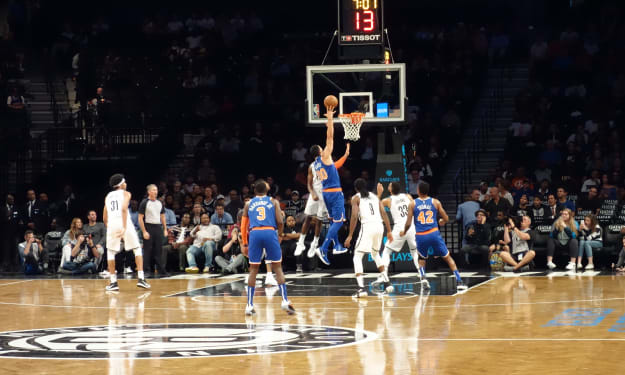
Rivalry Reloaded: How the Knicks and Nets Reflect Two Competing Futures for New York
In the city that never sleeps, basketball has long functioned as a mirror for identity. The Knicks and Nets rivalry, once an afterthought, now feels like a referendum on what kind of New York the next decade will belong to: one rooted in legacy and loyalty, or one powered by reinvention and disruption.
By Trend Vantage33 minutes ago in Unbalanced
Wild Card Weekend Recap: What Happens Now?
I think I figured out why I love Wild Card Weekend so much. It's because it's the first playoff anything of the calendar year. The NFL season starts in the fall, and once upon a time, the champion was crowned either on or slightly before New Year's. The evolution of the NFL schedule has resulted in the playoffs starting just into the New Year, and currently, the final week of the season falls on the first weekend of the New Year, with Wild Card Weekend coming a week after that. So yes, chronologically, the NFL's Wild Card Weekend serves as the first playoff anything of the calendar year.
By Clyde E. Dawkins9 days ago in Unbalanced
A Grand Night for James
It can be said that the 2025-26 season has been a bit magical for Northland senior point guard Diante James. Not only is he hitting buzzer beaters and game-winning shots on a seemingly weekly basis, he added a new accomplishment to his basketball resume.
By Winners Only7 days ago in Unbalanced
The CEO of Everything
They say "jack of all trades, master of none," but they forgot to mention the part where the jack of all trades is also the camera woman, the makeup artist, and the person currently yelling at a tangled Wii microphone cable in a her own bathroom while recording herself singing and trying to make it look realistic and professional. (As professional as you can make it with nothing but a cell phone camera and a mic that doesn't work)
By Sara Wilson4 days ago in Humans



Comments
There are no comments for this story
Be the first to respond and start the conversation.