
5 Aesthetic Sports You've Never Heard Of
These sports are aesthetic in nature, and mesmerizing to watch, yet not so widely known


Gymnastics... figure skating... diving... cheerleading... baton twirling... artistic swimming... and a plethora of styles of martial arts and dance...
These sports all share the common link of being aesthetic in nature.
"Aesthetic" sports are tied together by common skillsets that include various methods of jumping, spinning, intricate step patterns, fancy looking tricks, bodily rhythm and often (though not always) musicality.
These disciplines are not based on who is the fastest or strongest nor on whose team puts up the most points. Instead, athletes are found perfecting some sort of pre-choreographed routine or sequence of specific steps or techniques.
In this article, I will cover the histories and competitive scenes of five such sports that don't get much mainstream attention. These sports are:
- German Wheel
- Cyr Wheel
- Australian Calisthenics
- Freestyle Slalom Skating
- Tricking
1. German Wheel
Anyone familiar with the history of German physical culture will know that the Germans made significant contributions to the sport of gymnastics. These contributions include the invention of such apparatus as the horizontal bar and balance beam.
There is a subgenre of gymnastics, however, that few are aware of (and I am not speaking of rhythmic gymnastics!). It is known as "Wheel Gymnastics."
Wheel gymnastics, or rhönradturnen in German, is a form of acrobatic gymnastics that originated in Germany not too long after the turn of the 20th century.
The sport -- as well as its corresponding apparatus -- were invented by Otto Feick, a German locksmith and railway worker who also had a gymnastics background.
World War Lingers
It all started in the aftermath of the first world war, when French troops occupied the Palatinate (now the southern quarter of the Rhineland Palatinate). Their objective was to pressure Germany into fulfilling their reparations from the war and demilitarize the region as stipulated by the Treaty of Versailles.
In 1921, Otto Feick was charged with obstruction and subsequently jailed by the French troops. While incarcerated in Mainz, Feick reminisced about his childhood in Reichenbach, in the North Palatinate mountains.
One particularly vivid memory was of a time he found two iron hoops in his grandfather's blacksmith shop, connected them together with crossbars, and rolled down the hill beside his parents' house in his new contraption.
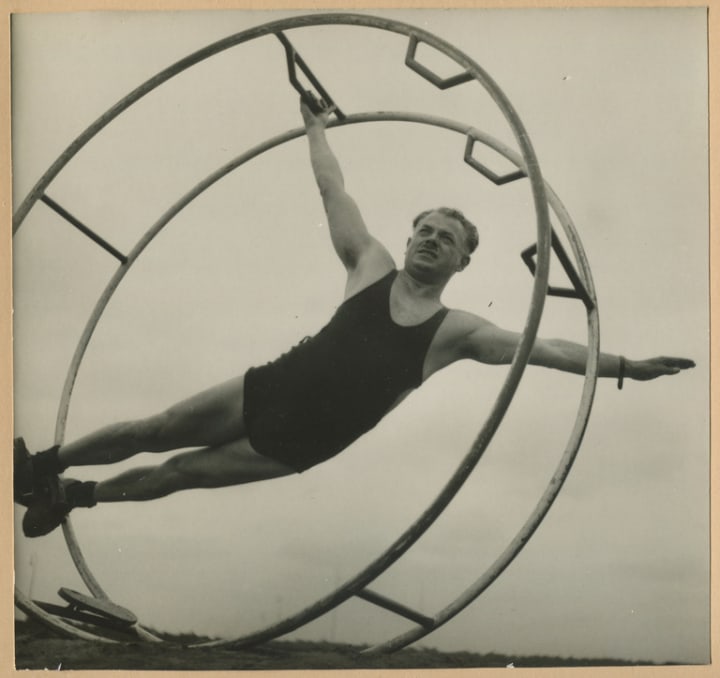
Once out of prison, Otto Feick built his first prototype for his new gymnastics wheel in his hometown of Ludwigshafen, on the grounds of a sports club he'd founded back in 1919.
Eventually, Feick was expelled from the Palatinate by the French occupation forces and moved to Schönau an der Brend, his wife Pauline's hometown, in the Rhön Mountains in Bavaria.
In Schönau, Feick got together with some acquaintances to open a metal workshop. His new business produced game devices and bedstands. During this time, he applied for a patent for his gymnastics wheel, which he was awarded on November 8, 1925. The name of his wheel, the Rhönrad, was not registered until a year later, however. Feick chose the name to honor his new home (Rhönrad from the Rhön Mountains).
Promotion and Exhibition
Making the gymnastics wheel popular proved a persistent struggle. Otto Feick toured half of Europe with his Rhönrad, presenting it on many trips to Austria, Switzerland, France, the UK, and the Americas, among other nations.
The first ever German Wheel tournament took place in Bad Kissingen, a Bavarian town, in 1940. Two years later, the wheel was featured in a German Olympic show in Berlin. This served as a prelude to a demonstration at the Olympic games in the city in 1936, which included one hundred-twenty gymnasts.
The second world war brought about an economic collapse that delayed the promotion of the Rhönrad. But by 1953, wheel gymnastics resumed in Berlin and was officially recognized as a gymnastic discipline by the German Gymnastics Federation in 1959.
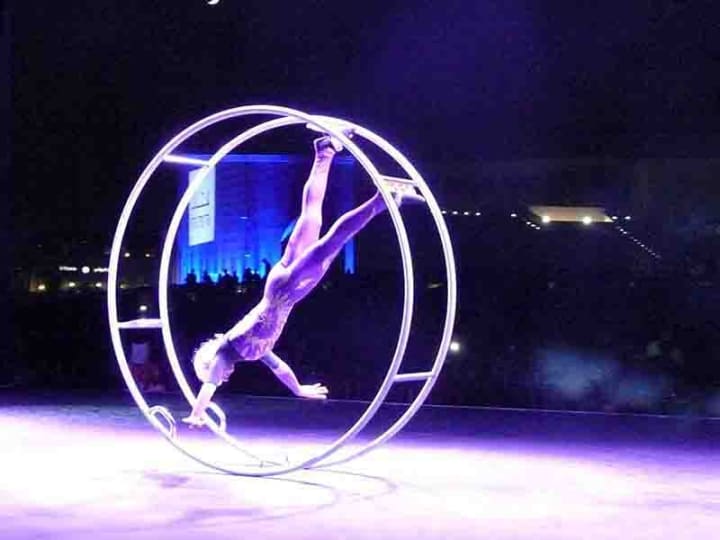
Competitive Scene
While the focus on wheel gymnastics remains primarily German, the sport has attained a modest but loyal international following. The International Wheel Gymnastics Federation (IRV) currently has 11 participating countries and hosts a world championship competition every year.
Video above: 2016 World Championships in Gymwheel, Germany Team Final, Yana Looft, Straight line
. . . . . . . . .
2. Cyr Wheel
The Cyr wheel is another acrobatic wheel apparatus that originated in Germany. It was actually developed as a variation of Otto Feick's German wheel (see #1 above).
However, unlike the original German wheel, recognizeable by its two parallel rings, the cyr wheel looks not unlike an oversized hula hoop. It is typically made of steel or aluminum tubing, with its diameter set at about four to six inches taller than the performer.
German Origins and Canadian Resurrection
The earliest references to the Cyr wheel, then referred to as einreifen, appear around 1930. Its credited inventor is Adalbert von Rekowski, a gymnastics coach working in Magdeburg, the capital of Saxony-Anhalt, following the second world war.

Little else is publicly known about Retkowski, and mid-20th century images of him in German newspapers are what little evidence remains of the Cyr wheel's existence prior to its resurrection in the late 1990's. As it turns out, Retkowski's modification of Otto Feick's invention never saw widespread use and was largely forgotten by the late 20th century.
It wasn't until 1996 when the wheel resurfaced, courtesy of the Canadian circus performer Daniel Cyr, whom it was also named after. Interestingly, Cyr came up with the idea completely independent of Otto Feick's and Adalbert von Rekowski's creations.
Cyr was instead inspired by a huge hula hoop and an old wrought iron coat wrack. His original design was made from a single piece of raw steel and was, as one can imagine, very rough.
A few improvements and reincarnations later, Daniel Cyr made his debut appearance with his eponymous wheel in 1998, in the Cirque Éloize production of Excentricus.
Cyr proceeded to tutor a few of his Cirque Éloize castmates on the intricacies of his wheel. Together, the introduced this new (or some would argue, revived) art form to audiences around the world.

Competition and Circus Scenes
Since its popularization as a circus skill, hundreds of circus artists from around the world have performed on the Cyr wheel, and it is now taught at circus schools worldwide.
It is a relatively new sport to the competitive scene, holding its first Weel Gymnastics Federation-sanctioned competition in Chicago in 2011. Its first ever world championships took place in 2013, during the 10th annual Wheel Gymnastics World Championships, also in Chicago.
Video above: People are Awesome: Billy George (Cyr Wheel)
. . . . . . . . .
3. Australian Calisthenics
When most of us think of calisthenics, we think of the practice of weight-bearing exercises, maybe with the occasional gymnastics trick thrown in. It has exploded in popularity in recent years thanks in large part to fitness communities on social media platforms.
While looking up calisthenics on YouTube, however, I stumbled into a world where the word "calisthenics" had a completely different meaning. It is beautifully choreographed, team-oriented, with a strong dose of showmanship. And it comes from the land Down Under.
Australian calisthenics is a sport practiced exclusively in Australia and New Zealand. Known simply as calisthenics in its fatherland, it would probably look like competition dance to the outsider. And it does share many similarities.
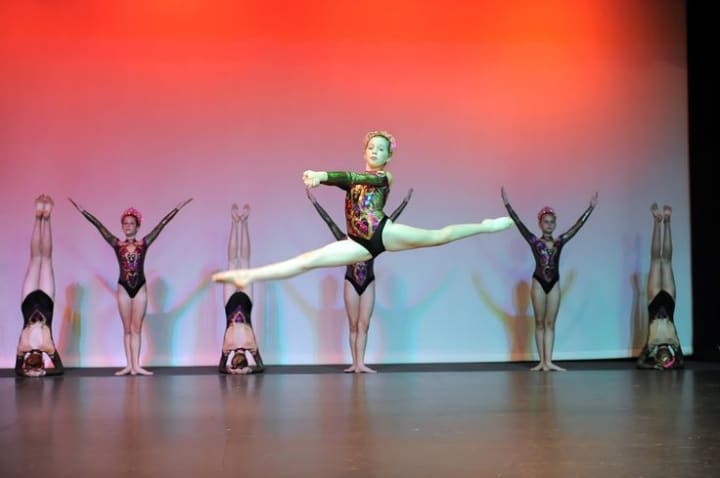
Gold Rush and European Influence
Calisthenics was first introduced to Australia during the 1880's and came into prominence during the Victorian Gold Rush. Its original purpose was to provide a way for city dwellers to keep fit.
The earliest forms of calisthenics in Australia combined elements of gymnastics, dancing, as well as various apparatus such as clubs and rods as influenced by 19th century European physical culture. The turner movement in Germany was particularly instrumental in spreading their gymnastics-based physical education programs internationally via immigration. Their emphasized apparatus work and group exercises were a means not only of building strength and discipline but also of national spirit.
Calisthenics practitioners gradually added musical accompaniment to enhance performances. As a result, music slowly became an integral part of the sport.
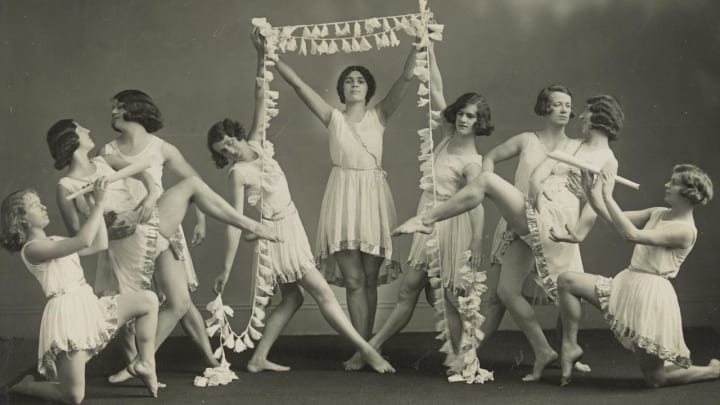
Competitive Scene and Events
Australian calisthenics is divided into a variety of events as mandated by the Australian Calisthenics Federation (ACF). Some of these events, as mentioned earlier, look nearly identical to competition dance. Others, however, resemble rhythmic gymnastics and even drill team activities such as twirling clubs and marching in large group formations.
The earliest competition (or eisteddfod, as they're known in Australia) can be traced back to 1903 in Ballarat, Victoria. To this day, Calisthenics enjoys a thriving competitive scene throughout Australia.
Unfortunately for us non-Aussies, however, Australian calisthenics is very much a "true blue" (that is, an authentically Australian) entity. It is deeply tied to Australian tradition and community structure and is therefore difficult to import internationally.
Video above: Calisthenics Victoria State Team 2018 — Intermediate Free Exercises
. . . . . . . . .
4. Freestyle Slalom Skating
Like the Cyr wheel (see #2 above), the final two sports on this list are relatively "new kids on the block" in the aesthetic sports realm and were not officially recognized as distinct athletic disciplines until the 1990's. The first of these is freestyle skating, which was a product of the inline skating boom of the decade.
Off the record, freestyle skating is a hybrid of figure and street skating, with some breakdancing elements thrown in.
Notable elements include a variety of spins, sits, and footwork sequences, not unlike figure skating. But rather than perform these moves around a large rink, freestyle skaters must creatively weave themselves in and out of lines of cones. They have two minutes to execute a routine set to music that is then scored based on difficulty and artistic merit.

History and Artistic Influences
Though inline skating can be traced back to the 18th century, it did not reach peak popularity until the 1980's when Scott Olson founded Rollerblade Inc. Olson was an avid junior hockey player from St. Louis Park, Minnesota. At 19 years old, he sought a way to train during the summer months and stumbled upon inline skates.
Though Olson did not invent the inline skate in concept, he improved the design by making the wheels softer and faster and creating a more comfortable, sturdy boot based off of an ice hockey skate.
Olson's contributions paved the way for a plethora of inline skating disciplines to flourish, including freestyle slalom skating.

Kim Sung Jin: Father of Freestyle Skating
Korean Kim Sung Jin is a legendary figure in the sport of freestyle slalom skating and is often credited with shaping the sport on an international level.
He began inline skating at the age of 10 and quickly became fascinated with the freestyle slalom discipline. Sung Jin gained international recognition when he won his first world championship in Shanghai at the age of 15. His skating style became known for its speed, innovation, and maturity.
Kim Sung Jin has gone onto play a huge role in the sport's technical progression and artistic expression, and is recognized as one of the sport's greatest ever.
Competitive Scene
Today, freestyle skating enjoys a global presence, with events and competitions that are recognized internationally.
Standard movements in competitive routines include criss-crosses (crossing one skate over the other while weaving through the cones), sitting moves (slalom tricks while in a seated position), and sevens (an advanced move created by Kim Sung Jin involving complex spins and patterns around four cones to create the shape of a number "7"). Some elite level skaters may incorporate various jumps over the cones or even flips.
Routines are judged based on technical difficulty and artistic flow as well as the competitors' confidence.
Video above: Amazing Freestyle Skating — Zhang Hao (China) 1st
. . . . . . . . .
5. Tricking
Tricking is another sport that has only started to make waves in the recent decades. It combines combative kicks from martial arts with the acrobatic flips and twists of gymnastics. While not a martial art in and of itself, it borrows techniques from a variety of martial arts styles, such as taekwondo (Korean) and Wushu (Chinese).
The practice of tricking can be traced back to martial arts tournaments as early as the 1960's. Flashy spins, acrobatic tricks, and flying karate kicks became popular across both demonstration and competition routines.
Though the term "tricking" had not yet been coined, its emphasis on flying kicks became especially exciting for practitioners of taekwondo, which means "way of the kick" in Korean.

Official Recognition
Before tricking was officially recognized as a sport or distinct discipline, a new martial arts style emerged in the 1990's called Xtreme Martial Arts (or XMA). This flashy new martial art was created by Thai American martial artist and stunt man Michael Chaturantabut (known simply as Mike Chat) and emphasized movie-esque entertainment over self defense. Routines were choreographed combining martial arts kicks and gymnastics flips with dance-like spins, often to music.
This showmanship in tandem with flips and spins would provide the creative springboard for the sport of tricking, which became an internet phenomenon in the early 2000's.
The term "tricking" was used by martial artists when sharing their moves online on websites such as Biling.Com and TrickTutorials.Com (both no longer martial arts related), and later on platforms such as YouTube. This online sharing formed a worldwide community, rapidly spreading the sport's popularity and also giving the sport its name.

Competition and Free Form
What separates tricking from the other sports on this list is that it is very free form in structure. While elements of tricking are regularly incorporated into XMA routines for tournaments and demonstrations, tricking itself has no governing body or strict rules. Generally speaking, performers are free to perform any dramatic or creative maneuver that comes to mind and call it a “trick.”
Most trickers focus on martial arts tricks, which incorporate kicks into some sort of acrobatic trick or intricate jump of spin sequence, combined with freestyle tumbling.
Tricking may also appear in conjunction with sports such as freerunning or parkour.
Video above: 60 Tricking Basics — Easiest to Hardest (Slow Motion)
About the Creator
Liesl Grunewald
6G NOLA Native . Dancer, Diver, & Martial Artist for life . Aspiring athletics & movement polymath . Creative techie . Slightly reformed neurotic.
Keep reading
More stories from Liesl Grunewald and writers in Unbalanced and other communities.
Super Bowl LX Recap: A Team Called Hawks
Sixty. The Super Bowl turned 60! Still amazes me that this was the sixtieth Super Bowl played in NFL history. It seems like yesterday that I watched Super Bowl XXVII, the first SB I ever watched. The QB who won Super Bowl XXVII has since called a few SBs, and will call next year's game, but that's another story. Super Bowl LX took place at Levi's Stadium in Santa Clara, California, the home stadium of the San Francisco 49ers. However, it was one of their division foes who represented the NFC, as the Seattle Seahawks faced off against the New England Patriots.
By Clyde E. Dawkins19 days ago in Unbalanced
Tyson Fury Fight 11/4/2026
Tyson Fury is coming out of retirement again, and the boxing world is wide awake because of it. April the 11th, 2026, is the date being spoken about, and already you can feel that restless energy building. Some fighters leave quietly, some fade, but Fury never does anything small. He walks away loud, and he returns even louder.
By Marie381Uk 6 days ago in Unbalanced
Echoes
I stepped carefully around the corner, the familiar sights and sounds hitting me like a brick to the face. My eyes watered. I could practically see us, all of us, back then, clustered around the outdoor tables in front of the pizza shop, the bar, the coffee shop. I could smell the various stalls from the events we’d been to on this street. I could taste the churros and nachos.
By Phoenixica246 days ago in Fiction




Comments
There are no comments for this story
Be the first to respond and start the conversation.