
Why has Beijing approved Tesla cars for use as government vehicles in China?
Tesla's electric cars have recently been included in government procurement lists in eastern coastal areas such as Shanghai and Jiangsu Province.

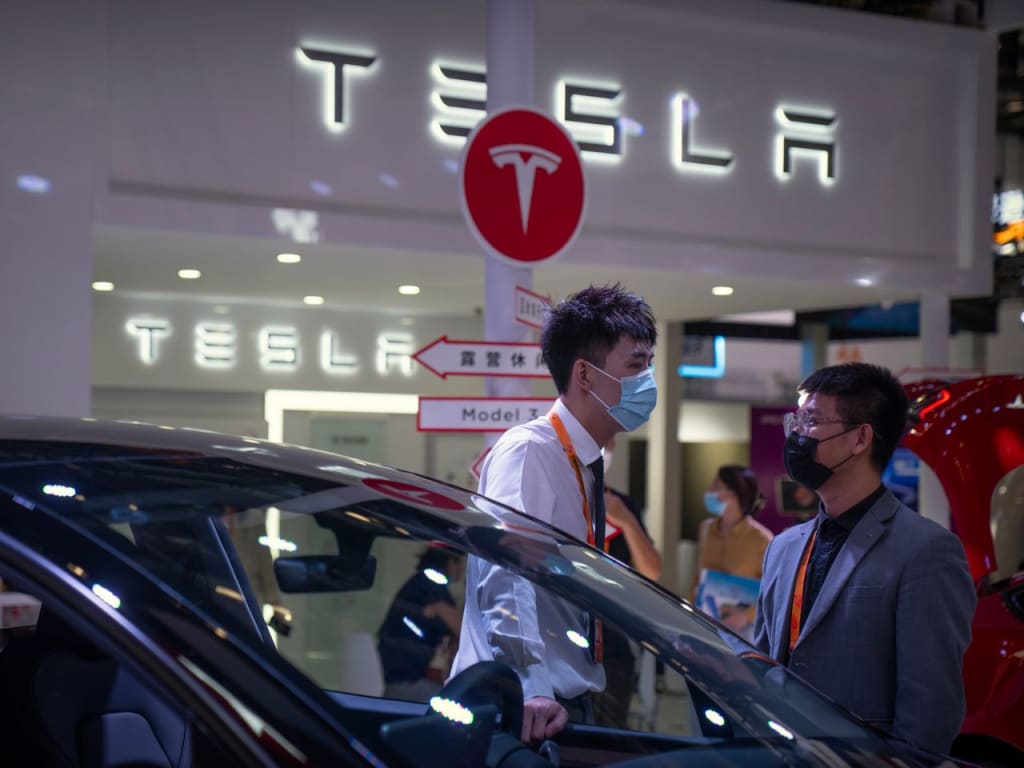
A Chinese analyst has suggested that the Chinese Communist Party (CCP) is providing special treatment to Tesla to obtain the carmaker's battery technology. This move is believed to potentially ease production bottlenecks in Chinese electric vehicles (EVs).
According to Chinese financial media, Tesla's stock price increased by 25.88% in the first week of July, and its market capitalization grew by $163.32 billion. This surge follows the expansion of local authorities' Tesla brand acquisitions.
On July 5, the official Weibo account of Shanghai's Lingang Special Area Investment Promotion Service Center announced that several local state-owned enterprises, such as the City Investment Xingang Group and the Lingang Investment Holding Group, have bought Model Y vehicles from Tesla (Shanghai) Co., Ltd. for their corporate use.
The government procurement website of Jiangsu, a coastal province adjacent to Shanghai, announced on June 6 that Tesla was the only foreign electric car brand listed among the 56 shortlisted car companies for the 2024-25 electric vehicle suppliers list.
China analyst and U.S.-based economist David Huang, speaking to the Chinese edition of The Epoch Times, stated that the CCP's decision to include Tesla cars on an approved list for government procurement holds significant symbolism. He suggests that Tesla CEO Elon Musk may have struck a deal with Beijing, enabling the company to bypass the strict scrutiny imposed by the CCP on foreign products.
In the past year, Tesla has encountered sales challenges in China. These challenges include tough competition in the Chinese auto market and restrictions imposed by the CCP on Tesla's sales due to concerns about data security, especially concerning the Starlink internet service in certain Tesla vehicles.
Tesla enhances cooperation with China
On April 28, Chinese Premier Li Qiang met with Elon Musk in Beijing. He stated that foreign companies are "indispensable" to China's development and praised Tesla as a successful example of trade cooperation between China and the United States. Musk responded by expressing Tesla's willingness to further enhance its collaboration with China for mutually beneficial outcomes.
On the same day, the China Association of Automobile Manufacturers announced that 76 models from six car makers, including Tesla, have met the regulator's requirements for automotive data security. These requirements involve protecting facial recognition data, cabin data, and personal information about the vehicle's owner.
In November 2023, before the APEC summit in San Francisco, CCP leader Xi Jinping expressed support for Tesla's development in China when meeting with executives of major U.S. corporations, including Musk.
Elon Musk stated that Tesla had been operating in the Chinese market for approximately ten years and looked forward to collaborating with China to create new energy vehicles and make advancements in energy storage, artificial intelligence (AI), and other related areas. According to Huang, Tesla was acknowledged by CCP regulators as meeting standards, which helped to eliminate specific barriers to Tesla's full self-driving technology (FSD) in China.
Huang suggested that Tesla may have obtained approval from Chinese regulators after meeting Beijing's conditions to address aspects of data security, such as a mapping and navigation agreement with Baidu, China's largest online search engine.
Huang suggested that Musk's bargaining chip could be "the battery control technology." He pointed out that Chinese electric cars frequently encounter quality issues such as spontaneous combustion. Tesla's advanced battery control technology might solve this problem, giving Musk leverage to negotiate with the CCP.
Elon Musk has contributed to numerous cutting-edge science and technology products through companies such as SpaceX, Neuralink, and OpenAI, as well as the social media platform X. Huang mentioned the risk of the CCP exploiting these core technologies, citing Beijing's "national network" to control speech and other tools to consolidate the Party's authoritarian rule.
CCP's tactics
Huang states that the CCP typically provides generous support and favorable terms to foreign companies. However, the CCP then uses various tactics to force these companies to comply with the Party's directives, ultimately discarding them once their value is depleted.
In 2018, Tesla set up its own company in Shanghai and received free land and special tax benefits from the local government. Tesla's technology has played a significant role in advancing China's electric vehicle industry. As a result of substantial progress and expansion, Chinese electric car manufacturers have surpassed Tesla in the Chinese market and have reduced the company's global market share by engaging in low-priced dumping.
Huang said, "As Beijing has demonstrated proficiency in integrating diverse interests, Tesla is still of great value to the CCP."
China's cheap labor and supply chain has allowed Tesla to proliferate, with more than half of its cars coming from the Shanghai plant. This has made it difficult for Tesla to leave China.
About the Creator
Ryan
Write whatever I like :))
A Transparent Look at Vocal Challenges and Top Stories
Almost three years ago, we shared a resource article that served as a place for people to suggest new challenge prompts. We thought it would be a good idea to refresh that thread, and take the opportunity to answer a few common questions about top stories, how challenges are judged and how submissions are reviewed.
By Vocal Curation Team4 days ago in Resources


Comments (1)
Thanks for sharing