
Whispers of Wealth: The Secret Legacy of the Golden Trader
A tale of ambition, mystery, and the rise of a forgotten trading dynasty.

The Silk of Their Souls
Long before borders were carved with politics and swords, before nations stood and empires fell, there were traders — silent architects of civilizations.
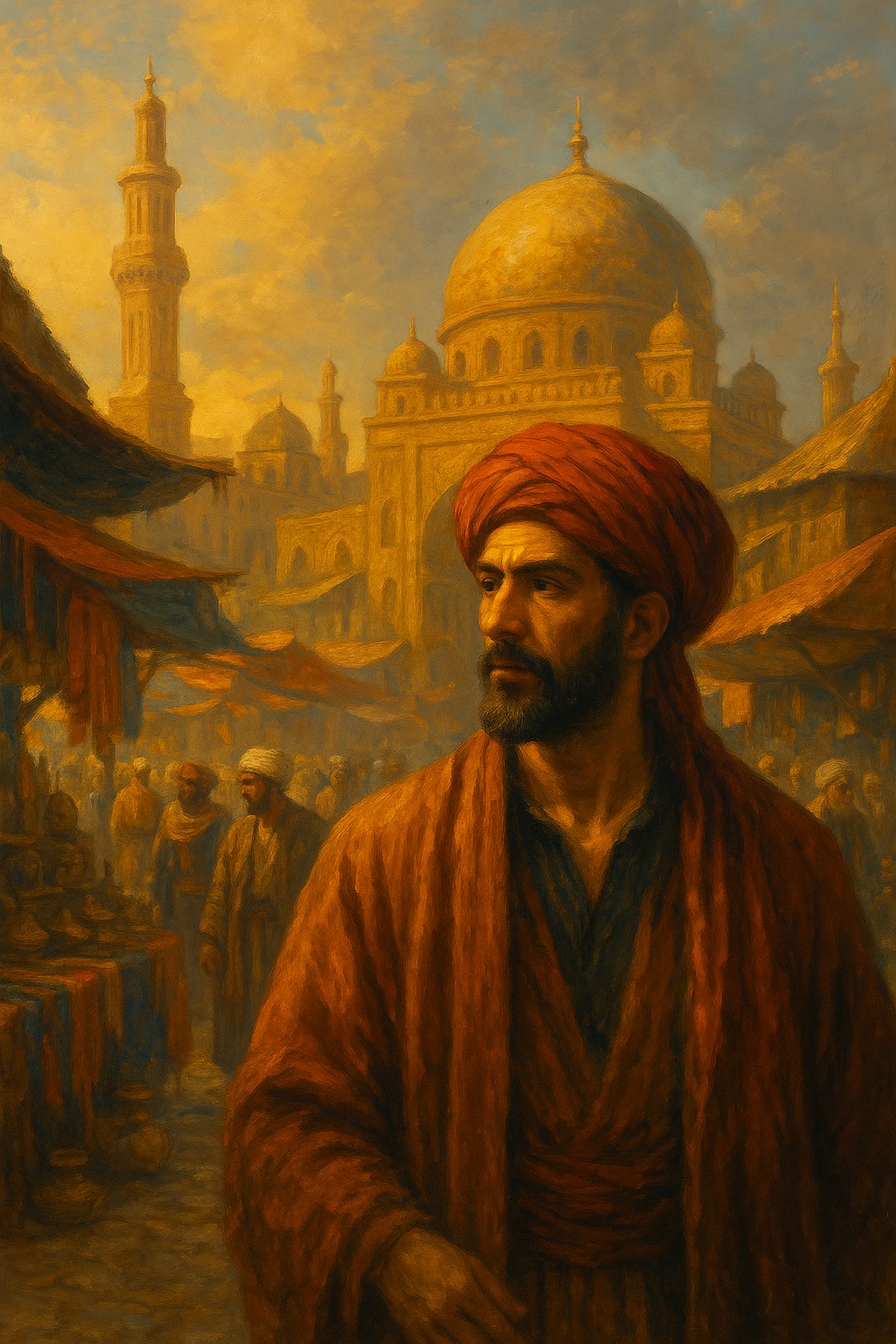
This is the story of Bazir, a humble spice trader from the fabled town of Malkh, nestled where mountains kissed the desert and rivers wept through ancient valleys. It was not marked on any modern map, for Malkh was not a place of power, but of movement. A city that never stood still. Its bazaars rang with voices in a dozen tongues, its alleys smelled of cinnamon and steel, and its people measured time not by calendars, but by caravans.
Bazir was born in a one-room clay house, the son of a widowed mother who wove silk scarves by candlelight. He grew up learning to count not from books, but from bundles of peppercorn and packets of saffron. His school was the market square, his teachers the merchants with hands like cracked leather and eyes that could read a man’s soul before he spoke a word.
By the age of ten, he could recite the prices of salt from Samarkand, tea from Tibet, and lapis lazuli from Badakhshan. By sixteen, he was part of a caravan. By twenty, he led his own.
But Bazir was not just a seller of goods. He was a weaver of trust, a translator of cultures, a diplomat without a flag. In his travels, he crossed endless dunes, sat with Persian poets, ate with Buddhist monks, bartered with Greek sailors, and prayed with African elders. Every deal he made was not just about profit — it was about preserving the flow of something deeper: connection.
He knew that trade was not merely economic. It was spiritual.
One year, a great drought fell across Malkh. Crops failed. Wells dried. The people were starving.
Bazir returned from a trip to the southern coasts with his camels heavy with dates, grain, dried fish, and water barrels. When other merchants hoarded, he opened his stores. When others sold at ten times the price, he gave it all away.
His fellow traders were furious.
“You’re making us look weak!” they shouted.
“You’re killing your own trade!” they warned.
Bazir only smiled.
“If I trade my soul for profit,” he said, “then what exactly am I selling?”
The people of Malkh survived because of him.
Years passed. Empires rose and shattered like sandcastles. Foreign armies marched through the region, bringing fire and flags. When Malkh finally fell to invaders, they found the city empty — the people had vanished into the mountains, but the market was still full. Rows of unsold goods, preserved scrolls, spices perfectly stacked, scales resting on counters like sleeping guardians.
And in the center of the square, they found Bazir’s journal — wrapped in silk, sealed with wax, and written in four languages.
Inside it read:
> “We traders are not kings, but we shape kingdoms.
We build no temples, but carry prayers across borders.
We own no land, yet no land survives without us.
We are the thread.
Without us, the world unravels.”
Hundreds of years later, when historians pieced together the origins of Malkh, they found remnants of its culture scattered like seeds in distant places: a word in a Moroccan dialect that came from Urdu. A Sufi poem in Anatolia that described Malkh’s skyline. A Persian merchant guild in Istanbul that still followed Bazir’s code of fairness.
And in every major trade city across Asia, Africa, and Europe, there was always a whisper, a myth, a memory:
> “There was once a city of traders.
Where gold was less valuable than trust.
Where the richest man gave everything away.
And where the true treasure wasn’t spice or silk —
but the soul of trade itself.”
The Legacy of Traders
This story, though fictionalized, is a tribute to real trading communities across history — from the Sindhi and Gujarati merchants, to the Jewish caravan leaders, the Arabs of the spice routes, and the African gold traders. They were economists, cultural ambassadors, peacekeepers, and human bridges. The silent giants behind every ancient miracle.
Their legacy isn’t just in coins or camels —
It’s in the way the world still speaks in many languages, eats from many lands, and wears cloth dyed in ideas that crossed deserts on tired feet.
About the Creator
Keep reading
More stories from Darwesh Khan and writers in Trader and other communities.
United States Interactive Whiteboard Market Size and Forecast 2025–2033
Introduction The United States is undergoing a significant transformation in how information is shared, taught, and collaboratively developed. From digital classrooms and university lecture halls to corporate boardrooms and remote work environments, interactive technologies are redefining traditional communication tools. Among these, interactive whiteboards (IWBs) have emerged as one of the most powerful and versatile platforms for enhancing engagement, productivity, and real-time collaboration.
By Marthan Sir4 days ago in Trader
Australia Faucet Market Flows Toward Strong Growth on Construction, Water Efficiency & Smart Tech Adoption
The Australia faucet market is experiencing a dynamic growth phase as consumer demand, regulatory momentum, and construction activities converge to drive broader adoption of modern plumbing fixtures. According to IMARC Group, the market was valued at USD 661.13 Million in 2025 and is expected to reach USD 1,142.71 Million by 2034, exhibiting a compound annual growth rate (CAGR) of 6.27% over 2026–2034.
By Rashi Sharma4 days ago in Trader



Comments
There are no comments for this story
Be the first to respond and start the conversation.