
Where Does Crude Oil Come From? Science and the Modern Theory
Crude oil is a naturally composed liquid, carrying higher trading value in the commodity market.

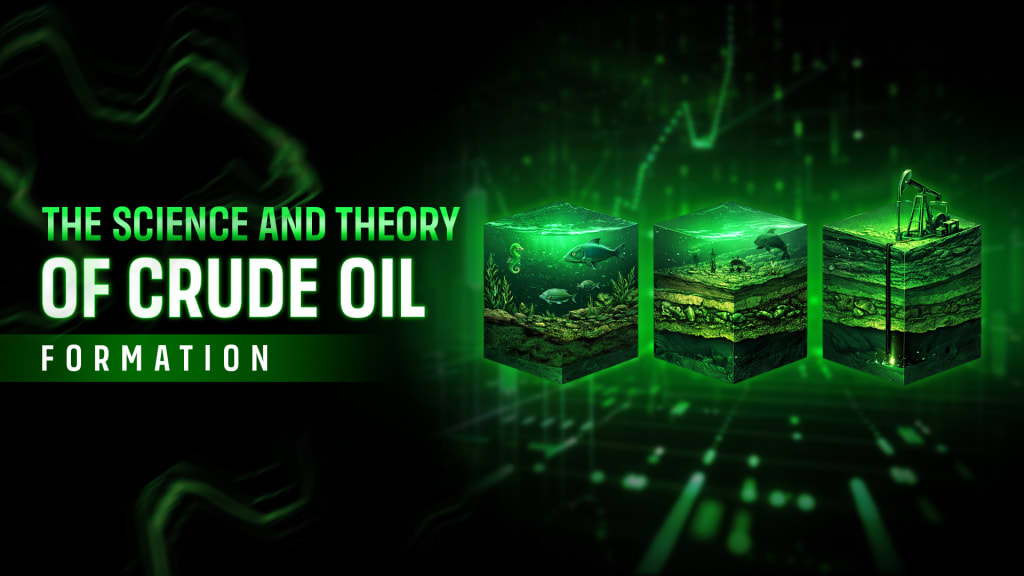
In simple terms, crude oil forms from the remains of ancient microscopic plants and organisms that lived in oceans millions of years ago. Over vast geological timescales, heat and pressure transformed this buried organic material into hydrocarbons, which we now extract as crude oil.
This explanation reflects the dominant scientific consensus, known as the biogenic theory, and is supported by geology, chemistry, and fossil evidence. To understand the crude oil origin fully, we need to look at biology, sedimentary geology, time, and how oil is trapped and extracted today.
What is Crude Oil?
Crude oil is a naturally occurring liquid found beneath the Earth’s surface, composed mainly of hydrocarbons—molecules made of hydrogen and carbon. It is often confused with petroleum and natural gas, but there are differences. Petroleum is the broader category that includes crude oil, natural gas, and related hydrocarbons. Natural gas is lighter and gaseous, while crude oil is liquid and heavier. Crude oil is used by nearly every country in the world. That is why crude oil is so valuable.
The Biogenic Theory: The Scientific Explanation
The most widely accepted explanation for crude oil origin is known as the biogenic theory. It explains oil formation as a slow, multi-step geological process involving ancient life, sediment burial, and Earth’s internal heat.
Step 1 – Ancient Plankton and Algae Capture Carbon
Millions of years ago, oceans were filled with microscopic plankton and algae. These organisms used photosynthesis to convert sunlight, water, and carbon dioxide into energy-rich organic matter. When they died, their remains sank to the seafloor, effectively acting as natural carbon capture systems that locked atmospheric carbon into sediments.
Step 2 – Burial in Sedimentary Basins
Over time, layers of mud, sand, and mineral particles covered this organic material. These environments, known as sedimentary basins, were often low in oxygen. Low oxygen slowed decomposition, allowing large amounts of organic sediments to be preserved rather than broken down by bacteria.
Step 3 – Heat and Pressure Transform Organic Matter into Kerogen
As sediments piled up, the buried organic material sank deeper into the Earth. Increasing heat and pressure transformed it into a waxy substance called kerogen.
This process, known as thermal maturation or thermogenesis, typically occurs at depths of 2–4 kilometers, where temperatures range between 60°C and 120°C.
Step 4 – Kerogen Becomes Crude Oil and Natural Gas
With continued heating, kerogen breaks down into liquid and gaseous hydrocarbons. This happens within specific temperature ranges known as the oil window and gas window.
The formation of usable hydrocarbons takes place over millions of years, explaining why crude oil is considered a fossil fuel.
How Long Does It Take to Form Crude Oil?
Crude oil forms over millions to hundreds of millions of years, spanning geological eras such as the Carboniferous and Jurassic periods. Compared to the speed at which humans consume oil—over a century on an industrial scale—this is extraordinarily slow. That mismatch is why crude oil is classified as a non-renewable resource. A timeline infographic showing plankton evolution, burial, kerogen formation, and modern drilling fits well here for visual clarity.
How Crude Oil Moves and Gets Trapped Underground
Before oil can be extracted, it must migrate and accumulate in the right geological structures.
- Migration Through Porous Rocks
Once formed, oil moves upward through porous and permeable rocks like sandstone or limestone. This migration happens because oil is less dense than surrounding water and rock fluids.
- Reservoir Rocks and Cap Rocks
Oil accumulates in reservoir rocks that can store fluids. Above them lies a cap rock, such as shale or salt, which prevents oil from escaping. Structural features like anticlines, fault traps, and salt domes create geological traps that concentrate oil into recoverable oil fields.
Where is Crude Oil Found Today?
Crude oil is found mainly in large sedimentary basins around the world. Major oil-producing regions include the Middle East, North America, Russia, and offshore basins beneath oceans.
The distribution of oil reserves is closely tied to ancient geological conditions, explaining why some regions are rich in oil while others have none.
Conclusion
Understanding its origin reveals two critical truths: oil is finite, and it forms far more slowly than we use it. As society moves toward a sustainable future, this geological perspective highlights why transitioning beyond fossil energy is not just an environmental choice, but a physical necessity written into Earth’s deep history.
About the Creator
Sarah Thompson
Lead Forex Strategist & Financial Writer at SureShotFX
Keep reading
More stories from Sarah Thompson and writers in Trader and other communities.
Forex Seasonality: Simple Guide to Trade Smarter All Year
Forex Seasonality: Simple Guide to Trade Smarter All Year Forex doesn’t move the same way all year. Some months are fast and active, while others are slow and unpredictable. This repetitive pattern is called forex seasonality.
By Sarah Thompson3 months ago in Trader
France Convenience Store Market Size and Forecast 2026–2034
France Convenience Store Market Overview The France Convenience Store Market is entering a decisive phase of transformation, supported by urbanization, evolving consumer behavior, and a strong shift toward fast, flexible retail formats. According to Renub Research, the market is expected to expand from US$ 26.52 billion in 2025 to US$ 44.54 billion by 2034, registering a CAGR of 5.93% during the forecast period 2026–2034.
By Sakshi Sharma7 days ago in Trader




Comments
There are no comments for this story
Be the first to respond and start the conversation.