
When Does the Stock Market Close Today? A Clear and Complete Guide
When Does the Stock Market

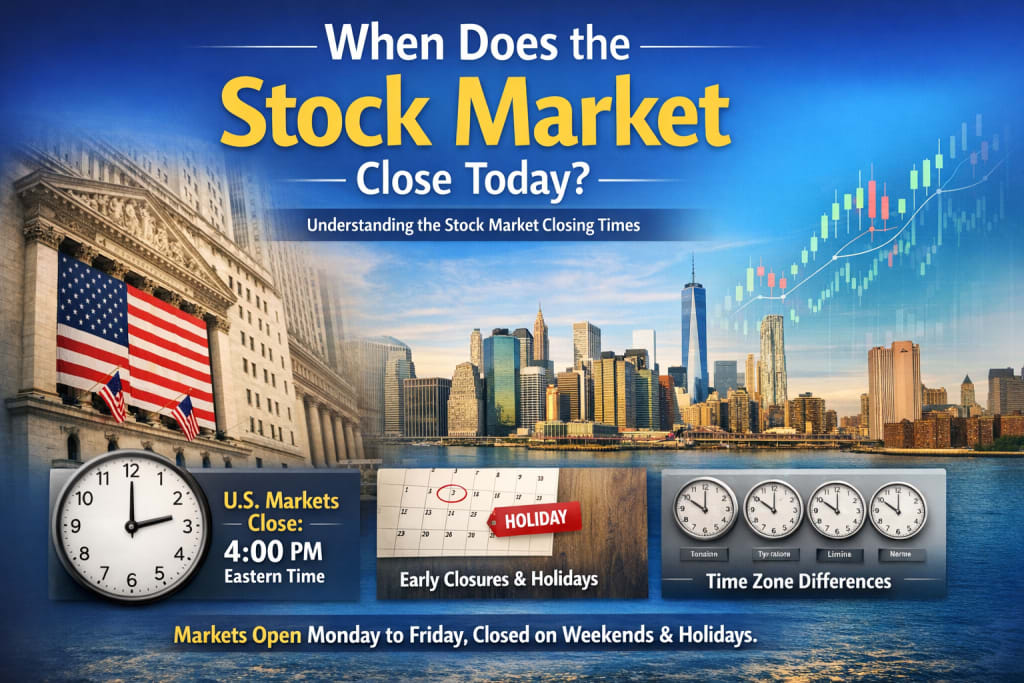
especially investors, traders, and beginners who want to follow market movements accurately. Knowing the exact closing time of the stock market is important because it affects buying and selling decisions, price movements, and daily investment planning. The answer, however, depends on which stock market you are referring to, since trading hours vary from one country to another. This article provides a clear and professional explanation while answering the most common questions people search for and ask.
In the United States, the stock market mainly refers to two major exchanges, the New York Stock Exchange and the Nasdaq. On a normal trading day, these markets operate on a fixed schedule. They open in the morning and close in the afternoon according to Eastern Time. The regular closing time for both exchanges is four o’clock in the afternoon Eastern Time. This schedule applies from Monday to Friday. On Saturdays and Sundays, the stock market is closed and no official trading takes place.
Many people also ask whether the stock market closes at the same time every day. In most cases, the answer is yes. On regular business days, the market closes at the same time consistently. However, there are exceptions related to holidays and special trading days. On certain days before major public holidays, the stock market may close earlier than usual. These early closings are announced in advance so that investors can plan accordingly. On major holidays, the market may remain completely closed for the entire day.
Another common question is whether the stock market is open today or closed today. The answer depends on the calendar. If today is a weekday and not a public holiday, the market is usually open and follows the standard trading hours. If today is a weekend or an official holiday, the market will be closed. This is why many investors check the trading calendar daily, especially around holiday seasons when schedules can change.
People who live outside the United States often ask how to know the closing time in their local time zone. Since the U.S. stock market operates on Eastern Time, investors in other regions must convert the time difference. For example, in many parts of Europe, the market closes in the evening local time. In the Middle East, including countries like Egypt, the market usually closes late in the evening. Understanding this time difference helps international investors follow the market without confusion.
Another frequent question is whether trading completely stops when the market closes. Officially, the regular trading session ends at the closing time. However, there is something known as after hours trading. This allows some buying and selling to continue electronically after the main market session ends. While after hours trading exists, it is different from regular trading. It usually has lower trading volume, fewer participants, and larger price fluctuations. Because of this, many long term investors prefer to trade only during regular market hours.
People also want to know why the stock market does not stay open all day and all night. The main reason is regulation and order. Fixed trading hours allow exchanges to manage transactions, settle trades, monitor risks, and ensure fair pricing. Although technology makes continuous trading possible, having a defined closing time helps maintain stability and transparency in the financial system.
Another important question is what happens at the exact moment the market closes. When the closing time arrives, the market stops accepting regular buy and sell orders. The final prices at the close become the official closing prices for that day. These prices are very important because many investment funds, portfolios, and market reports use them to measure daily performance. Trading activity often increases near the closing time as investors adjust their positions before the market ends for the day.
Some people also ask whether all global stock markets close at the same time. The answer is no. Every country has its own stock exchange schedule based on local business hours, time zones, and public holidays. For example, Asian markets close many hours before U.S. markets open, while European markets close earlier in the day compared to the United States. This creates a continuous global trading cycle, even though each individual market has its own opening and closing time.
If you are asking specifically when the stock market closes today, the general answer for U.S. markets on a normal weekday is four in the afternoon Eastern Time. If today is a holiday or a special trading day, the closing time may be earlier or the market may be closed completely. Checking the daily trading schedule is always a smart habit for anyone involved in investing or trading.
In conclusion, understanding when the stock market closes today is essential for making informed financial decisions. On most regular business days, major U.S. stock markets close at four p.m. Eastern Time. Exceptions occur on weekends and holidays. Knowing the closing time, understanding time zone differences, and being aware of special schedules can help investors stay organized, avoid mistakes, and better manage their trading activities.
About the Creator
America today
Breaking news, political insights, real-time analysis, U.S. politics, global politics, elections, government policies, international relations, diplomacy, political debates, trending political stories, expert commentary, factual reporting,.
Keep reading
More stories from America today and writers in Trader and other communities.
Why People Are Paying Attention to Silver Prices Today
Why People Are Paying Attention to Silver Prices Today Over the last several hours, searches for silver price today have continued to rise. What is interesting is that this attention did not fade quickly, which usually means something deeper is happening. Silver prices today are not just reacting to one piece of news, but to a broader feeling of uncertainty and curiosity in the market.
By America today 2 months ago in Trader
US Rare Earth Elements Market Size, Share, Industry Trends & Growth Factors Forecast 2034
Understanding the Evolution of the US Rare Earth Elements Market Rare earth elements play a quiet but essential role in modern life. From smartphones and electric vehicles to wind turbines and advanced electronics, these materials support technologies that define today’s economy. In the United States, growing industrial demand and supply chain awareness are reshaping how rare earth resources are sourced, processed, and utilized.
By Kim Soo hyun3 days ago in Trader
Review of 'Man on the Run'
My wife and I saw Man on the Run, a nearly 2-hour documentary on Amazon Prime, about Wings, Paul McCartney's group that flew around the world from shortly after The Beatles broke up in early 1970 to shortly after John Lennon was murdered at the end of 1980, making a Beatles reunion forever impossible.
By Paul Levinson5 days ago in Beat




Comments
There are no comments for this story
Be the first to respond and start the conversation.