
When AI Agents Moved From Talking to Doing
The crypto industry is quietly shifting from chatty bots to actual financial execution


Honestly, watching AI agents evolve in the crypto world has been a bit like watching a side project accidentally turn into a real product. The early attempts were pretty simple. Most of them were just automated chat layers built into places like X, simple sentiment scrapers or shallow on-chain scanners that made everything sound smarter than it actually was. It worked well enough to call it the first wave, and it gave teams something to build on, but the real action was happening off-chain, where all the inference and decision-making actually lived. Still, those first tools shaped how people imagined what an AI agent could be, and that mattered more than the features themselves.
As the landscape matured, the second wave began to feel different. Teams started pushing beyond friendly chatbots and moved into areas that actually interact with money. Frameworks like ELIZA, ARC, Virtuals and Coinbase’s AgentKit showed that you could build an agent with a personality but also plug it into on-chain systems. Most of the heavy lifting stayed off-chain, of course, but the idea of connecting AI reasoning to blockchain execution became a lot more legitimate. Some repos exploded in popularity before cooling off, tokens surged and crashed, and developers treated these frameworks like playgrounds for whatever they wanted to automate next.
Then DeFAI entered the picture. This is where things got more serious. Projects like HeyAnon, Wayfinder, Giza’s ARMA agent and Almanak started treating AI as something that could actually move assets, rebalance positions or suggest complex DeFi paths without making the user learn the mechanics underneath. The irony is that none of this worksunless the models remain off-chain, since blockchains are too rigid and deterministic to run AI directly. So everything important happens out of sight and only the final signal touches the chain. But even with safeguards, the idea that an LLM has to interpret smart contracts before anything executes introduces its own brand of risk, especially if something gets misread or manipulated.
ARMA is a good example. It tries to optimize multi-protocol yields by constantly reallocating and auto-compounding based on real-time rates, which sounds great but also depends entirely on trustworthy data inputs. Almanak takes it even further by modeling strategies through a blockchain state machine and using LLMs to turn brainstorming, simulation and deployment into a single workflow. And then there’s Story, which went in a completely different direction by trying to make on-chain IP programmable and licenseable with agent-driven negotiation logic. It feels like a reminder that AI agents don’t always need to manage money to matter.
The bigger trend underneath these projects is hard to miss. The first wave focused on personality, community and clever conversation loops. They were fun, and they proved that AI could plug into crypto culture pretty naturally, but they didn’t move real economic weight. The second wave is all about closing that gap. These agents are now stepping directly into transactional territory, bridging chains, executing strategies and handling tasks that previously required specialized knowledge. It’s progress, but it also opens a new set of concerns. Off-chain processing introduces new attack surfaces. Smart contract misunderstandings can trigger unintended outcomes. Data feeds can be corrupted. And private-key management becomes even more sensitive when an automated agent can act faster than a human ever could.
Still, the trajectory feels inevitable. If DeFAI delivers enough convenience, people will use it even if they worry about the risks, just like they did with early trading bots. A portion of users will eventually get burned by bad security or a malicious exploit, but the broader movement will continue forward because the benefits are simply too appealing. The whole space is slowly shifting from AI as a novelty to AI as real infrastructure. And if developers manage to build strong fail-safes and test every edge case before pushing things live, we might end up with agents that make DeFi feel less like a puzzle and more like a normal part of everyday digital finance.
About the Creator
crypto genie
Independent crypto analyst / Market trends & macro signals / Data over drama
Keep reading
More stories from crypto genie and writers in Trader and other communities.
Are Stablecoins and Bitcoin the Unexpected Solution to America's Debt Crisis?
It feels a little strange to say this out loud, but there is a growing argument that crypto might actually help the United States crawl out of its massive debt problem. A few years ago I would have called that a wild theory, but now it’s hard to ignore how the pieces are falling into place.
By crypto genie3 months ago in Trader
AI in Education Market Size and Forecast 2026–2034: Transforming Global Learning Through Intelligent Technologies
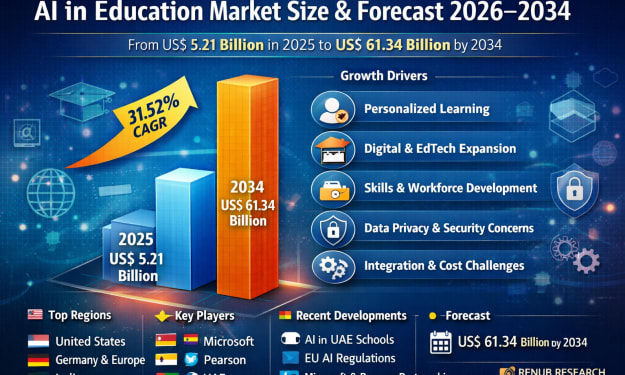
AI in Education Market: A Rapidly Expanding Global Industry The global AI in Education Market is entering a phase of remarkable expansion as digital transformation reshapes how knowledge is delivered, consumed, and managed. According to Renub Research, the market is expected to grow from US$ 5.21 billion in 2025 to US$ 61.34 billion by 2034, registering a robust compound annual growth rate (CAGR) of 31.52% from 2026 to 2034. This extraordinary growth reflects the rising role of artificial intelligence in making education more personalized, scalable, and efficient across the world.
By shibansh kumar3 days ago in Trader
Netherlands Diabetes Device Market Size and Forecast 2026–2034
Introduction: A Market Moving Toward Smarter Diabetes Care The Netherlands has long been recognized for its strong healthcare infrastructure, early adoption of medical technology, and emphasis on preventive care. These strengths are now clearly reflected in the country’s diabetes devices market, which is entering a phase of sustained and technology-driven growth. According to Renub Research, the Netherlands diabetes-care devices market is projected to expand from US$ 392.4 million in 2025 to US$ 737.3 million by 2034, registering a compound annual growth rate (CAGR) of 7.27% during 2026–2034.
By Sakshi Sharma4 days ago in Trader



Comments
There are no comments for this story
Be the first to respond and start the conversation.