
What the U.S. Employment Report Headlines (released on March 5, 2021) Don't Tell You?
U.S. Job Outlook

The stronger than expected +379k gain in non-farm payrolls (Establishment Survey) and the +208k gain in the number of employed workers (Household Survey) reported by the Bureau of Labor Statistics, reported on March 5, 2021 was great news given that snow-storm activity during Feb. 2021 was supposed to have suppressed job creation. A weaker outcome was expected as some workers may have been unable to commute to work during the “Employment Survey Week,” due to inclement weather as seasonal factors are generally unable capture weather abnormalities.
Second, the 355k jump within the Leisure and Hospitality sector revealed the Covid-19 vaccine program is allowing the service sector to gradually re-open. It is no secret that due to social distancing requirements -- this sector has been one of the largest casualties of the Covid-19 pandemic. As a result, the gradual recovery in this sector, strongly signals that the ravaging effects of the pandemic are beginning to wane as more individuals are vaccinated and as medical treatments have allowed doctors to better manage those that fall ill as a result of the virus.
This effect can be especially observed in the “discouraged worker,” category which fell by 102k in the latest month. Discouraged workers represent individuals that have looked for a job sometime during the previous 12-months but have stopped looking for a job because they think the odds of securing a job are too low to justify the effort of looking for one! As a result, these “out of work” individuals are not counted in the official Unemployment Rate which declined to 6.2% (Feb. 2021) versus the prior month’s reading of 6.3%.
Still hidden in the plethora of stats in this same category, is another “catch-all,” statistic that captures the number of “other individuals,” that stopped looking for a job (but had looked for one sometime in the prior twelve months) due to being unable to secure child-care, or fear of catching Covid-19, etc. This less closely followed employment metric (available on a non-seasonally adjusted basis) has become quite useful because it reflects the underlying collateral effects of the pandemic with a lag.
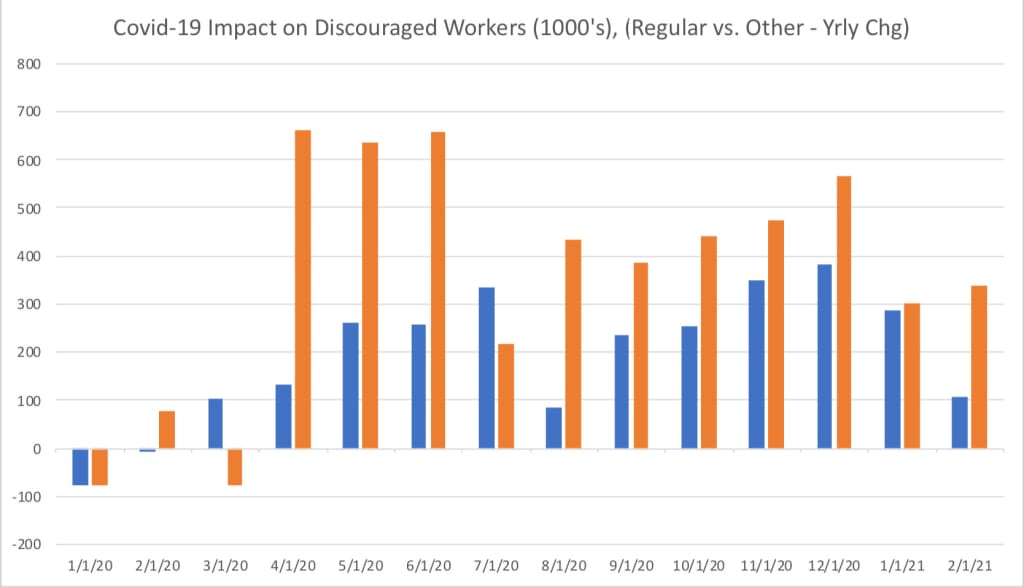
This means that to properly gauge changes, one needs to track the year-over-year level changes each month to avoid the distortionary impacts of seasonal changes in the data. When looking at both of these series in this manner, we find observe a nice improvement in the number of regularly measured discouraged workers that had stopped looking for a job because they didn’t think they could find a job. However, the “other category,” of discouraged workers that remained in that group due an inability to secure child-care or having to stay at home to care for a sick relative etc. appears to have stabilized but hasn’t not shown the same level of improvement that we have observed in the traditional “discouraged worker” category.
As we can see from the chart, --- this “other category” of discouraged workers has stabilized in the latest month after rising strongly from April to June 2020 along with a small pick-up from Oct. to Dec. 2020 as the virus flared up again.
Good News!
Over the next couple of months, we expect to see further improvements in the badly shattered “Child-Care,” sector that may have shed as many as 40% plus of child-care slots (during the peak of the pandemic last year) as many of the firms offering such services went out-of-business. However, with some government support, many of these firms may be able to gradually recover and re-open their doors. But even if many of the hundreds of thousands of smaller child-care facilities across the country don’t come back quickly – we are seeing some indications that large child-care companies will be able to fill the gap of these Mom-and-Pop establishments that operated on shoe-string budgets. Although this may not be great news for these small firms that are unable to reopen, the fact that many of these lost slots will be made-up by mega-large Child-Care companies, it will still help the general economy recover jobs that were hindered due to the lack of health care options. And as more individuals receive the vaccine and grow more confident – we should expect many of these workers that had become discouraged, will eventually re-enter the labor force (as the economy re-opens) due to diminished fears of contracting the virus.
Conclusion:
The latest employment report revealed that labor market conditions are gradually regaining some of the groove they lost during the pandemic!
About the Creator
Anthony Chan
Chan Economics LLC, Public Speaker
Chief Global Economist & Public Speaker JPM Chase ('94-'19).
Senior Economist Barclays ('91-'94)
Economist, NY Federal Reserve ('89-'91)
Econ. Prof. (Univ. of Dayton, '86-'89)
Ph.D. Economics
Keep reading
More stories from Anthony Chan and writers in Trader and other communities.
Fleeting Leaves
Autumn leaves drift down, Beauty fades as time rushes Life, too, feels so brief.
By Anthony ChanExclusive • 6 months ago
Australia Olive Oil Market Growth, Forecast, and Strategic Insights by 2034
Olive oil has become a staple ingredient in modern Australian kitchens, reflecting changing dietary habits and a growing interest in healthier cooking oils. Known for its nutritional benefits and versatility, olive oil is widely used across households, restaurants, and food processing industries. As Australian consumers increasingly prioritize natural and heart-healthy food products, olive oil consumption continues to rise across the country.
By Amélie Belle4 days ago in Trader
Stanislav Kondrashov on How Bank Strategy Is Evolving Across Europe’s Financial Landscape
The banking sector across Europe is going through a quiet but meaningful transformation. Digital expectations are rising, customer behaviour is shifting, and financial institutions are reassessing how they operate in a rapidly changing environment. For many industry observers, this moment represents not just an adjustment, but a turning point in how banks think about strategy, structure, and long-term relevance.
By Stanislav Kondrashovabout 4 hours ago in Trader


Comments
There are no comments for this story
Be the first to respond and start the conversation.