
What is the Best Indicator for 1-Minute Scalping?
Scalping on a 1-minute chart is like Formula 1 racing — you need speed, precision, and zero hesitation. Every second counts, so the right indicator setup can make all the difference.


Scalping is one of the fastest-paced trading strategies in the market — traders open and close positions within seconds or minutes to capture small price movements. The 1-minute chart is the most extreme version, where every candle represents just one minute of price action.
In such a high-speed environment, having the right indicator can mean the difference between consistent profits and random trades. But which one works best for scalping in 1-minute timeframes? Let’s break it down.
What is 1-Minute Scalping?
1-minute scalping is a short-term trading strategy where traders aim to profit from tiny price changes by entering and exiting trades within a few minutes — often under 5 minutes.
Key features of 1-minute scalping:
High trade frequency – Dozens of trades per session.
Tight stop-losses – Typically 3–10 pips in forex, or small ticks in stocks/futures.
Small targets – 5–10 pips or similar.
Low tolerance for delays – Even 1–2 seconds can matter.
Because the market moves quickly, traders need indicators that provide instant, reliable signals without lag.
Why Indicators Matter in 1-Minute Scalping?
In longer timeframes, you can rely more on chart patterns, fundamentals, or broader trends. But in ultra-short timeframes, decisions are made in seconds — and indicators help by:
- Spotting micro-trends before they fade.
- Identifying overbought/oversold zones for quick reversals.
- Confirming trade entries and exits with precision.
- Reducing emotional decision-making in fast markets.
Best Indicators for 1-Minute Scalping
Exponential Moving Average (EMA) is the best and widely used indicator for 1-Minute scalping. Below are some of the top indicators used by professional scalpers and prop traders for ultra-short trading windows.
1. Exponential Moving Average (EMA) – The Scalper’s Backbone
The EMA reacts faster to price changes than the Simple Moving Average (SMA), making it perfect for scalping.
How to use for 1-minute scalping:
Use two EMAs: a fast (e.g., 9 EMA) and a slow (e.g., 21 EMA).
Buy when the fast EMA crosses above the slow EMA.
Sell when the fast EMA crosses below the slow EMA.
Pros:
✅ Fast and responsive to price changes
✅ Easy to understand and implement
✅ Works well with other indicators
Cons:
❌ Can give false signals in ranging markets
❌ Requires discipline to avoid overtrading
2. Relative Strength Index (RSI) – Quick Overbought/Oversold Detector
The RSI measures momentum and shows whether a market is overbought or oversold. For scalping, traders often lower the period setting (e.g., RSI 7 instead of 14) for faster signals.
How to use:
Buy when RSI crosses below 30 and turns upward.
Sell when RSI crosses above 70 and turns downward.
Pros:
✅ Simple visual cue for reversals
✅ Helps avoid chasing trades
✅ Can be combined with EMA for higher accuracy
Cons:
❌ Can stay overbought/oversold longer in strong trends
❌ Less effective in choppy markets
3. Bollinger Bands – Volatility Scalper’s Tool
Bollinger Bands adjust dynamically to volatility, showing potential breakout or reversal points.
How to use:
When price touches the lower band, look for buy signals (if confirmed by RSI/EMA).
When price touches the upper band, look for sell signals.
Pros:
✅ Great for timing reversals
✅ Adapts to volatility changes automatically
✅ Works for breakout and mean-reversion scalping
Cons:
❌ Can produce whipsaws in flat markets
❌ Needs confirmation from another indicator
4. VWAP (Volume-Weighted Average Price) – Institutional Level Filter
VWAP shows the average price weighted by volume and is often used by institutional traders to judge fair value.
How to use:
Buy when price is above VWAP (trend confirmation).
Sell when price is below VWAP.
Combine with EMA or RSI for entries.
Pros:
✅ Helps trade in the direction of market momentum
✅ Acts as a dynamic support/resistance
✅ Reduces bad trades against the trend
Cons:
❌ Not available on all platforms for 1-minute charts
❌ Less effective in extremely low-volume sessions
Best Combination for 1-Minute Scalping
Most pro scalpers don’t rely on a single indicator — they combine 2–3 for more accurate signals. Here's a simple, powerful combo for 1-minute scalping-
- 9 EMA + 21 EMA crossover = Trend direction
- RSI (7) = Momentum (enter under 30, exit above 70)
- Bonus: Add MACD crossover for extra confirmation
Inspired by YOutuber Trade with Pat’s method and time-tested techniques, here's a streamlined strategy to help you scalp like a pro:
What Youtuber Pat Highlights:
His “complete course” focuses on efficient scalping over just a couple of hours—maximizing profits while minimizing screen time.
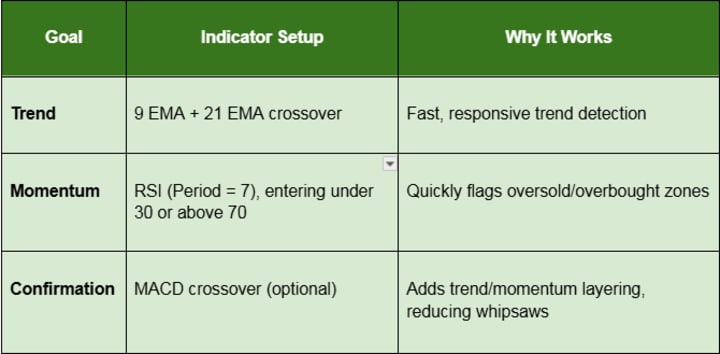
Speed + Clarity: EMA crossover delivers fast trend signals; RSI adds momentum confirmation.
Reduced Noise: Combining tools ensures you're not just reacting to random price swings.
Balanced Approach: Momentum filters prevent chasing moves; trend tools keep you aligned with direction.
Pro Tips for Using Indicators in 1-Minute Scalping
- Keep your chart clean — too many indicators create confusion.
- Always backtest your indicator settings before live trading.
- Combine with strong risk management — risk only 1–2% per trade.
- Avoid trading during low-liquidity periods unless volatility is high.
Conclusion – Which is the Best Indicator?
There’s no single “magic” indicator that works for everyone. For most scalpers, the EMA crossover combined with RSI offers the best balance of speed, accuracy, and clarity on 1-minute charts.
The best approach? Test combinations in a demo account, fine-tune your settings, and focus on discipline and consistency rather than chasing every signal.
About the Creator
Daniel Reid
Technical & Finance Writer| Casual Trader| Web Content Strategist
X: https://x.com/DReid43887 IG: https://www.instagram.com/danielreidtsc/
Keep reading
More stories from Daniel Reid and writers in Trader and other communities.
Contract Catering Market — Global Industry Overview, Trends, Forecast & Key Players Analysis
Market Overview Contract catering refers to the outsourcing of food service operations by organizations—including businesses, educational institutions, healthcare facilities, and events— to professional catering providers. These services typically encompass meal planning, food preparation, delivery, and on-site service management.
By James Smith7 days ago in Trader




Comments
There are no comments for this story
Be the first to respond and start the conversation.