
United States Small Kitchen Appliances Market Size and Forecast 2025–2033
Smart Kitchens, Smarter Choices: How Innovation Is Reshaping America’s Small Appliance Market

Introduction
The modern American kitchen is no longer just a place to cook—it has become a hub of technology, convenience, and lifestyle expression. From smart coffee makers that start brewing before you wake up to compact air fryers that promise healthier meals in minutes, small kitchen appliances have become essential tools for today’s consumers.
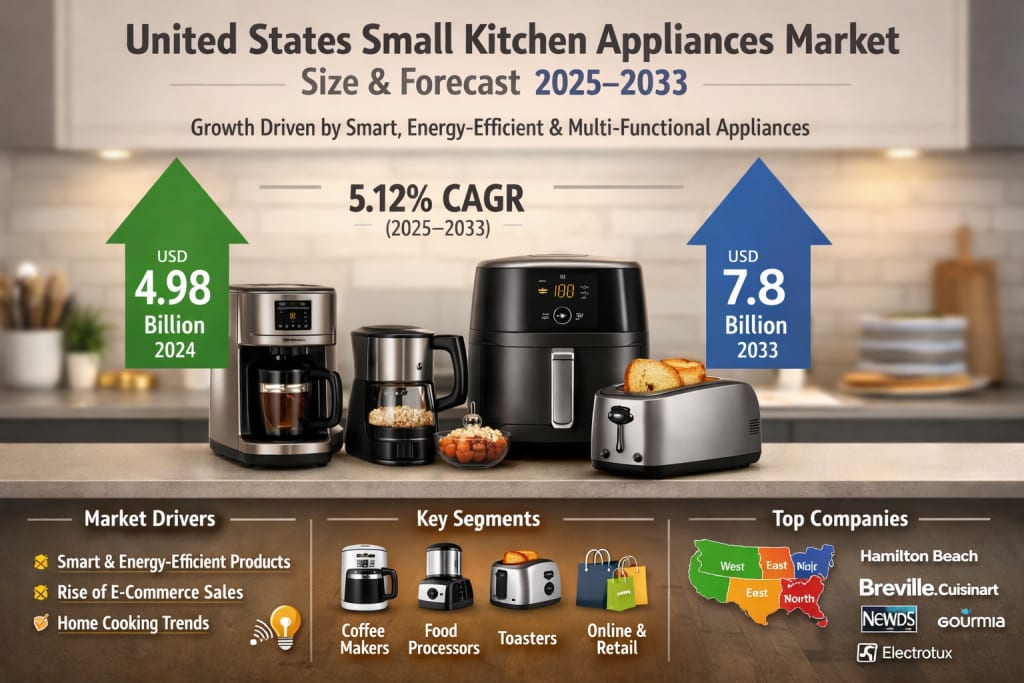
According to Renub Research, the United States Small Kitchen Appliances Market is expected to grow from USD 4.98 billion in 2024 to USD 7.8 billion by 2033, expanding at a compound annual growth rate (CAGR) of 5.12% during 2025–2033. This steady rise is being fueled by growing demand for smart, energy-efficient, and multi-functional appliances, alongside changing lifestyles, higher home-cooking trends, and the rapid expansion of online retail channels.
The market forecast covers segmentation by Product (Coffee Maker, Food Processors, Toasters, Grills and Roasters, Tea Makers/Electric Kettles, and Others), Distribution Channel (Hypermarkets & Supermarkets, Electronic Stores, Exclusive Brand Outlets, Online, Others), End User (Residential and Commercial), Region (East, West, North, South), along with Company Analysis for 2025–2033.
United States Small Kitchen Appliances Market Overview
Small kitchen appliances are portable, compact, and mostly electric devices designed to support food preparation and cooking tasks. These include blenders, coffee makers, toasters, air fryers, slow cookers, mixers, and food processors, among others. Their core appeal lies in saving time, improving efficiency, and simplifying everyday cooking.
In the United States, these appliances are widely used in households, restaurants, cafés, and other food service establishments. The growing focus on healthy eating has increased demand for products such as air fryers, smoothie makers, and juicers, which allow consumers to prepare nutritious meals at home. At the same time, the rise of smart homes and connected devices has accelerated the adoption of Wi-Fi-enabled and programmable kitchen appliances.
With increasingly busy lifestyles and a renewed interest in home cooking, American consumers are actively seeking innovative, energy-efficient, and multi-functional appliances. This combination of convenience, performance, and technology continues to shape purchasing decisions and drive long-term market growth.
Growth Drivers in the United States Small Kitchen Appliances Market
Increased Demand for Smart and Energy-Efficient Appliances
U.S. consumers are showing strong interest in smart kitchen appliances equipped with features such as Wi-Fi connectivity, app-based controls, voice assistants, and programmable settings. These appliances not only enhance convenience but also improve energy management and overall efficiency.
Energy efficiency has become a key buying criterion as households look to reduce electricity consumption and adopt more sustainable lifestyles. Manufacturers are increasingly integrating AI and IoT technologies into small kitchen appliances, enabling smarter usage patterns and better performance optimization.
In January 2024, Drew Barrymore’s home goods brand Beautiful launched a new range of affordable appliances, including a built-in grinder single-serve coffee machine, a personal blender set, and a compact air fryer. The collection focused on combining style, functionality, and accessibility, reflecting a broader industry trend toward making smart and attractive appliances available to a wider audience.
Expansion of E-Commerce and Online Sales Channels
The rapid expansion of e-commerce platforms has significantly boosted the small kitchen appliances market in the United States. Online retailers such as Amazon, Walmart, and Best Buy offer consumers a wide product range, competitive pricing, easy comparison tools, and customer reviews, all of which simplify the buying process.
Home delivery, seasonal discounts, and exclusive online deals continue to attract more shoppers. At the same time, many manufacturers are strengthening their direct-to-consumer (DTC) channels through branded websites, offering personalized recommendations and bundled promotions.
In November 2024, PowerXL introduced the Stirmax Multi-Cooker, available through Walmart and Walmart.com. This advanced appliance features automatic stirring and shredding technology, highlighting how innovation combined with strong online distribution can accelerate market adoption.
Shifting Consumer Lifestyles and Growing Home Cooking Trends
The trend toward home-cooked meals and healthier eating has gained strong momentum across the United States. As a result, consumers are investing more in high-quality, efficient kitchen appliances that support healthier cooking habits.
Sales of air fryers, blenders, and slow cookers have risen as people look for convenient ways to prepare nutritious meals. Urbanization and longer working hours have further increased dependence on time-saving appliances. Additionally, the popularity of meal prepping, specialized diets, and gourmet home cooking is driving demand for multi-functional and high-performance devices.
In February 2025, Midea showcased its Flexify Pro Air Fryer Oven at the Kitchen and Bath Industry Show (KBIS), emphasizing advanced technology, versatility, and modern design—key attributes that resonate strongly with today’s consumers.
Challenges Confronting the United States Small Kitchen Appliances Market
Market Competition and Price Pressures
The U.S. small kitchen appliances market is highly competitive, with numerous global and regional brands competing for consumer attention. Established players such as KitchenAid, Cuisinart, and Breville face increasing pressure from newer brands offering innovative features at lower prices.
This intense competition leads to frequent discounts and promotional offers, which can impact profit margins. Consumers often compare multiple options before purchasing, making brand loyalty harder to maintain. Additionally, fluctuating raw material prices further challenge manufacturers’ profitability and pricing strategies.
Supply Chain Disruptions and Inflation Impact
Global supply chain disruptions, shipping delays, and rising raw material costs have affected the availability and pricing of small kitchen appliances. Shortages of key components such as semiconductors and stainless steel have increased production costs and extended delivery timelines.
Inflation has also raised retail prices, potentially influencing consumer spending behavior. To adapt, manufacturers and suppliers are focusing on better inventory management, diversified sourcing strategies, and operational efficiency to maintain stability and competitiveness.
Product Segment Insights
United States Small Kitchen Coffee Maker Market
Coffee makers remain a staple in American households. The growing coffee culture, combined with work-from-home trends, has driven demand for both traditional drip machines and single-serve pod systems. Smart coffee makers with app integration and customizable brewing options are gaining popularity.
Brands such as Keurig and Nespresso continue to lead this segment through consistent innovation and product upgrades, catering to consumers who value both convenience and premium coffee experiences.
United States Small Kitchen Toasters Market
Toasters are among the most common kitchen appliances in U.S. homes. Demand is increasing for models with multiple toasting levels, digital displays, and wider slots for greater versatility. Energy efficiency and improved safety features are also key selling points.
Design plays an important role, with stainless steel and vintage-style toasters from brands like Breville and Cuisinart appealing to consumers who want appliances that match modern kitchen aesthetics. The fast-paced breakfast culture continues to support steady growth in this segment.
Distribution Channel Insights
United States Small Kitchen Appliances Electronic Stores Market
Electronics retailers such as Best Buy and Home Depot remain important sales channels for small kitchen appliances. These stores allow customers to see, compare, and test products in person, while also benefiting from expert advice, financing options, and extended warranties.
In-store demonstrations and promotional campaigns further enhance the shopping experience, encouraging consumers to make confident purchase decisions.
United States Small Kitchen Appliances Online Market
Online platforms have transformed the way consumers buy kitchen appliances. E-commerce offers unmatched convenience, broader product selection, and easy access to reviews and price comparisons.
Subscription services, such as recurring deliveries for consumable accessories, and online-exclusive discounts continue to fuel growth. Many brands are also strengthening their direct-to-consumer strategies, making online sales one of the fastest-growing segments of the market.
End-User Insights
United States Small Kitchen Appliances Residential Market
Residential consumers represent the largest share of the market. Growth is driven by home renovation trends, smart home integration, and increased interest in home cooking. Consumers are particularly drawn to space-saving, multi-functional, and energy-efficient appliances that fit modern lifestyles.
Digital controls, connectivity features, and sleek designs are becoming standard expectations, making households a key driver of innovation and sales in the U.S. market.
United States Small Kitchen Appliances Commercial Market
The commercial segment includes restaurants, cafés, hotels, and catering services. These users require durable, high-performance, and professional-grade appliances to handle daily operations.
Commercial blenders, coffee machines, and heavy-duty food processors are essential in professional kitchens. The rise of cloud kitchens and food delivery services is further increasing demand for efficient, high-capacity small kitchen appliances designed for continuous use.
Regional Insights
West United States Small Kitchen Appliances Market
The western U.S., particularly states like California and Washington, shows strong demand for premium and technologically advanced appliances. Tech-savvy consumers in this region are early adopters of smart kitchen devices with voice control and app integration.
Sustainability is also a major focus, driving interest in energy-efficient and eco-friendly products. Retailers in this region often emphasize design, performance, and innovation to meet consumer expectations.
East United States Small Kitchen Appliances Market
The eastern U.S., including major cities such as New York and Boston, sees high demand for compact and multi-functional appliances due to smaller living spaces. E-commerce plays a major role in purchasing decisions, with online sales continuing to grow rapidly.
Health-conscious consumers in this region are driving strong demand for high-speed blenders, air fryers, and advanced coffee machines.
Market Segmentation Overview
By Product:
Coffee Maker
Food Processors
Toasters
Grills and Roasters
Tea Makers/Electric Kettles
Other Small Kitchen Appliances
By Distribution Channel:
Hypermarkets & Supermarkets
Electronic Stores
Exclusive Brand Outlets
Online
Others
By End User:
Residential
Commercial
By Region:
East
West
North
South
Key Players Analysis
The market features several prominent players, each analyzed from four perspectives: Overview, Key Person, Recent Developments, and Revenue. Major companies include:
Hamilton Beach Brands Holding Company
Newell Brands
Spectrum Brands
Breville Group Limited
Gourmia
Smeg SpA
Electrolux AB
Whirlpool Corporation
These companies continue to invest in product innovation, smart technology integration, and expanded distribution networks to strengthen their market positions.
Final Thoughts
The United States Small Kitchen Appliances Market is on a steady growth path, supported by smart technology adoption, evolving consumer lifestyles, and expanding online retail channels. With the market expected to reach USD 7.8 billion by 2033, according to Renub Research, opportunities remain strong for both established brands and innovative newcomers.
As consumers continue to prioritize convenience, energy efficiency, and multi-functionality, the future of small kitchen appliances in the U.S. looks increasingly smart, connected, and design-driven. For manufacturers, retailers, and investors alike, this market represents a dynamic and resilient segment of the broader home appliances industry—one that is set to redefine how Americans cook, eat, and live at home.
About the Creator
IFCI Share Price Today: Is This the Investment Opportunity You Can’t Miss?
The IFCI Share Price has caught the eye of many investors looking for a potential opportunity in the financial market. With recent movements showing promise, many are asking: is now the right time to invest? This article will break down the key factors affecting the IFCI Share Price, recent trends, and strategies to help you make smart investment decisions.
By hamza mirzaabout 14 hours ago in Trader
United States Communication Equipment Market Size and Forecast 2025
United States Communication Equipment Market Overview The United States communication equipment market stands as one of the most critical pillars of the nation’s digital economy. Valued at US$ 123.11 billion in 2024, the market is projected to expand steadily at a CAGR of 3.42% from 2025 to 2033, reaching approximately US$ 168.09 billion by 2033. This growth is being driven by rapid advancements in 5G networks, cloud computing, Internet of Things (IoT) devices, and the ever-increasing demand for high-speed, reliable communication infrastructure across industries.
By Sakshi Sharmaabout 16 hours ago in Trader
Our Song
Evening has given way to night. Gently, I settle next to you on the comfortable, old love seat and reach for your hand. You snatch it away, again. It cuts me to the quick, but I hide the pain, understanding that the reaction is but part of your demented state. Since the accident, your presence here in our cozy home has been clouded by a haze I can't see. Nevertheless, I feel the frigidity of your expressions and it serves as an excruciating reminder of the immeasurable distance between us.
By Dana Crandell6 days ago in Fiction



Comments
There are no comments for this story
Be the first to respond and start the conversation.