
North America Baby Food Market Trends & Outlook 2025–2033
Rising Demand for Organic, Fortified, and Convenient Infant Nutrition Fuels Steady Market Expansion Across the U.S., Canada, and Mexico

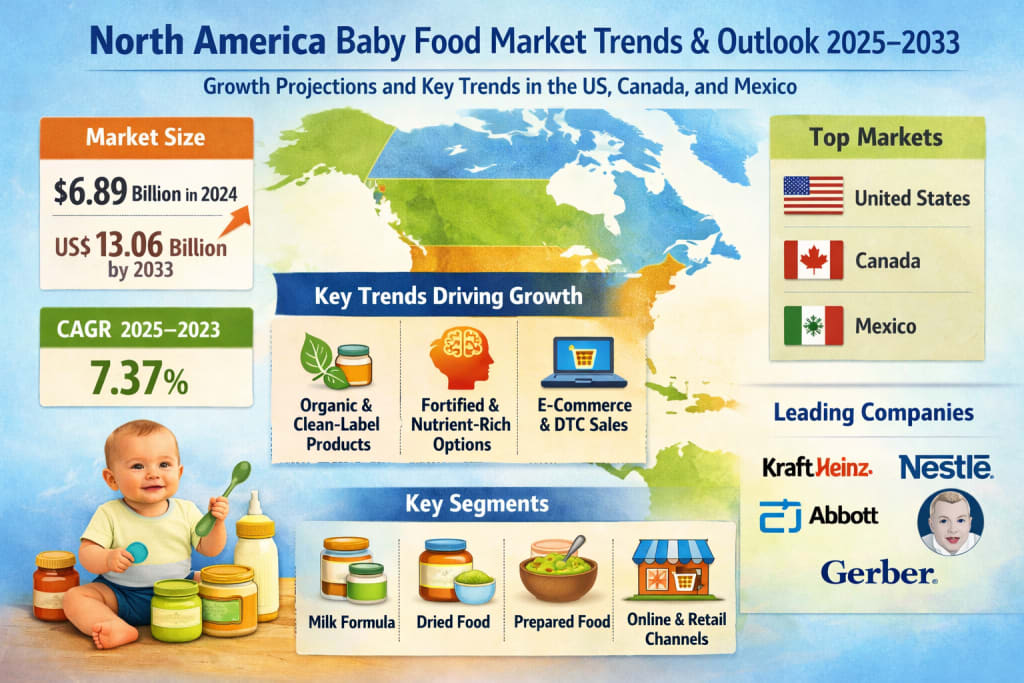
North America Baby Food Market: Trends & Summary
The North America Baby Food Market is witnessing a steady and resilient expansion, supported by changing parental preferences, rising awareness of infant nutrition, and continuous product innovation. The market is estimated to be worth US$ 6.89 billion in 2024 and is anticipated to grow at a CAGR of 7.37% during the forecast period from 2025 to 2033, reaching a value of US$ 13.06 billion by 2033.
This growth reflects more than just population trends—it highlights a structural shift in how parents approach early childhood nutrition. Modern parents in the United States, Canada, and Mexico are increasingly focused on providing food that is not only convenient but also safe, nutritious, clean-label, and aligned with evolving health standards. As a result, baby food has moved far beyond basic cereals and purees to include organic, fortified, allergen-free, and functional nutrition products designed to support cognitive, immune, and digestive development.
Baby food refers to specially prepared, soft, and easily digestible food products designed for infants and toddlers, typically between four months and two years of age. These products are formulated to deliver essential nutrients, vitamins, and minerals necessary for early growth and development. In North America, baby food is widely consumed in the form of purees, cereals, snacks, and infant formula, offering parents reliable and convenient feeding solutions that meet both nutritional and safety expectations.
The increasing participation of women in the workforce, busy urban lifestyles, and the need for reliable feeding options have further strengthened demand for packaged baby food. At the same time, heightened scrutiny of ingredients and sourcing has pushed manufacturers to reformulate products, improve transparency, and invest in premium, clean-label offerings.
Key Growth Drivers in the North America Baby Food Market
Increasing Demand for Organic and Clean-Label Baby Food
One of the most powerful growth drivers in the North American baby food market is the rising preference for organic, non-GMO, and preservative-free products. Parents are increasingly concerned about pesticide residues, artificial additives, and potential allergens in infant food. This has accelerated the shift toward clean-label products made with simple, recognizable ingredients and transparent sourcing practices.
Manufacturers are responding by expanding their portfolios of certified organic purees, cereals, and snacks that meet strict safety and nutritional standards. Premium brands, in particular, are positioning themselves around quality, traceability, and minimal processing. This trend is no longer niche—it is becoming mainstream across supermarkets, pharmacies, and online platforms.
For example, in February 2022, Sprout Organics expanded its product family with a co-branded range alongside the popular “CoComelon” characters, launching veggie-rich pureed meals and healthier snacks made from real organic ingredients. Such initiatives highlight how brands are combining clean-label nutrition with child-friendly branding to capture both parental trust and consumer attention.
Growing Awareness of Infant Nutrition and Well-Being
Today’s parents are more informed than ever about the long-term impact of early childhood nutrition. This has driven strong demand for fortified baby food products enriched with iron, DHA, probiotics, and essential vitamins and minerals that support brain development, immunity, and digestion.
Products such as iron-fortified cereals, omega-3-enriched purees, and probiotic-enhanced formulas are increasingly preferred, especially among health-conscious and urban families. Pediatric guidance promoting balanced diets and allergen-aware feeding has also supported the growth of plant-based, dairy-free, and hypoallergenic baby food options.
Demographic trends further support this demand. According to the Centers for Disease Control and Prevention, there were 3.6 million births in the U.S. in 2023, with the number expected to rise to 3.62 million in 2024. A stable birth rate combined with higher per-child spending on nutrition continues to create a solid foundation for market growth.
Expansion of E-Commerce and Direct-to-Consumer Sales
The rapid growth of e-commerce has transformed how parents purchase baby food in North America. Online platforms, brand websites, and subscription services now offer unmatched convenience, broader product selection, and personalized meal plans tailored to specific dietary needs and age groups.
Direct-to-consumer models, in particular, are gaining traction by offering customized baby meal programs, regular home deliveries, and transparent ingredient information. This digital shift allows brands to build closer relationships with consumers while quickly adapting to changing preferences and emerging nutrition trends.
In October 2024, a mom-founded pediatric nutrition brand introduced a new grass-fed whole milk infant formula in the U.S., reinforcing the idea that parents are seeking simple, high-quality, domestically produced ingredients. Such launches highlight how innovation and digital distribution are working together to reshape the competitive landscape.
Challenges in the North America Baby Food Market
High Competition and Market Saturation
The North American baby food market is highly competitive, with global multinational brands, private labels, and fast-growing organic startups all competing for shelf space and consumer loyalty. This intense competition has led to pricing pressures and tighter margins, particularly in mature segments such as infant formula and basic purees.
In addition, a growing number of parents are opting for homemade baby food, attracted by the perception of freshness, cost savings, and full control over ingredients. This trend poses a challenge for packaged food manufacturers, who must continuously innovate and communicate the added value of convenience, safety, and nutritional consistency.
Regulatory and Safety Pressures
Baby food is one of the most tightly regulated segments of the food industry. In North America, strict standards set by regulatory bodies such as the FDA and USDA require manufacturers to maintain high levels of safety, quality control, and labeling accuracy.
Recent concerns over heavy metals in baby food have intensified regulatory scrutiny, forcing companies to invest more in testing, supply chain monitoring, and quality assurance systems. While these measures improve overall product safety and consumer trust, they also increase operational costs—particularly for smaller and emerging brands.
Segment Insights
North America Baby Milk Formula Market
The baby milk formula segment continues to grow as more parents rely on formula as a supplement or alternative to breastfeeding, especially among working families. Demand is rising for organic, lactose-free, hypoallergenic, and fortified formulas that cater to specific dietary needs and sensitivities.
Innovations such as probiotic-enriched and DHA-fortified formulas are gaining traction, as parents increasingly prioritize cognitive development and immune support. Strict quality and safety standards across North America further reinforce consumer confidence in this segment.
North America Dried Milk Food Formula Market
Dried milk formula is popular due to its long shelf life, storage convenience, and ease of use, making it especially appealing for traveling families and cost-conscious consumers. The market offers a wide range of options, including organic, soy-based, and goat milk-based formulas for infants with allergies or special dietary requirements.
Manufacturers continue to focus on fortification with essential vitamins, minerals, and probiotics, enhancing the nutritional profile of these products and supporting sustained demand.
Distribution Channel Trends
Drugstores and Pharmacies
Drugstores and pharmacies play a crucial role in baby food distribution, particularly for infant formula and specialized nutrition products. Parents often trust these outlets for product authenticity and professional guidance. Many leading pharmacy chains are expanding their baby food assortments to include organic, fortified, and special-diet products, further strengthening this channel’s importance.
Online Stores
Online retail has become one of the fastest-growing channels in the North America baby food market. Platforms such as Amazon, Walmart, and brand-owned websites offer access to niche brands, subscription services, and specialized products that may not be available in traditional stores. Reviews, comparisons, and expert content also help parents make informed purchasing decisions, supporting continued growth in this segment.
Country-Level Outlook
United States
The United States leads the North American baby food market, driven by high disposable incomes, strong demand for organic and fortified products, and a well-developed retail and e-commerce infrastructure. U.S. parents increasingly seek non-GMO, allergen-free, and functional nutrition options, pushing brands to innovate across both food and formula categories.
Canada
Canada’s baby food market is growing steadily, supported by rising demand for organic, gluten-free, and clean-label products. Health-conscious consumers and expanding online retail availability are improving access to premium baby food options, while government-led nutrition awareness initiatives continue to shape purchasing behavior.
Mexico
Mexico’s baby food market is expanding alongside urbanization, rising incomes, and growing awareness of infant nutrition. While homemade baby food remains common, demand for convenient, fortified, and ready-to-use products is increasing, particularly among working parents. Supermarkets and online channels are playing a key role in improving product accessibility.
Market Segmentation
By Food Type:
Milk Formula
Dried Food
Prepared Food
Others
By Distribution Channel:
Supermarkets & Hypermarkets
Drugstores/Pharmacies
Convenience Stores
Online Stores
Others
By Country:
United States
Canada
Mexico
Company Analysis
The market features a mix of global leaders and specialized nutrition brands, including:
Kraft Heinz Company
Abbott Laboratories
Hero Group (Beech-Nut Nutrition Corporation)
Hain Celestial Group, Inc.
Nestlé S.A.
Reckitt Benckiser Group plc (Mead Johnson & Company, LLC)
Amara Organics Foods
Danone S.A.
Lactalis (Stonyfield Farm, Inc.)
Sun-Maid Growers of California
These companies compete across four key dimensions: overview, key persons, recent developments, and revenue performance, with a strong focus on innovation, quality, and brand trust.
Final Thoughts
The North America Baby Food Market is entering a phase of sustained, quality-driven growth. With the market expected to rise from US$ 6.89 billion in 2024 to US$ 13.06 billion by 2033, the future will be shaped by clean-label innovation, fortified nutrition, digital distribution, and evolving parental expectations.
As competition intensifies and regulations become more stringent, brands that invest in transparency, safety, and meaningful nutritional benefits will be best positioned to win long-term consumer trust. In a region where parents are increasingly viewing baby food as an investment in lifelong health, the market’s evolution is not just about convenience—it’s about building a healthier start for the next generation.
About the Creator
Electric Vehicle Battery Swapping Market Set to Soar to USD 1,440.12 Million by 2033 | CAGR 21.20%
Overview – Electric Vehicle Battery Swapping Market Electric vehicle battery swapping involves replacing a depleted EV battery with a fully charged battery at specialized swapping stations rather than charging the battery within the vehicle. This approach reduces charging time, minimizes range anxiety, and enhances operational efficiency for commercial EV fleets, including taxis, ride-sharing services, and delivery vehicles. The market is witnessing increased interest from automotive manufacturers, battery technology companies, and energy providers aiming to develop scalable battery swapping networks. As urbanization and environmental regulations continue to promote zero-emission transportation, battery swapping is emerging as a practical solution to support EV adoption.
By James Smithabout 9 hours ago in Trader
Australia Ferrous Scrap Recycling Market Set to Surge as Sustainable Steel Demand and Policy Support Intensify
The Australia ferrous scrap recycling market reached USD 4.6 Million in 2025 and is forecast to grow to USD 7.6 Million by 2034, expanding at a CAGR of 5.85% during 2026–2034.
By Rashi Sharmaa day ago in Trader



Comments
There are no comments for this story
Be the first to respond and start the conversation.