
United States Pharmaceutical Market Size and Forecast 2025–2033
Innovation, Aging Demographics, and Biotech Breakthroughs Reshape America’s Drug Industry

Introduction: The Pillar of Modern American Healthcare
Pharmaceuticals sit at the very heart of the U.S. healthcare system. From life-saving vaccines and cancer therapies to everyday treatments for diabetes, blood pressure, and infections, medicines shape how Americans live longer, healthier lives. The United States is not only the world’s largest pharmaceutical market, but also the global epicenter of drug innovation, home to many of the most influential pharmaceutical and biotechnology companies.
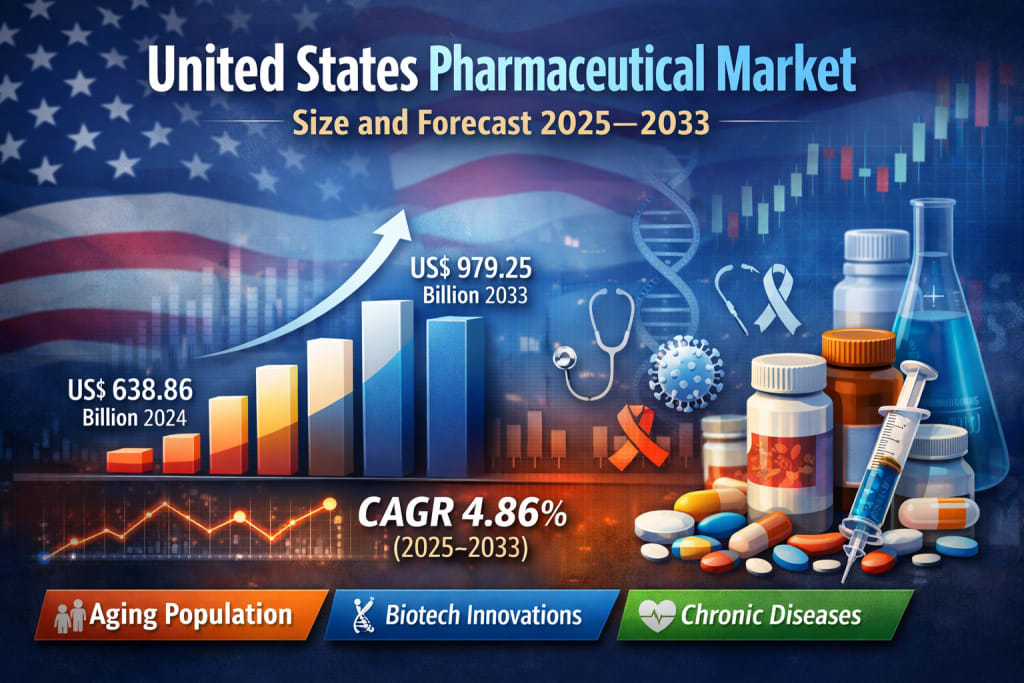
According to Renub Research, the United States Pharmaceutical Market is expected to grow from US$ 638.86 billion in 2024 to US$ 979.25 billion by 2033, registering a CAGR of 4.86% during 2025–2033. This growth is being driven by rising demand for novel therapies, the increasing burden of chronic diseases, rapid progress in biotechnology, and massive investments in research and development across key therapeutic areas such as oncology, neurology, and infectious diseases.
In an era where precision medicine, biologics, and digital health are transforming treatment pathways, the U.S. pharmaceutical industry is evolving faster than ever—balancing innovation, access, regulation, and cost pressures in one of the world’s most complex healthcare ecosystems.
United States Pharmaceutical Market Outlook
Pharmaceuticals include prescription drugs, over-the-counter (OTC) medicines, vaccines, and biologics used to prevent, diagnose, treat, and manage a wide range of diseases. The journey from discovery to market is long and expensive, involving years of research, clinical trials, regulatory review, and large-scale manufacturing. Yet, despite these challenges, the U.S. remains the most attractive market for drug development due to its strong intellectual property protection, advanced healthcare infrastructure, and high per-capita healthcare spending.
The country hosts many of the world’s largest pharmaceutical companies and most innovative biotech startups. With an aging population and rising prevalence of chronic conditions such as cancer, diabetes, cardiovascular disease, and neurological disorders, demand for effective and advanced therapies continues to climb. Favorable reimbursement structures, widespread insurance coverage, and rapid adoption of new treatments further strengthen the market’s foundation.
Key Growth Drivers in the United States Pharmaceutical Market
1. Aging Population and Rising Chronic Disease Burden
The United States is experiencing a significant demographic shift. The population aged 65 and above is expanding rapidly, and older adults are far more likely to suffer from chronic illnesses such as diabetes, heart disease, arthritis, cancer, and neurodegenerative disorders. These conditions often require long-term or lifelong medication, directly boosting prescription volumes and pharmaceutical spending.
As diagnostic tools improve and healthcare access expands, more patients are being identified and treated earlier. This trend is particularly visible in oncology, cardiovascular care, and metabolic diseases, where long-term drug therapy has become the standard of care.
2. Biotech Revolution and Innovative Drug Pipelines
The U.S. leads the world in biotechnology innovation. Breakthroughs in cell and gene therapy, immunotherapy, and RNA-based medicines are reshaping the treatment landscape. From CAR-T therapies for cancer to mRNA platforms expanding beyond COVID-19 into flu and RSV, innovation is accelerating.
Strong venture capital funding, public-private partnerships, and supportive regulatory pathways such as FDA Fast Track and Breakthrough Therapy designations are shortening time-to-market for high-impact drugs. The growing pipeline of high-value specialty and rare disease drugs is a major engine of revenue growth for the industry.
3. Healthcare Insurance and Reimbursement Framework
Broad coverage through private insurers, Medicare, and Medicaid ensures that most Americans can access prescription medicines. While pricing pressures exist, reimbursement systems still support the adoption of innovative and often expensive specialty therapies, especially in oncology and rare diseases.
Value-based care models are also gaining ground, encouraging pharmaceutical companies to focus on outcomes and real-world effectiveness. Meanwhile, large U.S. pharma companies continue to invest heavily in R&D, recognizing that innovation is the key to long-term competitiveness in a market facing patent expirations and generic competition.
Challenges Facing the U.S. Pharmaceutical Market
Pricing Pressure and Political Scrutiny
High drug prices remain one of the most controversial issues in American healthcare. Policymakers, insurers, and the public are increasingly demanding reforms, including price negotiations, caps on out-of-pocket expenses, and greater transparency.
These measures create uncertainty for pharmaceutical companies, particularly for high-margin specialty and branded drugs. Manufacturers must now balance profitability with affordability, while navigating tougher negotiations with payers and pharmacy benefit managers (PBMs).
Complex Regulatory Environment
Although the FDA offers accelerated pathways for innovative therapies, the overall regulatory process remains lengthy, expensive, and highly complex. Post-marketing surveillance, safety studies, and compliance requirements add to operational costs.
Smaller biotech firms, in particular, face challenges in meeting these regulatory demands, which can delay or even derail promising therapies. Still, rigorous regulation also underpins the global reputation of U.S. medicines for safety and quality.
Market by Molecule Type: Biologics, Biosimilars, and Small Molecules
Biologics—complex, large-molecule drugs such as monoclonal antibodies and recombinant proteins—now account for a growing share of U.S. pharmaceutical sales, especially in oncology, autoimmune diseases, and rare disorders. These therapies are expensive to develop and manufacture but command premium prices due to their high clinical value.
At the same time, biosimilars are reshaping competition by offering lower-cost alternatives to established biologics. As FDA interchangeability guidelines mature and physician confidence grows, biosimilars are expanding patient access and reducing payer costs, while still preserving healthy competition in the market.
Conventional small-molecule drugs, meanwhile, continue to dominate in terms of volume, especially in chronic disease management and primary care.
Branded vs. Generic Drugs: The Revenue Balance
Branded, patent-protected drugs remain the primary revenue drivers of the U.S. pharmaceutical industry. These products benefit from market exclusivity, strong physician awareness, and significant marketing support. However, once patents expire, generic drugs enter quickly, often causing steep price and revenue declines.
To counter this, pharmaceutical companies invest heavily in life-cycle management strategies—new formulations, additional indications, and improved delivery methods—to extend the commercial life of their brands. Generics, on the other hand, play a crucial role in improving affordability and access, especially for long-term therapies.
Prescription Drugs: The Core of the Market
Prescription medicines form the backbone of the U.S. pharmaceutical market. Growth in this segment is fueled by rising chronic disease prevalence, improved diagnosis rates, and better patient adherence programs. The expansion of telehealth and e-prescribing has further simplified access, increasing prescription volumes across many therapeutic areas.
Formulary decisions by insurers and PBMs strongly influence which drugs succeed commercially, making market access strategies and real-world evidence increasingly important for manufacturers.
Key Therapeutic Areas Driving Demand
Diabetes
With tens of millions of Americans affected, diabetes remains one of the largest and fastest-evolving therapeutic markets. New drug classes such as SGLT2 inhibitors and GLP-1 receptor agonists are transforming treatment, offering benefits beyond glucose control, including weight loss and cardiovascular protection.
Infectious Diseases
The COVID-19 pandemic renewed focus on antivirals, vaccines, and antimicrobial resistance. Investment in next-generation vaccines and novel antibiotics continues, supported by regulatory incentives and public health priorities.
Obesity
Obesity has emerged as a major pharmaceutical growth frontier. New GLP-1-based weight-loss drugs have shown remarkable clinical results, expanding the market far beyond traditional diabetes care and positioning obesity as a chronic, long-term treatment category.
Route of Administration: Oral vs. Parenteral
Oral drugs remain the most widely used due to convenience, patient preference, and lower manufacturing costs. They dominate in cardiovascular, metabolic, gastrointestinal, and CNS therapies.
Parenteral drugs—including injectables and infusions—are essential for biologics, oncology treatments, vaccines, and critical care. As biologics continue to grow, the parenteral segment will expand, supported by investments in sterile manufacturing and cold-chain logistics.
Age Group Dynamics: Adults Lead Demand
While pediatric and geriatric segments are important, adults account for the largest share of pharmaceutical consumption due to high prevalence of chronic diseases and long-term therapy needs. Preventive care, digital health monitoring, and disease management programs are further increasing medication adherence in this group.
Distribution Channels: The Power of Retail Pharmacies
Retail pharmacies—including major chains and independent stores—remain the dominant distribution channel in the U.S. Beyond dispensing medicines, they now offer vaccinations, health screenings, and medication therapy management, strengthening their role in primary healthcare delivery.
Digital integration, mail-order services, and home delivery are reshaping consumer expectations and intensifying competition across the pharmacy landscape.
State-Level Highlights: California and New York
California stands out as the nation’s largest biotech and pharmaceutical innovation hub, with strong clusters in the Bay Area and San Diego. Its large population, advanced healthcare infrastructure, and progressive health policies make it a major driver of both demand and innovation.
New York plays a critical role in clinical research, healthcare delivery, and pharmaceutical finance. With world-class hospitals and research institutions, it remains a key center for clinical trials, specialty care, and drug distribution.
Competitive Landscape and Key Players
The U.S. pharmaceutical market is highly competitive and innovation-driven. Major global players such as Roche, Novartis, AbbVie, Johnson & Johnson, Merck, Pfizer, Bristol-Myers Squibb, Sanofi, GSK, and Takeda continue to invest heavily in R&D, strategic partnerships, and acquisitions.
These companies compete across multiple fronts—scientific innovation, market access, pricing strategies, and global expansion—while also facing rising competition from agile biotech firms and biosimilar manufacturers.
Final Thoughts: A Market Built on Innovation and Demand
The United States pharmaceutical market is on a steady growth trajectory, supported by powerful long-term fundamentals: an aging population, rising chronic disease burden, relentless innovation in biotechnology, and strong healthcare spending. While pricing pressure and regulatory complexity pose real challenges, they also push the industry toward more value-driven, outcome-focused solutions.
With the market projected to reach US$ 979.25 billion by 2033, the coming decade will likely be defined by biologics, precision medicine, digital health integration, and new treatment frontiers such as obesity and gene therapy. For investors, policymakers, and healthcare stakeholders alike, the U.S. pharmaceutical industry will remain one of the most dynamic and strategically important sectors in the global economy.
About the Creator
Australia Energy Efficiency Retrofits Market 2026: Decarbonisation Goals, Smart Building Upgrades and Sustainable Infrastructure
Australia Energy Efficiency Retrofits Market Overview Australia’s energy efficiency retrofits market is gaining strong momentum as the country accelerates its transition toward low-carbon infrastructure and sustainable building practices. Retrofitting existing buildings with energy-efficient technologies — including insulation, lighting upgrades, HVAC improvements and smart energy management systems — has become a critical strategy for reducing energy consumption and operational costs. With a large share of Australia’s building stock constructed before modern efficiency standards, retrofit solutions offer substantial potential for emissions reduction and energy savings across residential, commercial and industrial sectors.
By Amyra Singhabout 17 hours ago in Trader
Saudi Arabia Home Energy Management System Market Size and Forecast 2025–2033
Introduction: A Smarter Way to Power Saudi Homes Saudi Arabia is undergoing a profound transformation in how energy is produced, consumed, and managed. As part of the Kingdom’s ambitious Vision 2030 agenda, sustainability, digital transformation, and energy efficiency have moved to the center of national policy and private investment. One of the most visible results of this shift is the rapid rise of the Home Energy Management System (HEMS) market.
By Sakshi Sharma3 days ago in Trader
When Amazon Says You’re a Disappointment
Yesterday, for the first Wednesday in months, I didn’t publish a piece on Vocal. Believe me, I wanted to. I had it all written up and ready to go. I was going to share the news that I had officially become a published author.
By Sandy Gillman5 days ago in Writers


Comments
There are no comments for this story
Be the first to respond and start the conversation.