
Global Vending Machine Market Size & Forecast 2025–2033
From Snacks to Smart Retail: How Vending Machines Are Redefining Convenience Worldwide

Global Vending Machine Market Overview
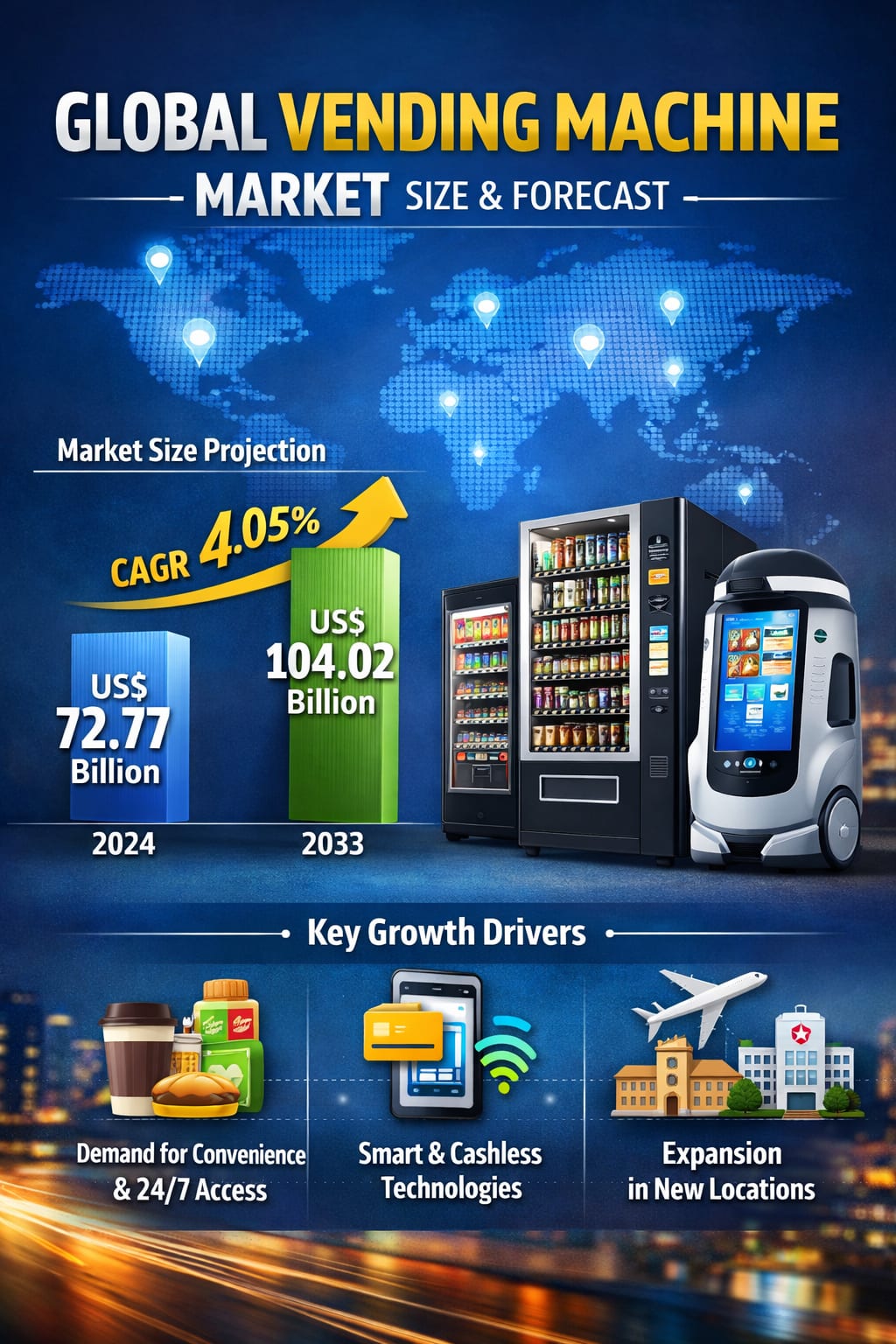
The global vending machine market is undergoing a quiet but powerful transformation. Once seen as simple coin-operated snack dispensers, vending machines have evolved into intelligent, connected retail points capable of selling everything from fresh meals and premium coffee to electronics, cosmetics, and even books. According to Renub Research, the Global Vending Machine Market is expected to grow from US$ 72.77 billion in 2024 to US$ 104.02 billion by 2033, registering a CAGR of 4.05% from 2025 to 2033.
This steady expansion is being driven by changing consumer lifestyles, rapid urbanization, and the growing demand for on-the-go, 24/7 access to food, beverages, and essential products. At the same time, technological advancements—particularly in cashless payments, AI-powered inventory management, and smart vending systems—are reshaping how operators and consumers interact with these machines.
A vending machine today is no longer just a metal box that dispenses snacks. It is a self-service retail hub that can accept cards, QR codes, and mobile wallets, display digital advertisements, track inventory in real time, and even recommend products based on buying patterns. These features are making vending machines more attractive not only to consumers but also to businesses seeking low-cost, scalable, and manpower-free retail solutions.
Across the world, vending machines are becoming deeply embedded in daily life. In countries like Japan and the United States, they are already a common sight in offices, schools, malls, airports, and train stations. Europe is seeing strong growth in health-focused and eco-friendly vending solutions, while emerging markets in Asia-Pacific and Latin America are rapidly adopting smart, cashless machines to serve urban, digitally connected populations.
Key Drivers of Growth in the Global Vending Machine Industry
1. Rising Demand for Convenience and On-the-Go Consumption
Modern consumers value speed, accessibility, and convenience more than ever. Busy work schedules, long commutes, and urban lifestyles have increased the demand for quick, hassle-free access to snacks, beverages, and daily essentials. Vending machines perfectly fit this need by offering 24/7 availability without the requirement for staff or traditional retail space.
These machines are no longer limited to impulse purchases. In corporate offices, universities, hospitals, and transit hubs, vending machines are increasingly used for planned, routine consumption, such as healthy meals, coffee, and travel essentials. For businesses, this represents a scalable and cost-efficient retail model that reduces labor costs while maximizing reach.
A good example of this momentum can be seen in the growth of automated retail providers expanding across multiple countries with thousands of connected machines, processing tens of thousands of transactions daily—showing how unattended retail is becoming a mainstream sales channel.
2. Technological Advancements: Smart, Cashless, and Interactive Machines
Technology is at the heart of the vending machine market’s evolution. Today’s machines are equipped with touchscreens, IoT sensors, AI-based analytics, and cloud connectivity, enabling features such as:
Real-time inventory tracking
Remote machine management
Dynamic pricing and promotions
Personalized product recommendations
Detailed sales and consumer behavior analytics
The shift toward cashless payments—including cards, NFC, QR codes, and mobile wallets—has significantly improved user experience while reducing operational issues related to cash handling, theft, and maintenance. Contactless payments, in particular, gained strong momentum after the COVID-19 pandemic, as hygiene and safety became top priorities for consumers.
Smart vending machines also double as digital advertising platforms, allowing brands to run targeted campaigns directly at the point of purchase. This combination of retail and media makes vending machines more profitable and strategically valuable in high-traffic locations.
3. Expansion into Non-Traditional and High-Potential Locations
Vending machines are increasingly being deployed beyond traditional spots like train stations and malls. Today, they are commonly found in corporate lobbies, hospitals, universities, gyms, airports, hotels, and residential complexes. These locations offer a captive audience and consistent demand for quick-access products.
Emerging markets, particularly in Asia-Pacific and Latin America, are opening up new growth opportunities due to rising disposable incomes, urbanization, and increasing acceptance of digital payments. In these regions, smart vending machines are being used not only for food and beverages but also for SIM cards, electronics accessories, personal care products, and e-commerce pickups.
Challenges in the Global Vending Machine Market
1. High Initial Investment and Ongoing Maintenance Costs
While basic vending machines are relatively affordable, advanced smart vending machines with refrigeration, touchscreens, IoT connectivity, and AI software require significant upfront investment. In addition to installation costs, operators must also account for regular maintenance, cleaning, software updates, and technical support.
In low-traffic or remote locations, the return on investment can be slow, making it difficult for smaller operators to justify large-scale deployments. This financial barrier can limit market entry and expansion, especially in developing regions.
2. Product Spoilage and Security Risks
Machines that dispense fresh food, dairy products, or ready-to-eat meals face challenges related to temperature control, shelf life, and regular restocking. Any failure in cooling systems or inventory management can lead to spoilage and financial losses.
Security is another concern. Unmanned machines are vulnerable to vandalism, theft, and tampering, particularly in less monitored public areas. Operators must invest in cameras, alarms, robust machine designs, and regular inspections, which further increases operational costs.
Segment Analysis
Food Vending Machine Market
Food vending machines have expanded far beyond chips and chocolates. Today, they offer sandwiches, salads, hot meals, and healthy snacks, especially in offices, universities, hospitals, and transit hubs. These machines cater to the growing demand for fresh, convenient, and healthier food options.
While food vending involves higher maintenance and spoilage risks, operators are increasingly using data analytics and predictive restocking to reduce waste and improve efficiency. Partnerships with food brands and franchises also help build consumer trust and ensure consistent quality.
Beverages Vending Machine Market
Beverage vending remains one of the strongest segments, covering soft drinks, bottled water, energy drinks, fresh juices, and premium coffee. Advanced machines now feature bean grinders, milk frothers, and multi-flavor options, delivering café-like experiences on the go.
Health and wellness trends are boosting demand for sugar-free, organic, and functional beverages. Since liquid products are generally easier to manage than fresh food, this segment often offers faster returns on investment and lower operational complexity.
Automatic Vending Machine Market
Automatic vending machines focus on fully self-service operations with minimal human involvement. They are widely used for snacks, beverages, pharmaceuticals, electronics accessories, and office supplies. These machines are ideal for business parks, hotels, campuses, and hospitals, where reliability and speed are essential.
However, maintaining mechanical reliability and software stability is crucial to avoid downtime and protect brand reputation.
Smart Vending Machine Market
Smart vending machines represent the future of the industry. By integrating AI, IoT, digital signage, and data analytics, these machines can personalize offers, optimize inventory, and support targeted marketing campaigns. Operators benefit from real-time insights into sales performance and consumer behavior, enabling smarter business decisions.
Although initial costs and cybersecurity risks are higher, the long-term efficiency gains and branding opportunities make smart vending highly attractive, especially in premium locations.
Cashless Vending Machine Market
Cashless vending is growing rapidly due to the global rise of digital payments and contactless transactions. These machines reduce cash handling costs, improve transaction speed, and enhance security while providing valuable data on customer preferences.
In many regions, especially in Europe and Asia, NFC, QR codes, and mobile wallets are becoming the default payment methods. Government initiatives promoting digital payments are further accelerating this shift.
Application-Based Insights
Corporate Offices
Vending machines in workplaces are increasingly part of employee wellness and convenience programs. They offer healthy snacks, fresh meals, and premium coffee, helping improve productivity and reduce time spent on off-site food runs. Employers benefit from outsourcing inventory and maintenance to vending operators while still providing valuable amenities to staff.
Public Places
Airports, bus stations, malls, and tourist areas remain key locations for vending machines. High foot traffic ensures strong sales, especially for snacks, drinks, tickets, SIM cards, and travel essentials. Digital screens also enable additional advertising revenue streams, making these machines even more attractive for operators.
Regional Market Insights
United States
The U.S. remains a global leader in vending machine deployment, with strong adoption of smart and cashless technologies. Health-focused vending, premium coffee machines, and data-driven management systems are shaping the market. Regulatory focus on nutrition labeling is also influencing product selections toward healthier and more transparent options.
Germany
Germany leads Europe in advanced, sustainable vending solutions. Cashless payments, eco-friendly packaging, energy-efficient machines, and strict hygiene standards define the market. Health-oriented products and multilingual interfaces are common, reflecting the country’s strong regulatory and consumer standards.
India
India’s vending market is still emerging but growing quickly in metros and business hubs. Smart kiosks, coffee machines, book vending, and e-commerce pickup lockers are gaining traction. While infrastructure and temperature control remain challenges, rising urbanization and digital payments are expected to drive strong long-term growth.
Saudi Arabia
In Saudi Arabia, vending machines are expanding across airports, malls, universities, and hospitals, supported by a young, tech-savvy population and strong government backing under Vision 2030. Demand for fresh juices, healthy snacks, and customized services is rising, and high-end machines with multilingual interfaces are becoming more common.
Market Segmentation
By Type:
Food Vending Machine
Beverages Vending Machine
Tobacco Vending Machine
Others
By Technology:
Automatic Machine
Semi-Automatic Machine
Smart Machine
By Payment Mode:
Cash
Cashless
By Application:
Hotels and Restaurants
Corporate Offices
Public Places
Others
By Region:
North America (U.S., Canada)
Europe (France, Germany, Italy, Spain, UK, Belgium, Netherlands, Turkey)
Asia Pacific (China, Japan, India, South Korea, Thailand, Malaysia, Indonesia, Australia, New Zealand)
Latin America (Brazil, Mexico, Argentina)
Middle East & Africa (Saudi Arabia, UAE, South Africa)
Competitive Landscape
Key players in the global vending machine market include:
Azkoyen Group
Bianchi Industry S.p.A.
Cantaloupe Inc.
Crane Co.
Fuji Electric Co. Ltd.
Glory Ltd.
Jofemar Corporation
Orasesta Spa
Royal Vendors Inc.
Sanden Holdings Corporation
These companies are analyzed across company overview, key personnel, recent developments, SWOT analysis, and revenue performance, reflecting a highly competitive and innovation-driven market.
Final Thoughts
The global vending machine market is no longer just about convenience—it is about smart, connected, data-driven retail. With Renub Research projecting growth from US$ 72.77 billion in 2024 to US$ 104.02 billion by 2033, the industry is clearly on a steady upward path.
Driven by urban lifestyles, digital payments, and intelligent automation, vending machines are becoming an essential part of modern retail ecosystems. While challenges such as high investment costs and operational risks remain, the long-term outlook is strong. As technology continues to evolve, vending machines are set to play an even bigger role in shaping the future of unattended, always-on retail.


Comments
There are no comments for this story
Be the first to respond and start the conversation.