
United States Olive Oil Market Trends & Summary
Health-conscious consumers, premiumization, and sustainable packaging reshape a US$ 6.04 billion market opportunity by 2033

Introduction: A Health-Driven Shift in American Kitchens
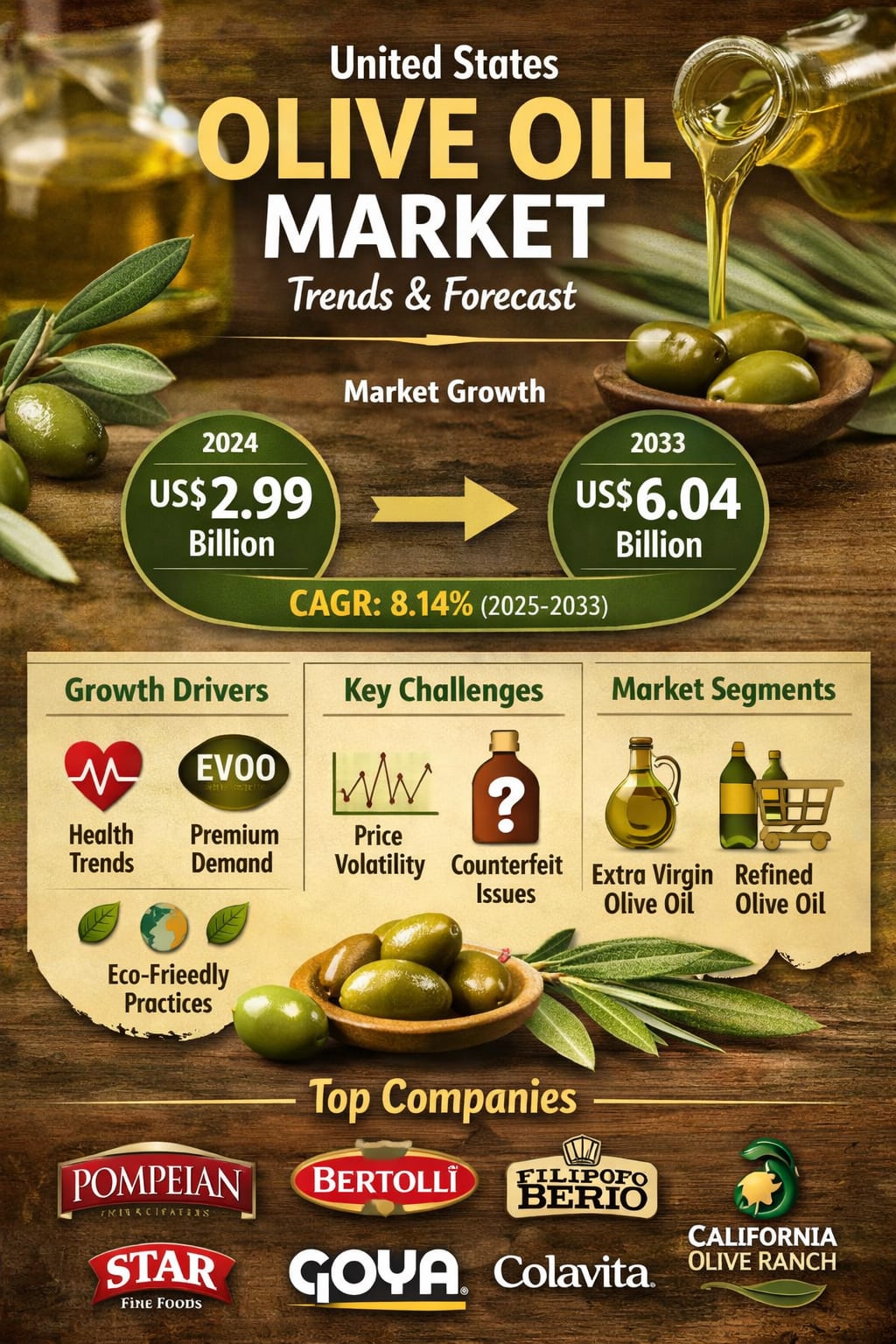
The United States Olive Oil Market is undergoing a remarkable transformation, driven by changing consumer lifestyles, rising health awareness, and an increasing appetite for premium and authentic food products. Valued at US$ 2.99 billion in 2024, the market is projected to expand at a CAGR of 8.14% from 2025 to 2033, reaching an estimated US$ 6.04 billion by 2033. This strong growth trajectory reflects how olive oil has moved from being a niche, specialty ingredient to a mainstream staple in American households, restaurants, and food processing industries.
Traditionally associated with Mediterranean cuisine, olive oil has now found a permanent place in the U.S. culinary landscape. Consumers are increasingly drawn to its nutritional profile, including heart-friendly monounsaturated fats, antioxidant properties, and anti-inflammatory benefits. These qualities align perfectly with the broader shift toward preventive healthcare, clean-label foods, and functional nutrition.
Beyond the kitchen, olive oil is also gaining traction in personal care, cosmetics, and pharmaceutical applications, further widening its commercial relevance. At the same time, advancements in production technology, the rise of eco-friendly farming practices, and innovations in packaging are reshaping how olive oil is produced, marketed, and consumed across the United States.
Market Overview: From Mediterranean Roots to American Staple
Olive oil is a natural oil extracted from olives, primarily cultivated in Mediterranean regions. Globally recognized for both its culinary versatility and health benefits, olive oil has seen steady adoption in the United States over the past few decades. What was once considered a premium import product is now a daily-use cooking oil for millions of American consumers.
In the U.S., olive oil is widely used for sautéing, grilling, baking, and salad dressings, and it is often positioned as a healthier alternative to butter, margarine, and other refined vegetable oils. Its role has expanded beyond food into skincare, haircare, cosmetics, and pharmaceutical formulations, thanks to its moisturizing, nourishing, and therapeutic properties.
As demand for high-quality and organic extra virgin olive oil continues to rise, its usage is growing across households, foodservice establishments, and industrial food processing. This broad-based adoption is a key reason behind the market’s strong growth outlook through 2033.
Key Growth Drivers in the United States Olive Oil Market
1. Growing Health Awareness and Demand for Healthy Cooking Oils
One of the most powerful forces behind the expansion of the U.S. olive oil market is the rising awareness of health and nutrition. American consumers are increasingly shifting away from trans fats, hydrogenated oils, and heavily processed cooking fats in favor of healthier alternatives rich in monounsaturated fats and antioxidants.
Olive oil is widely associated with heart health, reduced inflammation, and better cholesterol management, making it a preferred choice among health-conscious consumers. The popularity of the Mediterranean diet, which emphasizes olive oil as a primary fat source, has further accelerated this trend across diverse demographic groups.
Over the decades, U.S. olive oil consumption has grown dramatically—from around 28,000 metric tons in 1970/71 to over 400,000 metric tons in the 2020s, now accounting for nearly 5% of all vegetable oils consumed as food in the country. For marketing year 2024/25, the United States is expected to be the second-largest consumer of olive oil globally, representing about 13% of worldwide usage over the past decade. This long-term structural shift strongly supports the market’s future growth.
2. Rising Demand for Organic and Premium Olive Oil Varieties
Another major trend reshaping the market is the surge in demand for organic, cold-pressed, and premium extra virgin olive oil (EVOO). Today’s consumers are not only interested in health benefits but also in product authenticity, origin, and production methods.
Premium olive oils, often sourced from specific regions and produced using traditional or sustainable methods, are increasingly valued for their superior flavor, aroma, and nutritional quality. This has encouraged producers and retailers to expand their high-end offerings, particularly in specialty stores, gourmet shops, and online platforms.
In September 2024, Kosterina, a Mediterranean food and beauty company, expanded into more than 600 Target stores nationwide, marking Target’s entry into the premium olive oil category. The launch included Kosterina’s organic Premium Reserve Extra Virgin Olive Oil and Spicy Red Pepper Olive Oil, available both in-store and online. Already present in Whole Foods and Crate & Barrel, the brand has built a reputation for award-winning products, reflecting how premiumization is becoming a defining theme in the U.S. olive oil market.
3. Growth in Foodservice and Culinary Applications
The foodservice sector plays a crucial role in driving olive oil consumption in the United States. Restaurants, hotels, catering services, and fast-casual dining chains increasingly rely on olive oil for a wide range of culinary applications—from salad dressings and marinades to sautéing, grilling, and finishing dishes.
The rising popularity of Mediterranean, Italian, and global cuisines, combined with the demand for healthier menu options, has made olive oil a core ingredient in commercial kitchens. Chefs value its versatility, flavor profile, and perceived health benefits, which align well with evolving consumer preferences.
In September 2024, Corto Olive Co. introduced its limited Harvest 2024 Agrumato-Method Calabrian Chili Olive Oil, designed to elevate seasonal and holiday dishes. Such product innovations highlight how culinary creativity continues to expand olive oil’s role in the U.S. foodservice industry.
Challenges Facing the United States Olive Oil Market
1. Price Volatility and Supply Chain Disruptions
Despite strong demand, the U.S. olive oil market is not without challenges. Global price fluctuations, driven by weather conditions, crop yields, and geopolitical factors in major producing countries such as Spain and Italy, can significantly impact supply and pricing in the U.S.
Extreme weather events, logistics disruptions, tariffs, and trade barriers can all create supply shortages or cost pressures. These uncertainties make it difficult for importers and retailers to maintain stable pricing and inventory levels, occasionally pushing price-sensitive consumers toward alternative cooking oils.
2. Prevalence of Counterfeit and Low-Quality Products
Another persistent issue is the presence of adulterated or misbranded olive oil, often sold as extra virgin despite being blended or of lower quality. This undermines consumer trust and damages the credibility of genuine producers.
The lack of uniform enforcement of quality standards and labeling regulations has made it challenging for consumers to differentiate between authentic and inferior products. As a result, industry stakeholders and regulators are increasingly emphasizing transparency, traceability, and authentication measures to protect product integrity and maintain market confidence.
Segment Analysis: A Market Defined by Diversity
Refined Olive Oil Market
Refined olive oil, processed to remove impurities and improve stability, remains popular among cost-conscious consumers and commercial users. Its mild, neutral taste makes it suitable for frying, baking, and large-scale food processing. As demand for affordable cooking oils continues, refined olive oil maintains a strong position in households and food manufacturing.
Extra Virgin Olive Oil Market
Extra virgin olive oil (EVOO) represents the premium end of the market. Known for its rich flavor, aroma, and superior nutritional profile, EVOO is increasingly favored by health-focused consumers and culinary enthusiasts. Growing interest in organic, cold-pressed, and sustainably sourced products is driving this segment’s expansion across specialty stores, online platforms, and mainstream retailers.
Packaging Trends: Innovation Meets Sustainability
Olive Oil Bottles
Glass bottles—especially dark glass—remain the most popular packaging format, as they protect oil from light and oxidation. Sustainability concerns are also pushing brands toward recyclable and eco-friendly materials, while premium products increasingly use visually appealing designs to enhance shelf presence and brand value.
Olive Oil Pouches and Cans
Flexible pouches and innovative can formats are gaining traction due to their lightweight nature, lower carbon footprint, and improved shelf-life protection. In May 2024, Neolea introduced its extra virgin olive oil in eco-friendly aluminum cans with a “Fresh Cap” designed to preserve quality, freshness, and taste. Such innovations reflect the market’s shift toward sustainability and convenience-driven packaging solutions.
Application Insights: Beyond the Kitchen
Food & Beverage
Olive oil is now widely used in gourmet snacks, sauces, dressings, and specialty foods, and even explored in health-oriented beverage concepts. The rise of functional and clean-label foods has encouraged manufacturers to highlight olive oil as a premium, health-forward ingredient in new product formulations.
Pharmaceuticals
In the pharmaceutical sector, olive oil is valued for its anti-inflammatory and antioxidant properties. It is commonly used as a carrier oil in supplements, topical formulations, dermatological products, and medicinal preparations. As interest in natural and plant-based remedies grows, this application segment is expected to expand further.
Distribution Channels: Retail and Foodservice Lead the Way
The U.S. olive oil market is broadly divided into foodservice and retail channels, with retail further segmented into hypermarkets & supermarkets, convenience stores, online platforms, and others. While supermarkets remain dominant in terms of volume, online retail is gaining momentum due to convenience, wider product selection, and growing consumer interest in premium and imported brands.
Foodservice continues to be a major volume driver, supported by restaurant chains, hotels, and catering services that increasingly prioritize healthier cooking oils.
Regional Outlook: East and North United States
East United States
States such as New York and Florida show strong demand due to diverse culinary influences, including Mediterranean, Italian, and Middle Eastern cuisines. The presence of gourmet stores, organic retailers, and high-end dining establishments supports robust consumption of premium olive oils in this region.
North United States
In northern states like Illinois and Massachusetts, demand is driven by health-conscious consumers and well-developed retail infrastructure. The popularity of organic, farm-to-table, and traceable food products continues to support growth, along with ongoing consumer education about olive oil quality and authenticity.
Competitive Landscape: Key Players Shaping the Market
The U.S. olive oil market features several prominent players, each evaluated across overview, key persons, recent developments, and revenue performance. Major companies include:
Pompeian, Inc.
BERTOLLI
FILIPPO BERIO
Colavita USA, LLC
STAR Fine Foods
Goya Foods, Inc.
California Olive Ranch Inc.
OLIVARI
Olivina, LLC
These companies continue to compete through product innovation, premiumization, sustainable sourcing, and brand positioning to capture a growing and increasingly sophisticated consumer base.
Final Thoughts: A Market Fueled by Health, Quality, and Innovation
The United States olive oil market is clearly on a strong and sustainable growth path, supported by rising health awareness, expanding culinary applications, premium product demand, and innovations in packaging and distribution. With the market expected to grow from US$ 2.99 billion in 2024 to US$ 6.04 billion by 2033 at a CAGR of 8.14%, olive oil is no longer just a specialty import—it is a core component of modern American consumption.
While challenges such as price volatility and product authenticity remain, ongoing efforts toward quality assurance, sustainability, and consumer education are strengthening the market’s long-term outlook. As consumers continue to prioritize wellness, transparency, and taste, olive oil is set to remain one of the most dynamic and valuable segments within the U.S. edible oils and specialty ingredients landscape.
About the Creator
Amazon Share Price Surge: Key Insights Wall Street Won’t Share
The Amazon Share Price has been rising in ways that surprise many investors. While headlines focus on daily gains, the true drivers behind the Amazon Share Price are often overlooked. Understanding these hidden factors can help investors make better decisions and avoid costly mistakes. For further insights, see our article on Top E-Commerce Stocks to Watch in 2026.
By John.doe7987 days ago in Trader
Dow Jones Industrial Average Outlook: Subtle Market Signs Many Investors Miss
Dow Jones Industrial Average trends often reveal the market’s next move long before headlines do. At present, the Dow Jones Industrial Average looks calm, but quiet signs suggest change may be near. Many investors focus on daily price swings and miss these early clues. Learning how to read the Dow Jones Industrial Average can help investors stay prepared and avoid sudden surprises.
By hamza mirza6 days ago in Trader
When True Love Never Questions Your Soul
“And she’s going to learn that this life will hit you, hard, in the face, wait for you to get back up, just so it can kick you in the stomach but getting the wind knocked out of you is the only way to remind your lungs how much they like the taste of air.” — Sarah Kay’s Poem — If I Should Have a Daughter
By Chantal Christie Weiss3 days ago in Humans


Comments
There are no comments for this story
Be the first to respond and start the conversation.