
United States Nicotine Pouches Market Size and Forecast 2025
Smoke-Free, Fast-Growth: How Nicotine Pouches Are Reshaping America’s Nicotine Economy

Introduction: A Market Moving at Breakneck Speed
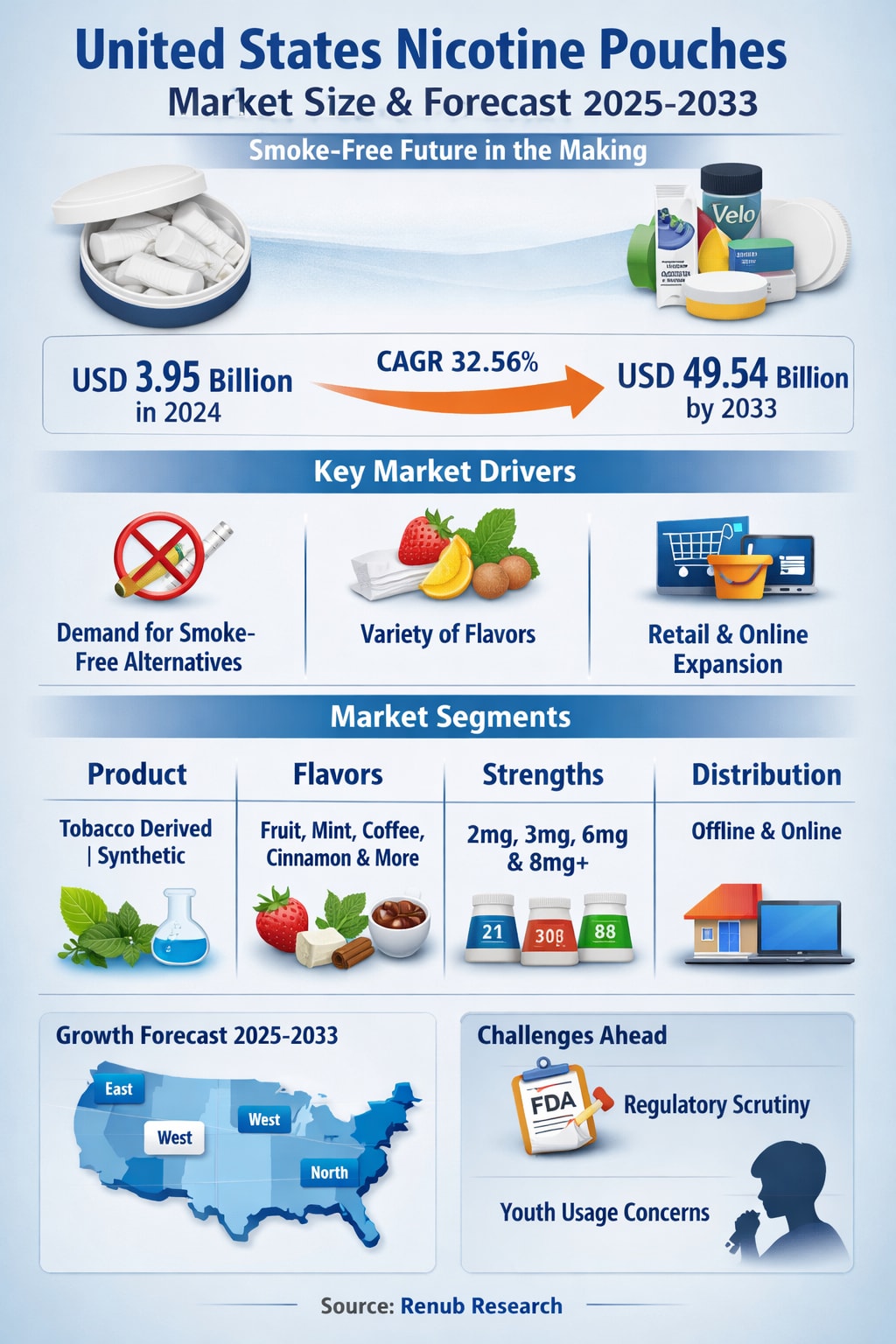
The United States nicotine pouches market is experiencing one of the fastest growth trajectories in the broader consumer health and wellness landscape. Valued at around USD 3.95 billion in 2024, the market is projected to surge to approximately USD 49.54 billion by 2033, expanding at a striking compound annual growth rate (CAGR) of 32.56% between 2025 and 2033.
This explosive growth is not accidental. It reflects a fundamental shift in how American consumers think about nicotine consumption—away from smoke, vapor, and ash, and toward cleaner, more discreet, and socially acceptable alternatives. Nicotine pouches, which are tobacco-free and smokeless, have rapidly carved out a space among adult consumers who want the nicotine experience without the stigma and health risks associated with combustible cigarettes.
Adding further momentum to this transformation is innovation in synthetic nicotine products, with major players introducing next-generation offerings such as British American Tobacco’s Velo Plus. Combined with changing regulations, rising health awareness, and evolving retail strategies, nicotine pouches are no longer a niche category—they are becoming a mainstream nicotine delivery format in the U.S.
United States Nicotine Pouches Market Overview
Nicotine pouches are tobacco-free, smokeless oral products designed to deliver nicotine in a discreet and convenient manner. These small, pre-portioned pouches contain either synthetic or tobacco-derived nicotine, flavorings, and plant-based fibers. Users simply place the pouch between the upper lip and gum, allowing nicotine to be absorbed through the oral mucosa—no smoke, no vapor, and no spitting required.
In the United States, nicotine pouches have gained popularity as a smoke-free alternative to cigarettes, cigars, vaping devices, and traditional chewing tobacco. Their appeal lies in several key advantages: they are odorless, easy to use, socially discreet, and permitted in many places where smoking or vaping is restricted.
For adult consumers who are increasingly concerned about lung health, secondhand smoke, and social inconvenience, nicotine pouches offer a compelling harm-reduction pathway. As a result, the market is expanding at a remarkable pace, supported by wider flavor selections, varied nicotine strengths, and aggressive retail expansion across both physical and digital channels.
Growth Drivers in the United States Nicotine Pouches Market
1. Increasing Demand for Smoke-Free Options
One of the strongest growth engines behind the U.S. nicotine pouches market is the rising demand for smoke-free and vapor-free alternatives. Growing public awareness around the health risks of smoking and concerns over vaping-related issues have encouraged many consumers to seek cleaner nicotine delivery methods.
Nicotine pouches fit neatly into this shift. They eliminate combustion entirely, reduce exposure to harmful byproducts, and offer a discreet experience that aligns with modern workplace and public-space restrictions. With stricter smoking bans and expanding smoke-free zones, these products are increasingly seen as a practical, harm-reduction alternative for adult users.
This broader industry transition is also visible in major corporate strategies. In November 2024, Philip Morris International marked the 10th anniversary of its smoke-free product IQOS, reinforcing the industry’s long-term pivot away from traditional cigarettes and toward alternative nicotine technologies.
2. Broadening Product Range and Flavors
Product innovation is another major catalyst for market growth. Today’s nicotine pouch market offers a wide spectrum of flavors—from mint and citrus to coffee, berry, cinnamon, and unflavored options—along with multiple nicotine strengths tailored to different user preferences.
This diversity plays a crucial role in attracting both former smokers and new adult users who want a more enjoyable, customizable experience. Flavor variety not only enhances trial and adoption but also builds brand loyalty and encourages repeat purchases.
A notable example of this trend came in September 2023, when Premier Manufacturing Inc. partnered with Enorama Pharma Inc. to launch NIC-S tobacco-free nicotine pouches in the U.S. The products were introduced in unflavored and flavored variants such as mint, berry, orange, cinnamon, and wintergreen, available in 3 mg, 6 mg, and 9 mg strengths—highlighting how manufacturers are targeting multiple consumer segments simultaneously.
3. Greater Availability via Online and Retail Sales
Accessibility has become a critical growth lever for the nicotine pouches market. Products are now widely available across convenience stores, gas stations, supermarkets, and specialty retailers, while many brands also operate direct-to-consumer e-commerce platforms offering subscriptions, discounts, and bundled deals.
This omnichannel approach has significantly expanded market reach. Physical retail drives impulse purchases and brand discovery, while online channels provide convenience, variety, and recurring sales opportunities.
In September 2024, media personality Tucker Carlson announced the launch of a new nicotine pouch brand, Alp, scheduled for November 2024. The brand plans to offer four distinctive flavors and three strengths—one reportedly 33% stronger than ZYN’s strongest offering—underscoring how competition and innovation are intensifying in this fast-moving market.
Nicotine Pouches Market Challenges in the United States
Regulatory Uncertainty and FDA Scrutiny
Despite its rapid growth, the U.S. nicotine pouches market faces significant regulatory uncertainty. The U.S. Food and Drug Administration (FDA) continues to evaluate the long-term health implications of these products, particularly around addiction potential and population-level impact.
While nicotine pouches are often positioned as reduced-risk alternatives, concerns about marketing practices, product claims, and consumer safety could lead to stricter regulations, flavor restrictions, or advertising limitations in the future. This uncertainty creates strategic challenges for manufacturers, who must balance innovation and growth with compliance and responsible marketing.
Increasing Worries Over Youth Adoption
Another major concern is the potential appeal of flavored nicotine pouches to underage users. Although these products are intended for adult consumers, public health advocates worry that fruit and candy-like flavors could attract younger audiences.
This issue has already prompted calls for stricter age verification, marketing controls, and possible flavor bans. Addressing these concerns will be essential for ensuring the long-term sustainability and social acceptance of the category.
Segment Insights: Where the Growth Is Coming From
United States Tobacco-Derived Nicotine Pouches Market
Tobacco-derived nicotine pouches use nicotine extracted from tobacco leaves but contain no actual tobacco material. These products appeal to consumers who prefer nicotine sourced from traditional origins while avoiding smoking or chewing tobacco.
This segment continues to grow as more smokers transition to smokeless formats. According to CDC data released in September 2024, nearly 2.9% of American adults reported using nicotine pouches—supporting the strong upward trend in this category.
United States Flavored Nicotine Pouches Market
Flavored nicotine pouches dominate the market, thanks to their enhanced taste experience and personalization options. Popular flavors include mint, citrus, coffee, and berry, all of which help mask nicotine’s natural bitterness and improve user satisfaction.
As of July 2024, CDC figures showed that around 67.7% of U.S. adults were interested in quitting smoking, with about half attempting to do so within the past year. This growing health awareness is pushing many consumers toward smoke-free alternatives, including flavored nicotine pouches.
United States Fruit Nicotine Pouches Market
Fruit flavors such as mango, berry, and citrus are among the top-selling variants in the U.S. market. Their refreshing profiles make them especially appealing to younger adult consumers and those new to nicotine pouches, supporting continued growth in this segment.
United States Coffee Nicotine Pouches Market
Coffee-flavored nicotine pouches cater to consumers who enjoy rich, bold coffee notes combined with a nicotine boost. These products resonate strongly with working professionals and coffee enthusiasts, making this a steadily expanding niche within the broader market.
United States Normal (3 mg/pouch) Nicotine Pouches Market
The 3 mg/pouch segment is particularly popular among casual and moderate users. It offers a balanced nicotine experience and is often positioned as a default, everyday option by leading brands.
In August 2022, ZYN (Swedish Match AB) expanded its portfolio with tobacco-flavored nicotine pouches in 3 mg and 6 mg strengths, along with several 3 mg flavors such as cool mint, citrus, original, apple mint, and sweet tobacco—highlighting the importance of this mid-strength segment.
United States Offline Nicotine Pouches Market
Offline retail remains a crucial distribution channel, driven by convenience stores, gas stations, and supermarkets. Many consumers prefer in-store purchases for immediate availability and the ability to explore different brands and flavors.
In August 2022, Haypp Group launched a new warehouse in Missouri City, Texas, to strengthen nicotine pouch distribution across the southern United States—demonstrating ongoing investment in physical supply chains.
Regional Outlook
East United States
The East Coast, including major cities like New York, Boston, and Washington, D.C., shows strong demand driven by urban lifestyles, strict smoking regulations, and high retail density. Convenience and accessibility are key factors fueling adoption here.
West United States
The Western U.S., particularly California and Washington, benefits from a strong health and wellness culture. Consumers in this region are more inclined to switch to smokeless alternatives, and high e-commerce adoption further supports market growth.
North United States
In northern states such as Illinois, Minnesota, and Michigan, cold weather conditions often limit outdoor smoking, making nicotine pouches a practical indoor alternative. This supports consistent demand throughout the year.
Market Segmentation Overview
By Product:
Tobacco Derived
Synthetic
By Flavor:
Original / Unflavored
Flavored
Fruit
Mint
Coffee
Cinnamon
Others (Cool Cider, Licorice, etc.)
By Strength:
Light (2 mg/pouch)
Normal (3 mg/pouch)
Strong (4–6 mg/pouch)
Extra Strong (More than 8 mg/pouch)
By Distribution Channel:
Offline
Online
By Region:
East
West
North
South
Company Analysis
Key players covered from four perspectives—Overview, Key Persons, Recent Developments, and Revenue—include:
Velo (British American Tobacco p.l.c)
On! (Altria Group, Inc.)
ZYN (Swedish Match AB)
ZONE (Imperial Brands plc)
Swisher (Rogue Holdings, LLC)
FRE POUCH
Black Buffalo
Sesh Products
Cotton Mouth Nicotine
JUICE HEAD
Final Thoughts
The United States nicotine pouches market is no longer just an emerging category—it is becoming a core pillar of the modern nicotine industry. With a projected rise from USD 3.95 billion in 2024 to USD 49.54 billion by 2033, the sector’s 32.56% CAGR reflects a profound shift in consumer behavior, product innovation, and regulatory dynamics.
Driven by health awareness, demand for smoke-free alternatives, expanding flavor portfolios, and stronger retail penetration, nicotine pouches are poised to reshape how Americans consume nicotine. While regulatory and social challenges remain, the market’s momentum suggests that nicotine pouches will play a central role in the future of harm-reduction and alternative nicotine products in the United States.
About the Creator
Europe Vitamin Fortified and Mineral Enriched Food & Beverage Market Size and Forecast 2025–2033
Europe’s Fortified Foods Boom: A Market Built on Health, Science, and Smart Consumption The Europe Vitamin Fortified and Mineral Enriched Food & Beverage Market is entering a decisive growth phase, driven by a powerful combination of health awareness, demographic change, and evolving consumer expectations. According to Renub Research, the market was valued at USD 22.8 billion in 2024 and is projected to reach USD 31.11 billion by 2033, expanding at a compound annual growth rate (CAGR) of 3.52% during the forecast period 2025–2033.
By Sakshi Sharma6 days ago in Trader
Radiofrequency Ablation Device Market Size and Forecast 2025
Introduction: A Market Heating Up with Innovation The global healthcare industry is in the middle of a major transformation, driven by the demand for safer, faster, and more cost-effective treatments. Among the technologies benefiting from this shift is radiofrequency ablation (RFA)—a minimally invasive technique that uses heat generated by radiofrequency energy to destroy abnormal tissue. From treating cardiac arrhythmias and tumors to managing chronic pain, RFA has become an essential tool in modern medicine.
By Sakshi Sharmaabout 20 hours ago in Trader
The Angry Man in Your House
"If you grow up with an angry man in your house, there will always be an angry man in your house" This statement has caused plenty of controversy online, people say its a statement that blames victims while also undermining those who break traumatic cycles to form health relationships... but if I'm honest now that I'm in my 30s it makes more sense to me than ever, and I'd argue that its not just about fathers and uncles.
By S. A. Crawford5 days ago in Humans




Comments
There are no comments for this story
Be the first to respond and start the conversation.