
Japan Watch Market Size and Forecast 2025
How Heritage Craftsmanship and Smart Technology Are Reshaping Japan’s Timepiece Industry

Introduction: A Market Where Tradition Meets Technology
Japan’s watch market stands at a fascinating crossroads of tradition and innovation. Known worldwide for its obsession with precision, craftsmanship, and cutting-edge engineering, Japan has built one of the most respected watch industries on the planet. From legendary names like Seiko, Citizen, and Casio to the strong presence of Swiss luxury houses and global smartwatch brands, the country’s timepiece market reflects both heritage and modern lifestyle trends.
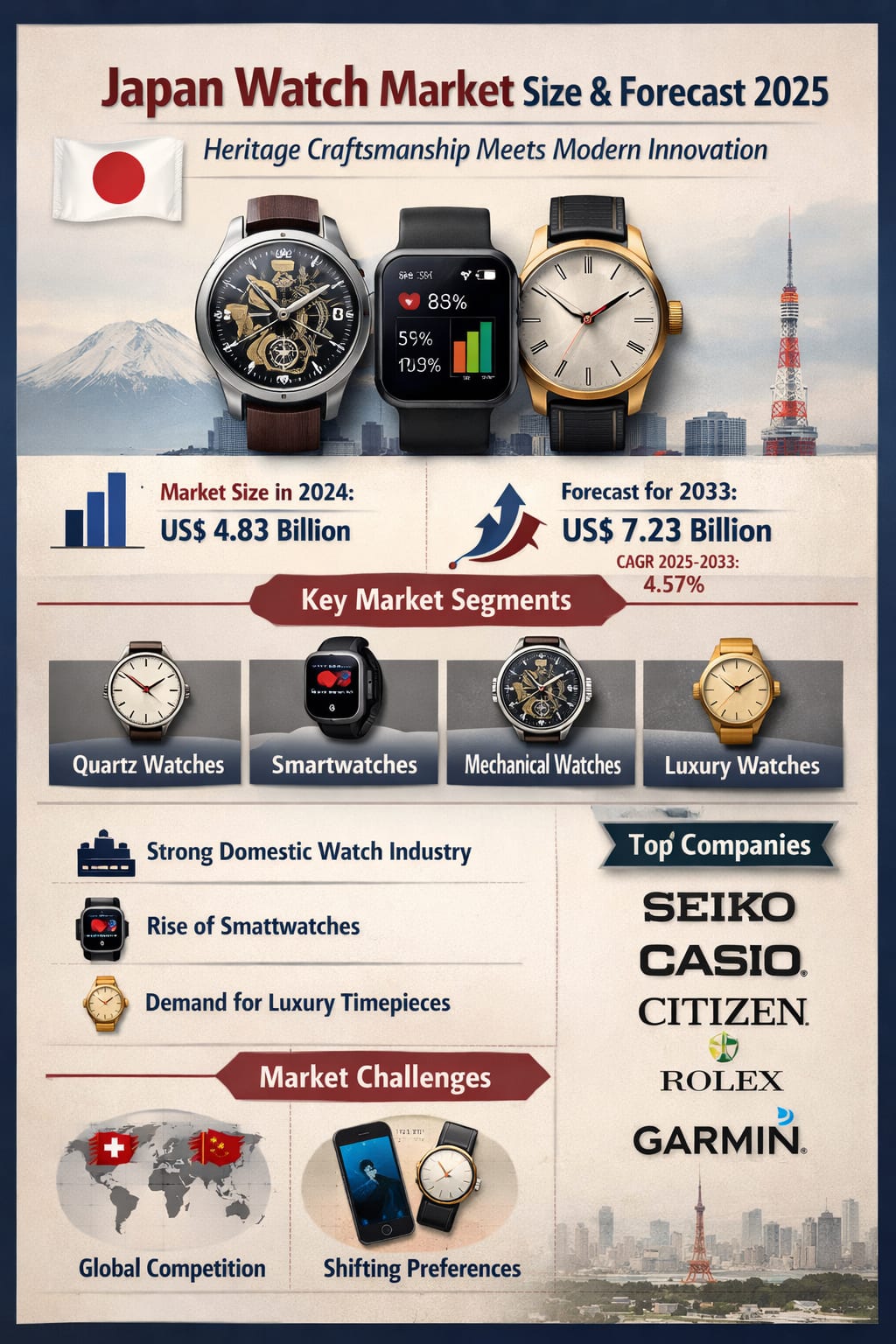
In 2024, the Japan watch market was valued at US$ 4.83 billion. Looking ahead, the market is projected to reach US$ 7.23 billion by 2033, growing at a compound annual growth rate (CAGR) of 4.57% from 2025 to 2033. This steady expansion is being fueled by multiple factors: a strong domestic manufacturing base, rising demand for luxury and collectible watches, and the rapid adoption of smartwatches among tech-savvy consumers.
Japan is not just a consumer market—it is also a global innovation hub for watchmaking. Whether it is high-end mechanical craftsmanship, ultra-precise quartz movements, or feature-rich smartwatches, Japanese brands continue to shape global trends. At the same time, changing consumer preferences, digital retail channels, and global competition are transforming how watches are designed, marketed, and sold in the country.
Japan Watch Market Overview
A watch is more than just a device that tells time. It is a personal accessory, a fashion statement, a status symbol, and increasingly, a health and lifestyle companion. Watches today range from traditional mechanical timepieces to quartz models and advanced electronic smartwatches that track fitness, monitor health, and connect seamlessly with smartphones.
Japan has a unique relationship with watches. The country is home to some of the world’s most respected watch brands, including Seiko, Citizen, and Casio, which are known globally for their reliability, innovation, and value for money. Mechanical watches are highly admired by collectors and enthusiasts who appreciate craftsmanship and heritage. Quartz watches dominate the mass market because of their accuracy, affordability, and low maintenance. Meanwhile, smartwatches from brands such as Apple, Garmin, and Google (Fitbit), alongside offerings from Japanese players, are gaining strong traction among younger and health-conscious consumers.
Japanese consumers view watches not only as functional tools but also as expressions of identity, taste, and lifestyle. This makes the market highly diverse and competitive, with products ranging from affordable everyday watches to ultra-premium luxury timepieces.
Market Size and Forecast: A Decade of Steady Growth
According to Renub Research estimates provided, Japan’s watch market was valued at US$ 4.83 billion in 2024 and is forecast to reach US$ 7.23 billion by 2033, registering a CAGR of 4.57% during the 2025–2033 period.
This growth is not driven by a single segment. Instead, it reflects a balanced expansion across luxury watches, mass-market quartz models, and electronic smartwatches. While traditional watches continue to hold cultural and emotional value, smart and connected devices are bringing new consumers into the market and increasing replacement cycles.
The long-term outlook remains positive, supported by Japan’s strong retail infrastructure, high purchasing power, and a consumer base that appreciates both quality and innovation.
Key Growth Drivers in the Japan Watch Market
1. Robust Domestic Watchmaking Industry
Japan’s domestic watch industry is one of the strongest in the world. Brands like Seiko, Citizen, and Casio have built global reputations for precision engineering, durability, and technological innovation. These companies invest heavily in research and development, continuously improving everything from mechanical movements to solar-powered quartz and hybrid smartwatches.
Japanese watchmakers are also known for offering excellent value across price segments. From affordable everyday watches to premium mechanical timepieces, domestic brands cater to a wide spectrum of consumers. This strong industrial base ensures a constant flow of innovation and keeps Japan at the forefront of global watchmaking.
In 2023, domestic sales of Japanese brands accounted for millions of units, while imports also remained strong, highlighting Japan’s role as both a producer and a major consumer market for watches.
2. Growing Popularity of Smartwatches
Smartwatches are one of the fastest-growing segments in Japan’s watch market. Consumers are increasingly interested in fitness tracking, health monitoring, and seamless connectivity with their smartphones. Brands like Apple, Garmin, and Google (Fitbit), along with Japanese players such as Casio and Sony, are launching feature-rich models that appeal to both tech enthusiasts and everyday users.
Rising health awareness is a major factor behind this trend. Features like heart rate monitoring, sleep tracking, step counting, and GPS tracking have turned smartwatches into essential lifestyle devices rather than optional accessories. Japan’s highly digital and tech-savvy population, combined with strong e-commerce infrastructure, further accelerates the adoption of smartwatches.
3. Rising Demand for Luxury and Collectible Watches
Luxury watches hold a special place in Japan’s consumer culture. Swiss brands like Rolex, Omega, and Audemars Piguet are extremely popular among high-end buyers and collectors. At the same time, Japanese luxury brands such as Grand Seiko and Credor are gaining global recognition for their exceptional craftsmanship and attention to detail.
Collectors in Japan value limited editions, heritage models, and timepieces that combine technical excellence with artistic design. The growing pre-owned luxury watch market, supported by both online platforms and specialized boutiques, is also expanding access to high-end watches and increasing overall market activity.
Key Challenges in the Japan Watch Market
1. Intense Global Competition
Despite its strong domestic industry, Japan faces stiff competition from both Swiss luxury brands and low-cost manufacturers from other countries. Swiss brands dominate the premium segment, while more affordable imports compete aggressively in the lower price ranges. This puts pressure on Japanese brands to continuously innovate, differentiate, and maintain competitive pricing.
2. Digital Disruption and Changing Consumer Preferences
Younger consumers are increasingly relying on smartphones and smartwatches instead of traditional watches. This shift has reduced demand for conventional mechanical and quartz watches in some segments. At the same time, the rise of online shopping has changed how consumers discover and purchase watches, forcing brands to invest more in digital marketing and direct-to-consumer strategies.
Segment Analysis
Japan Electronic Watch Market
The electronic watch segment, especially smartwatches, is growing rapidly in Japan. These devices offer a wide range of features, including fitness tracking, health monitoring, navigation, and smartphone integration. With continuous technological improvements and growing consumer interest in wearable technology, electronic watches are expected to remain a key growth engine for the market.
Japan Mechanical Watch Market
Mechanical watches continue to enjoy strong demand among collectors and enthusiasts. Brands like Grand Seiko, along with Swiss luxury houses, attract consumers who view mechanical watches as long-term investments and symbols of craftsmanship. Limited editions and handcrafted models further enhance the appeal of this segment.
Japan Quartz Watches Market
Quartz watches dominate the mass market in Japan due to their affordability, accuracy, and low maintenance. Seiko, Citizen, and Casio remain leaders in this segment, offering a wide variety of designs for everyday use. Innovations such as solar-powered quartz watches continue to keep this segment relevant despite competition from smartwatches.
Market by Gender
Men’s Watches: The men’s segment includes everything from luxury mechanical watches to rugged sports watches and advanced smartwatches. Business professionals, sports enthusiasts, and tech-savvy consumers all contribute to strong demand.
Women’s Watches: Women’s watches increasingly blend fashion with functionality, with growing interest in both stylish analog watches and compact smartwatches.
Unisex Watches: Minimalist designs and smartwatches have boosted the popularity of unisex models, especially among younger consumers.
Market by Price Range
Luxury Watches: Driven by collectors and high-income consumers, this segment includes both Swiss and premium Japanese brands. The resale and pre-owned markets are also expanding.
Non-Luxury Watches: This segment accounts for the bulk of volume sales, supported by affordable quartz and electronic watches for everyday use.
Market by Distribution Channel
Hypermarkets and Supermarkets: These outlets mainly sell affordable and mid-range watches to mass consumers.
Convenience Stores: Popular for basic, low-cost watches, especially among students, tourists, and impulse buyers.
Online Channels: E-commerce platforms such as Amazon Japan, Rakuten, and Yahoo! Shopping are playing an increasingly important role, offering wide selections, competitive pricing, and customer reviews that influence purchasing decisions.
Competitive Landscape and Key Players
The Japan watch market is highly competitive, with both domestic and international players. Key companies covered from multiple perspectives—overview, leadership, recent developments, and revenue—include:
Seiko Holdings Corporation
Casio Computer Co. Ltd
Citizen Watch Co. Ltd
Rolex SA
The Swatch Group Ltd
Compagnie Financière Richemont S.A
Fossil Group Inc.
Timex Group
Google LLC (Fitbit Inc.)
These companies compete across different segments, from affordable everyday watches to premium luxury timepieces and advanced smartwatches.
Final Thoughts: A Market Poised for Balanced, Sustainable Growth
The Japan watch market is entering a new phase of evolution. With a projected rise from US$ 4.83 billion in 2024 to US$ 7.23 billion by 2033, the industry is set for steady and healthy growth. What makes Japan unique is its ability to balance deep-rooted craftsmanship with cutting-edge technology.
Traditional mechanical and quartz watches will continue to hold cultural and emotional value, especially among collectors and enthusiasts. At the same time, smartwatches and electronic wearables will drive future growth by attracting younger, health-conscious, and tech-oriented consumers.
For brands, the challenge will be to stay relevant in a rapidly changing digital landscape while preserving the values of quality, precision, and design that define Japanese watchmaking. Those that succeed in blending heritage with innovation will be best positioned to thrive in Japan’s dynamic and competitive watch market over the next decade.
About the Creator
Having A House Is Pointless If You Don't Have Any Savings
A house is a luxury, and you do not need luxuries to experience success and fulfillment. Homeownership is often treated as proof that someone has “made it,” but that belief ignores context, timing, and individual financial reality. Success is not defined by what you own, but by how stable, flexible, and prepared you are for the future. For many people, chasing a house too early can actually delay real financial progress.
By Destiny S. Harris4 days ago in Trader
The Future of Gold: Why This Ancient Metal Still Rules the Modern World
Gold has fascinated humanity for thousands of years. From ancient Egyptian tombs to modern financial markets, this glowing metal has never lost its symbolic and economic power. While the world has changed dramatically — cryptocurrencies have emerged, economies have gone digital, and global finance is evolving faster than ever — gold continues to hold a unique place.
By Ghalib Khan4 days ago in Trader


Comments
There are no comments for this story
Be the first to respond and start the conversation.