
United States Defense Market Trends & Summary (2025–2033)
Modernization, Geopolitics, and Advanced Technologies Reshape America’s Defense Industry

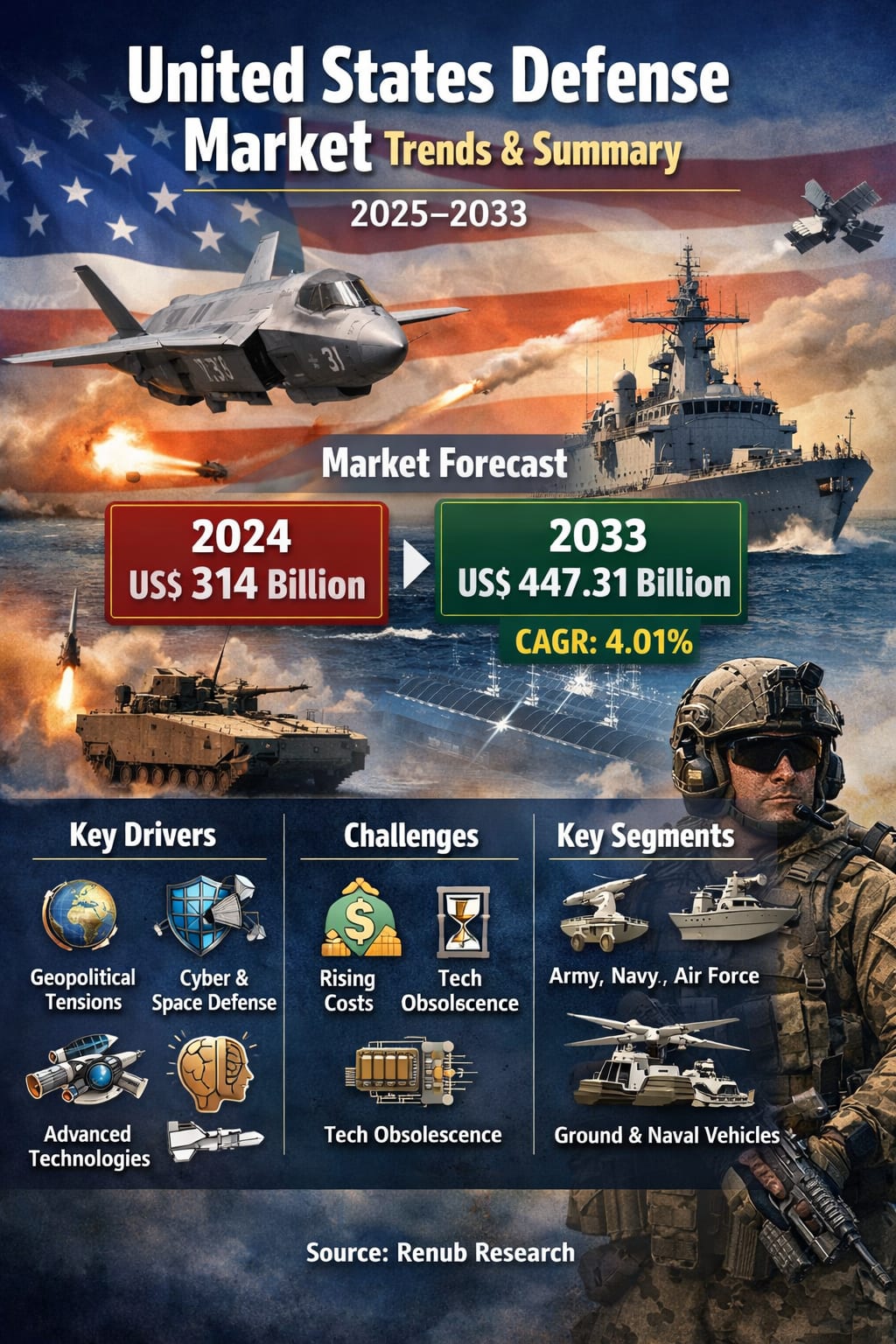
United States Defense Market Overview
The United States defense market continues to stand as one of the most influential and technologically advanced defense ecosystems in the world. Backed by the largest military budget globally and driven by a complex mix of geopolitical strategy, technological innovation, and national security priorities, the sector plays a defining role in shaping both domestic industrial capacity and global defense dynamics.
According to Renub Research, the United States Defense Market is expected to grow from US$ 314 billion in 2024 to US$ 447.31 billion by 2033, expanding at a CAGR of 4.01% from 2025 to 2033. This steady and resilient growth trajectory reflects ongoing military modernization programs, rising procurement of advanced platforms, and sustained investment in next-generation defense technologies.
The U.S. defense industry covers a wide spectrum of activities, including the design, development, manufacturing, integration, and maintenance of military hardware, software, and strategic systems. From fixed-wing combat aircraft and naval vessels to C4ISR networks, unmanned systems, and cyber defense solutions, the industry supports nearly every dimension of modern warfare. The scale of operations is immense, supported by a nationwide network of defense contractors, subcontractors, research institutions, and highly skilled labor.
At the heart of this ecosystem lies a close collaboration between the U.S. government—particularly the Department of Defense—and major private defense firms such as Lockheed Martin, Boeing, Northrop Grumman, RTX (Raytheon Technologies), General Dynamics, and L3Harris Technologies. These companies not only supply equipment to the U.S. armed forces but also drive innovation in areas such as aerospace engineering, artificial intelligence, space systems, and cybersecurity.
Beyond its military role, the defense sector is also a powerful engine of technological progress. Many civilian technologies—from GPS and advanced materials to cybersecurity frameworks—trace their roots back to defense research programs. As global security challenges evolve, the U.S. defense market is increasingly focused on maintaining technological superiority while ensuring operational readiness across all domains: land, sea, air, space, and cyberspace.
United States Defense Industry in a Changing Global Landscape
The United States maintains a significant international military presence, supported by alliances, overseas bases, and strategic partnerships across Europe, Asia-Pacific, and the Middle East. This global footprint requires continuous investment in both existing platforms and new capabilities.
In recent years, rising geopolitical tensions—particularly involving China, Russia, and North Korea—have reinforced the urgency of military preparedness. The U.S. Air Force and Navy, in particular, operate large and diverse fleets of aircraft and naval assets that require constant upgrades to remain effective against emerging threats. Concerns over stability in regions such as the South China Sea and the broader Indo-Pacific have further accelerated procurement and modernization efforts.
As a result, the U.S. has committed substantial resources to upgrading legacy systems and acquiring new platforms equipped with advanced sensors, stealth capabilities, network-centric warfare features, and enhanced survivability. This includes investments in next-generation fighter aircraft, missile defense systems, naval vessels, and space-based assets.
At the same time, the defense sector faces structural challenges. The COVID-19 pandemic exposed vulnerabilities in global supply chains, disrupting production schedules and logistics networks. Many defense programs depend on complex, international supply chains, making them sensitive to geopolitical, economic, and health-related disruptions. In parallel, the increasing digitization of defense systems has expanded the attack surface for cyber threats, making cybersecurity a top strategic priority.
For instance, U.S. federal institutions reportedly faced tens of thousands of cybersecurity attacks in a single year, underlining the scale and persistence of digital threats. Protecting sensitive defense data, critical infrastructure, and operational networks has therefore become just as important as safeguarding physical assets.
Key Growth Drivers of the United States Defense Market
1. Geopolitical Tensions and National Security Priorities
One of the most powerful drivers of growth in the U.S. defense market is the evolving global security environment. Rising strategic competition, regional conflicts, and the emergence of new forms of warfare have compelled the United States to continuously reassess and strengthen its military posture.
Threats are no longer limited to conventional battlefields. Cyber warfare, space-based competition, electronic warfare, and hybrid conflict models now play a central role in defense planning. To address these challenges, the U.S. is investing heavily in advanced weapons systems, intelligence and surveillance platforms, missile defense, and integrated command-and-control networks.
Maintaining military dominance and protecting national interests require a force that is not only powerful but also flexible and technologically superior. This strategic imperative is translating into sustained demand for new equipment, system upgrades, and cutting-edge defense solutions—directly supporting long-term market growth.
2. Strong Defense Budget and Government Spending
The United States consistently allocates the largest defense budget in the world, and this financial commitment is a cornerstone of the industry’s stability and expansion. Government spending supports everything from basic research and prototype development to large-scale production and long-term maintenance contracts.
A significant portion of the defense budget is dedicated to research and development (R&D), enabling the creation of next-generation technologies such as autonomous systems, artificial intelligence-driven analytics, advanced radar and sensor platforms, and resilient communication networks. At the same time, funding is also directed toward maintaining and upgrading existing fleets of aircraft, ships, and ground vehicles.
This dual focus—modernizing legacy systems while investing in future capabilities—ensures a continuous pipeline of projects for defense contractors and technology providers. It also helps the U.S. armed forces remain prepared for both current and emerging threats, reinforcing the strategic importance of consistent defense spending.
3. Cybersecurity and Space Defense as Strategic Priorities
Cybersecurity and space defense have rapidly become central pillars of U.S. national security strategy. Modern military operations rely heavily on digital networks, satellite communications, and data-driven decision-making systems. While this connectivity enhances operational effectiveness, it also introduces new vulnerabilities.
To counter growing cyber threats, the U.S. is investing in advanced cyber defense architectures, threat detection systems, and resilient network infrastructures designed to protect both military and civilian critical assets. Cyber defense is no longer a support function—it is a core operational domain.
Similarly, space has emerged as a contested and strategically vital domain. Satellites play a crucial role in navigation, communication, intelligence, surveillance, and reconnaissance. Protecting these assets and ensuring space superiority have become top priorities. This has led to increased spending on satellite defense systems, space situational awareness, and counter-space capabilities, further expanding the scope of the U.S. defense market.
Challenges Facing the United States Defense Market
1. Rising Costs and Budgetary Pressures
Despite the scale of U.S. defense spending, the industry faces growing financial pressures. The cost of developing, acquiring, and maintaining advanced military systems continues to rise. Sophisticated technologies such as AI-enabled platforms, autonomous systems, and cyber defense tools require substantial investment in both development and integration.
In addition, maintaining and modernizing aging fleets of aircraft, ships, and ground vehicles adds to long-term operational costs. Personnel expenses, training, and lifecycle maintenance further strain budgets. While overall defense spending remains high, these rising costs can limit flexibility and force difficult trade-offs between new programs and existing commitments.
Effective cost management and efficient allocation of resources will therefore be critical to sustaining growth without compromising readiness or strategic priorities.
2. Technological Obsolescence and the Pace of Innovation
The rapid pace of technological change presents another major challenge. Defense systems that are cutting-edge today can become outdated within a relatively short time. To maintain a technological edge, the U.S. military and its industry partners must continuously invest in innovation and upgrades.
Integrating new technologies into existing platforms is often complex, time-consuming, and expensive. There is also the risk of adopting technologies before they are fully mature, potentially leading to cost overruns or performance issues. Balancing innovation with reliability and operational readiness is an ongoing strategic and managerial challenge for the defense sector.
Regional Outlook of the United States Defense Market
Northeast United States Defense Market
The Northeastern region plays a critical role in the U.S. defense ecosystem due to its concentration of government institutions, military facilities, and leading defense contractors. States such as Virginia, Maryland, and New Jersey host key defense hubs, research centers, and corporate headquarters involved in aerospace, cybersecurity, and advanced defense technologies.
The presence of the Pentagon and numerous federal agencies in this region creates strong and consistent demand for defense-related services, from R&D to systems integration and manufacturing. The Northeast also benefits from a highly skilled workforce and well-established infrastructure, making it a magnet for innovation in areas such as cyber defense, artificial intelligence, and unmanned systems.
Midwest United States Defense Market
The Midwest is one of the most important regions for defense manufacturing and industrial production. States including Ohio, Michigan, Illinois, and Indiana are home to major defense companies, military installations, and advanced manufacturing facilities.
The region’s strong industrial base supports the production of military vehicles, aircraft components, naval systems, and other critical defense equipment. Companies such as General Dynamics, Northrop Grumman, and Boeing have a significant presence here, leveraging the Midwest’s expertise in aerospace, automotive engineering, and advanced manufacturing.
With growing emphasis on robotics, autonomous systems, and cybersecurity, the Midwest continues to strengthen its role as a backbone of U.S. defense production and innovation.
United States Defense Market Segmentation
By Armed Force (3 Viewpoints)
Army
Navy
Air Force
Each branch has distinct operational requirements, driving demand for specialized equipment, platforms, and support systems. From ground vehicles and weapons systems for the Army to advanced aircraft and space-related assets for the Air Force, and naval vessels and maritime defense systems for the Navy, this segmentation highlights the breadth of the U.S. defense market.
By Type (8 Viewpoints)
Fixed-wing Aircraft
Rotorcraft
Ground Vehicles
Naval Vessels
C4ISR
Weapons and Ammunition
Protection and Training Equipment
Unmanned Systems
This diverse product mix reflects the multi-domain nature of modern warfare, where success depends on integrated capabilities across air, land, sea, space, and cyberspace.
By Region (4 Viewpoints)
Northeast
Midwest
West
South
Each region contributes uniquely to the defense ecosystem, from R&D and headquarters functions to large-scale manufacturing and operational support.
Competitive Landscape and Company Analysis
The U.S. defense market is dominated by a group of powerful and highly specialized companies that operate across multiple segments. The report covers key players from four viewpoints: Overview, Key Persons, Recent Developments, and Revenue.
Major companies include:
Lockheed Martin Corporation
The Boeing Company
RTX Corporation (Raytheon Technologies)
General Dynamics Corporation
Northrop Grumman Corporation
L3Harris Technologies Inc.
CACI International Inc.
Textron Inc.
These companies play a central role in shaping the industry’s technological direction, supplying everything from combat aircraft and missile systems to advanced electronics, communication networks, and training solutions.
Final Thoughts
The United States Defense Market is entering a period of sustained and strategically driven growth. With the market projected to rise from US$ 314 billion in 2024 to US$ 447.31 billion by 2033, the industry’s expansion reflects not only higher spending but also a fundamental transformation in how defense capabilities are developed and deployed.
Geopolitical tensions, rapid technological change, and the growing importance of cyber and space domains are reshaping priorities across the U.S. defense ecosystem. While challenges such as rising costs, supply chain vulnerabilities, and technological obsolescence remain, the sector’s strong institutional support and innovation capacity provide a solid foundation for long-term growth.
About the Creator
MDFEX Market Insight: Silver Market
The global silver market has entered a period of extraordinary volatility, creating both challenges and opportunities for traders around the world. Over the past several months, price movements in silver have become increasingly unpredictable, driven by a complex mix of macroeconomic uncertainty, shifting investor sentiment, and evolving supply-demand dynamics. At MDFEX, we believe it is essential for traders to understand the underlying forces shaping today’s market in order to make more informed and strategic decisions.
By CyberMacro7 days ago in Trader
The Salt in her Voice
The myth says mermaids sing to lure sailors to their death. But why? The ocean is huge. Only 5 percent has been discovered by man. Why would a creature of the sea with that much space to roam ever care about the fate of men on ships? The answer, as it turns out, is not a simple one at all. The truth about the myth is older than the tides. Long ago before the first ship ever cut across the surface, the sea made a pact with the sky. The sky would take the souls of the drowned. Anyone who died in storms or any quiet accidents of the deep would have their soul lifted upward to the Heavens while the bodies would remain below, feeding the oceans endless hunger. The greedy sea however wanted more souls than the sky would claim. So it created mermaids. It gave them beautiful voices woven from currents and moonlight. It commanded them to sing. "Bring forth the ones who float where they should sink." it instructed them. So they did. They never killed out of malice but out of obligation. They sung to summon, not to seduce. A mermaid's voice could loosen the tether between the body and soul, making any man step willingly into the water. The sea would take the body and the sky would take the soul. Balance maintained.
By Sara Wilson6 days ago in Fiction



Comments
There are no comments for this story
Be the first to respond and start the conversation.