
United States Automotive Air Suspension Market Size and Forecast 2025–2033
Riding the Future: How Technology, EVs, and SUVs Are Reshaping America’s Suspension Landscape

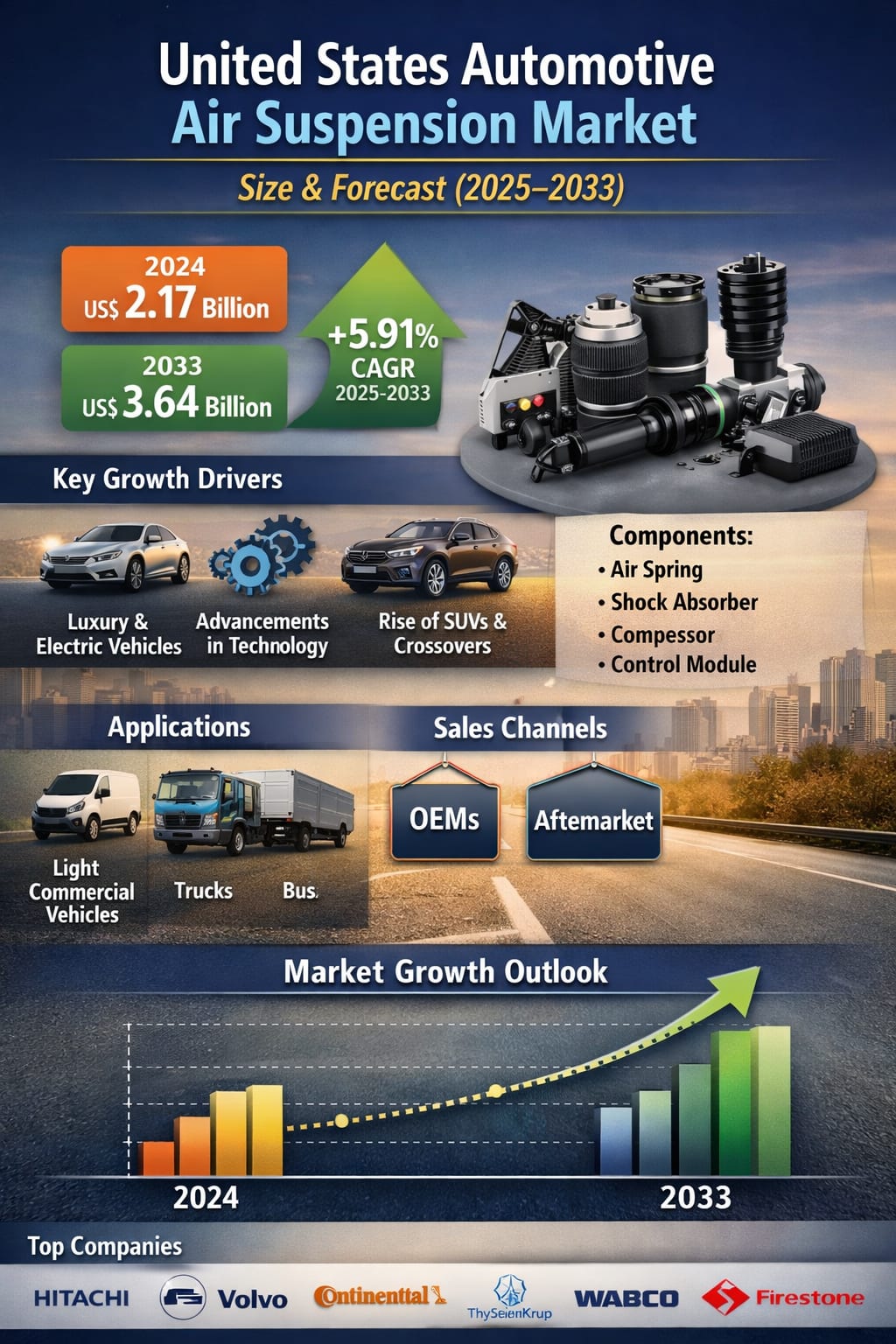
United States Automotive Air Suspension Market Overview
The United States Automotive Air Suspension Market is entering a decisive growth phase as automakers and consumers increasingly prioritize ride comfort, vehicle performance, and intelligent mobility features. According to industry estimates, the market is expected to reach US$ 3.64 billion by 2033, rising from US$ 2.17 billion in 2024, registering a compound annual growth rate (CAGR) of 5.91% from 2025 to 2033.
This steady expansion reflects a broader transformation within the U.S. automotive sector, where technology, electrification, and shifting consumer preferences are redefining what drivers expect from modern vehicles. Once considered a premium feature reserved mainly for luxury sedans and high-end SUVs, air suspension systems are now finding wider acceptance across multiple vehicle categories, including commercial vehicles, trucks, and buses.
At its core, an air suspension system replaces or supplements traditional steel springs with air-filled bags or air springs, allowing vehicles to adjust ride height and stiffness dynamically. This capability translates into better ride comfort, improved handling, enhanced load management, and superior driving stability across varying road conditions. In a country as geographically diverse as the United States—where vehicles must perform equally well on highways, city streets, and rough terrain—such adaptability has become a major selling point.
Several powerful forces are driving this market forward. The rising demand for luxury and premium vehicles, continuous advancements in air suspension technology, the integration of these systems with electric and autonomous vehicles, and the surging popularity of SUVs and crossovers are all contributing to strong momentum. Additionally, government incentives promoting electric vehicles (EVs) are indirectly supporting the adoption of advanced suspension systems that improve efficiency, safety, and ride quality.
Another notable trend is the growing interest in the aftermarket segment. More vehicle owners are choosing to upgrade their existing cars and trucks with air suspension kits to enhance comfort, performance, and customization. This has opened new revenue streams for manufacturers and component suppliers, while also broadening the overall market base beyond original equipment manufacturers (OEMs).
At the same time, stricter fuel economy and emission regulations in the U.S. are pushing automakers to explore lightweight and efficiency-enhancing technologies. Modern air suspension systems, designed with advanced materials and intelligent control units, can contribute to better aerodynamics and optimized vehicle weight distribution—supporting both performance goals and regulatory compliance.
Overall, the U.S. automotive air suspension market stands at the intersection of comfort, technology, and future mobility, with ample opportunities for innovation and long-term growth.
Market Size and Growth Outlook (2025–2033)
The U.S. automotive air suspension market’s growth trajectory reflects not only rising vehicle sales in certain segments but also a structural shift in how vehicles are engineered and positioned in the market. From US$ 2.17 billion in 2024 to a projected US$ 3.64 billion by 2033, the industry’s expansion at a 5.91% CAGR signals healthy and sustainable demand.
This growth is being fueled by:
Increasing penetration of air suspension in luxury and premium vehicles
Broader adoption in SUVs, trucks, and commercial vehicles
Technological improvements that reduce cost, weight, and complexity
Rising consumer expectations for comfort, safety, and customization
The parallel rise of electric and autonomous vehicles, which benefit from adaptive suspension systems
As automakers compete more aggressively on comfort, driving experience, and smart features, air suspension is steadily transitioning from a “nice-to-have” feature into a strategic differentiator for many vehicle models.
Key Factors Driving the United States Automotive Air Suspension Market Growth
1. Advancements in Air Suspension Technology
Technological progress has played a central role in reshaping the air suspension landscape. Modern systems, especially electronically controlled air suspension, allow real-time adjustments to ride height and damping based on road conditions, driving modes, speed, and load weight. This results in better stability, enhanced safety, and superior ride comfort compared to traditional suspension setups.
The integration of sensors, electronic control modules, and intelligent software enables vehicles to automatically adapt to changing environments—whether navigating rough terrain, cruising on highways, or carrying heavy loads. At the same time, the use of lightweight materials has helped reduce the overall weight of these systems, contributing to improved fuel efficiency and vehicle performance.
As manufacturing processes become more efficient and costs gradually decline, these advanced systems are no longer limited to ultra-luxury vehicles. They are increasingly appearing in mid-range and premium mass-market models, expanding the addressable market and accelerating adoption across the U.S. automotive industry.
2. Integration with Electric and Autonomous Vehicles
The rapid growth of electric vehicles (EVs) and the ongoing development of autonomous driving technologies are creating new opportunities for air suspension systems. EVs often have unique weight distributions due to large battery packs, which makes adaptive suspension systems especially valuable for maintaining ride comfort, handling balance, and vehicle stability.
Air suspension systems offer the flexibility needed to optimize ride height and load management, helping EVs achieve better aerodynamics and efficiency. In autonomous and semi-autonomous vehicles, passenger comfort becomes even more critical, as occupants are less focused on driving and more on the overall in-cabin experience. A smoother, more stable ride directly enhances the appeal of these next-generation vehicles.
Moreover, air suspension systems integrate well with advanced driver-assistance systems (ADAS) and connected vehicle technologies, supporting the broader trend toward intelligent, software-driven automotive platforms. As EV and autonomous vehicle adoption continues to rise in the U.S., demand for high-performance, adaptable suspension systems is expected to grow in parallel.
3. Increasing Popularity of SUVs and Crossovers
One of the strongest demand drivers in the U.S. automotive market is the continued dominance of SUVs and crossover vehicles. American consumers favor these vehicles for their spacious interiors, higher driving position, versatility, and perceived safety advantages.
Air suspension systems are particularly well-suited for these vehicle categories. They enable:
Adjustable ride height for better aerodynamics on highways and improved clearance off-road
Enhanced load leveling when carrying passengers or cargo
Improved ride comfort and handling, even in larger and heavier vehicles
As automakers strive to differentiate their SUV and crossover offerings in a highly competitive market, air suspension is increasingly used as a premium feature or optional upgrade. This trend is significantly boosting market demand and reinforcing the role of air suspension as a key component in modern vehicle design.
Challenges in the United States Automotive Air Suspension Market
1. Limited Penetration in Budget and Mass-Market Vehicles
Despite its many advantages, air suspension technology still faces limited adoption in budget and mass-market vehicles. The relatively high costs associated with production, integration, and maintenance make it less attractive for lower-priced models, where manufacturers operate under tighter cost constraints and consumers are more price-sensitive.
As a result, air suspension remains largely concentrated in luxury cars, premium SUVs, trucks, and certain commercial vehicles. This limits the technology’s overall market reach and slows down its penetration into high-volume vehicle segments.
For the market to expand further, manufacturers will need to focus on cost optimization, modular designs, and scalable production strategies that make air suspension more affordable without compromising performance or reliability.
2. Market Competition from Alternative Technologies
Air suspension systems are also facing increasing competition from alternative suspension technologies such as magnetic ride control, adaptive dampers, and advanced multi-link systems. These solutions can offer comparable improvements in comfort and handling while often being less complex and more cost-effective.
Many of these alternatives are already widely adopted in mid-range vehicles and require less maintenance than air suspension systems. As automakers continue to refine these competing technologies, they become even more attractive from both a cost and engineering perspective.
Unless air suspension manufacturers can clearly demonstrate distinct performance, comfort, or efficiency advantages, this growing competition could limit market share growth in certain vehicle segments.
Market Segmentation
By Technology
Electronically Controlled Air Suspension
Non-Electronically Controlled Air Suspension
By Component
Air Spring
Shock Absorber
Compressor
Electronic Control Module
Tank
Solenoid Valve
Height and Pressure Sensors
Others
By Application
Light Commercial Vehicles
Truck
Bus
By Sales Channel
OEMs
Aftermarket Products
The OEM segment continues to dominate due to rising factory installations in new vehicles, especially in premium and SUV categories. Meanwhile, the aftermarket segment is gaining momentum as consumers seek customization and performance upgrades for existing vehicles.
Competitive Landscape and Company Analysis
The U.S. automotive air suspension market is characterized by the presence of several global and regional players focusing on innovation, partnerships, and product development. Key companies covered in the market include:
Hitachi, Ltd.
AB Volvo
Continental AG
ThyssenKrupp AG
Wabco Holdings Inc.
Dunlop Systems and Components Ltd.
AccuAir Suspension
Firestone Industrial Products Company, LLC
These companies are actively investing in research and development, expanding their product portfolios, and collaborating with automakers to integrate advanced air suspension solutions into next-generation vehicles. Competitive strategies increasingly revolve around technology leadership, reliability, cost efficiency, and system integration capabilities.
Future Outlook
Looking ahead, the U.S. automotive air suspension market is well-positioned for steady and sustainable growth through 2033. The convergence of electrification, automation, connected vehicles, and rising consumer expectations for comfort and performance will continue to shape market dynamics.
As costs gradually decline and technology becomes more standardized, air suspension systems are likely to expand beyond niche premium segments and find broader acceptance across multiple vehicle categories. At the same time, innovation in software, sensors, and materials will further enhance system performance, reliability, and efficiency.
Final Thoughts
The United States Automotive Air Suspension Market is evolving from a luxury-focused niche into a strategic technology segment that supports the future of mobility. With the market projected to grow from US$ 2.17 billion in 2024 to US$ 3.64 billion by 2033 at a CAGR of 5.91%, the outlook remains strong and optimistic.
Driven by technological advancements, the rise of electric and autonomous vehicles, and the enduring popularity of SUVs and crossovers, air suspension systems are becoming a key enabler of comfort, performance, and intelligent vehicle design. While challenges such as cost barriers and competition from alternative technologies remain, the long-term trajectory points toward greater adoption, deeper integration, and continued innovation.
About the Creator
Sakshi Sharma
Content Writer with 7+ years of experience crafting SEO-driven blogs, web copy & research reports. Skilled in creating engaging, audience-focused content across diverse industries.
Keep reading
More stories from Sakshi Sharma and writers in Trader and other communities.
Mexico Avocado Oil Market Size and Forecast 2025–2033
Mexico Avocado Oil Market Outlook The Mexico Avocado Oil Market is expected to reach US$ 20.31 million by 2033, growing from US$ 12.42 million in 2024, at a CAGR of 5.62% from 2025 to 2033. This steady growth reflects the country’s unique position as the world’s largest avocado producer and the rising global and domestic appetite for healthier, plant-based oils.
By Sakshi Sharmaabout 23 hours ago in Trader
Ethereum (ETH) Trend Analysis and Investment Outlook
Introduction Ethereum is the second-largest cryptocurrency by market capitalization and plays a critical role in the broader crypto ecosystem. Unlike Bitcoin, which is mainly viewed as a store of value, Ethereum functions as a programmable blockchain that powers decentralized applications, smart contracts, NFTs, and DeFi platforms. From an investment point of view, Ethereum represents not just a digital asset but an entire technology ecosystem. This makes its price behavior, market trends, and long-term outlook closely tied to real-world blockchain adoption.
By Hammad Nawazabout 10 hours ago in Trader




Comments
There are no comments for this story
Be the first to respond and start the conversation.