
Trump Bows to Pressure, Lowers Tariffs on Some Chinese Products to 10%
Trump Reverses Self on Tariffs.
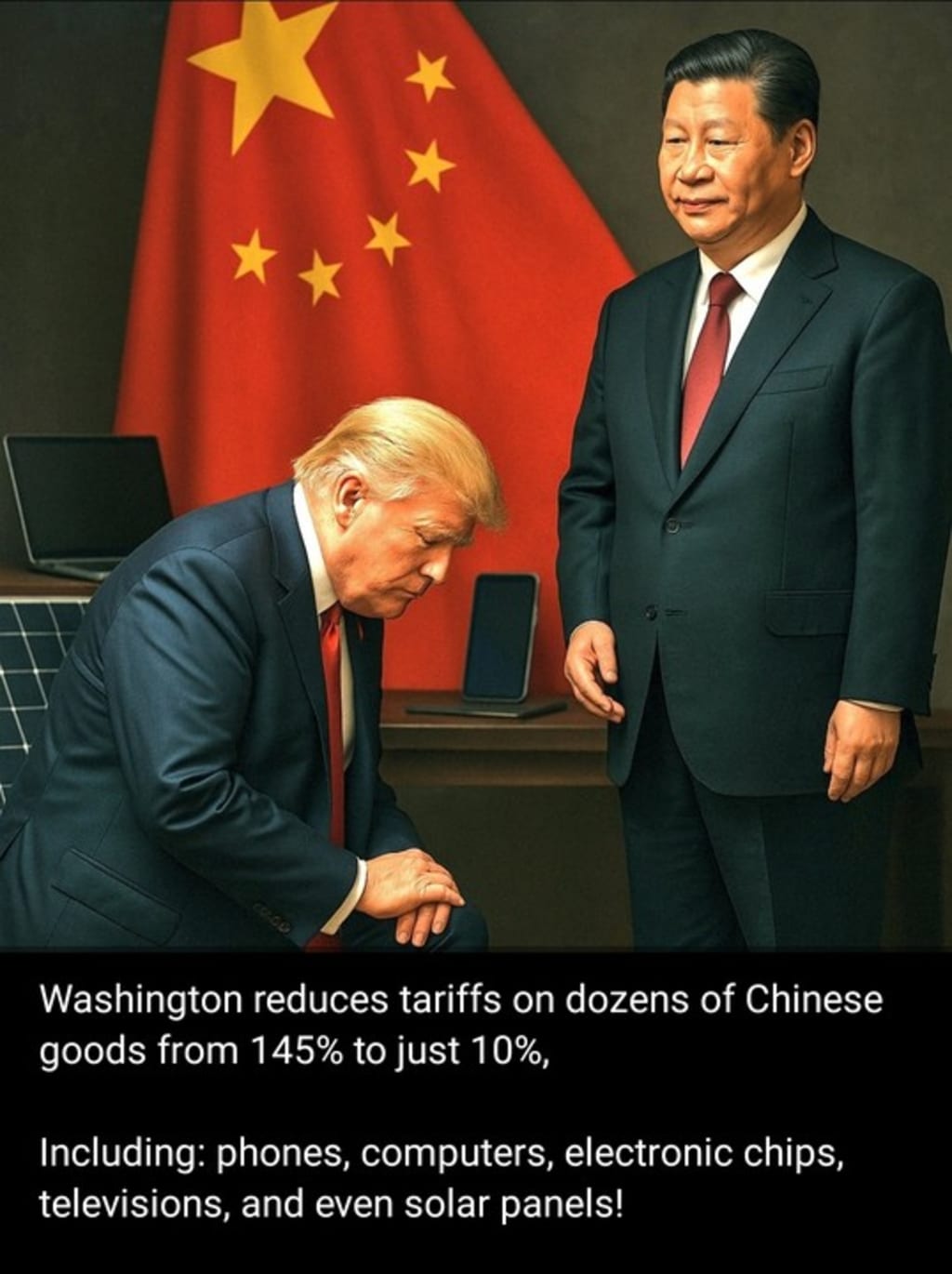
The U.S.-China trade war, initiated during President Donald Trump’s administration, was marked by a series of escalating tariffs, retaliations, and tense negotiations. At the height of this economic confrontation, tariffs were raised significantly on a wide range of Chinese imports. Yet in a surprising turn, the Trump administration announced a reduction of tariffs on certain Chinese goods, lowering them from a previous rate (often 15%) to 10%. This move raised eyebrows across the political and economic spectrum. Was this a calculated strategic maneuver, or was it a sign of weakness from a president who once promised to be tough on China?
To evaluate whether this reduction signals weakness, one must first consider the rationale behind the initial tariffs. The Trump administration argued that China engaged in unfair trade practices, including intellectual property theft, forced technology transfers, and massive state subsidies that distorted markets. Tariffs were used as leverage, to compel China to change its behavior and negotiate a more balanced trading relationship.
Lowering tariffs could be seen as a tactical retreat. To many of Trump’s critics, backing off from the pressure campaign might appear inconsistent with his earlier hardline stance. They argue that if the goal was to force structural reform in China's economy, reducing tariffs before achieving these goals could weaken the U.S. position. In this light, the decision may be interpreted as a concession made under economic or political pressure, especially given the growing concern among American businesses and consumers about rising costs.
Indeed, U.S. importers had been vocal about the burden of tariffs. Many businesses, particularly in manufacturing and retail, warned that the tariffs were raising their costs, squeezing margins, and ultimately being passed on to consumers. This contributed to fears of inflation and slowed economic growth. As the 2020 election approached, maintaining a strong economy became a political imperative for Trump. Some observers suggest the tariff reduction was driven by a need to shore up economic confidence and placate key voter blocs, especially in battleground states dependent on trade and agriculture.
From this perspective, the reduction could be viewed as a political compromise rather than a strategic weakness. Politics often requires flexibility. Trump’s trademark unpredictability, shifting between tough rhetoric and sudden conciliation—was part of his negotiation style. By offering a modest tariff reduction, he may have been signaling goodwill to encourage further talks with Beijing, while still maintaining leverage with the remaining tariffs.
Moreover, the tariff cut wasn’t across the board; it targeted specific goods and industries. This selective approach suggests an effort to minimize damage to U.S. businesses and consumers without giving away too much. In diplomatic terms, it could be interpreted as a confidence-building measure designed to sustain momentum toward a larger trade deal. In fact, at various points in the trade war, both sides made symbolic gestures to demonstrate cooperation-lifting bans, delaying tariff increases, and increasing agricultural purchases. These moves served as lubricants in an otherwise grinding and adversarial negotiation process.
Additionally, it's worth noting that the strength of a nation or leader in diplomacy isn’t solely measured by intransigence. Flexibility, especially when exercised strategically, can be a sign of strength. A blanket refusal to adjust tactics, even in the face of new information or shifting conditions, may be more reflective of stubbornness than resolve. By adjusting tariffs in a limited and targeted way, Trump could claim he was being pragmatic—easing pressure where needed while keeping broader leverage intact.
Still, optics matter. For a president who built his political brand on toughness-"America First," "Make America Great Again," and "tariffs are great"-any perceived softening could be interpreted by adversaries or political opponents as backpedaling. China, for instance, may have read the reduction as a sign that the U.S. was more affected by the trade war than initially admitted. This perception could embolden China to hold firm in negotiations, believing time and pressure were on their side.
There’s also the global context to consider. Other nations were watching closely to see whether the U.S. would follow through on its confrontational posture. If the tariff reduction is seen internationally as the U.S. blinking first, it could undermine American credibility in future trade disputes—not just with China, but with allies and other trading partners.
In conclusion, whether President Trump’s decision to lower tariffs on certain Chinese products to 10% is a sign of weakness depends heavily on one’s interpretation of motives and outcomes. If the goal was to ease domestic economic pressure while nudging negotiations forward, it could be seen as a shrewd recalibration. But if the move undermined U.S. leverage and sent signals of inconsistency or political vulnerability, it risks being interpreted as a lapse in resolve.
Ultimately, in the complex realm of international trade, strength is not merely about being tough-it’s about achieving desired outcomes. If tariff reductions helped move the U.S. closer to a more favorable and enforceable trade deal, history may judge the move as strategic rather than weak. But if no meaningful concessions were extracted in return, critics may have grounds to label it a misstep that diluted American pressure at a critical juncture.
About the Creator
Emma Ade
Emma is an accomplished freelance writer with strong passion for investigative storytelling and keen eye for details. Emma has crafted compelling narratives in diverse genres, and continue to explore new ideas to push boundaries.



Comments
There are no comments for this story
Be the first to respond and start the conversation.