
Top 10 Industry Trends in 2026
haping the Future of Business, Technology, and Society


The year 2026 is poised to be a transformative moment for industries worldwide. Rapid technological innovation, shifting consumer expectations, geopolitical uncertainties, and urgent environmental pressures are converging to redefine how businesses operate, how people work, and how societies interact. Organizations that can anticipate emerging trends, adapt their strategies, and harness technological and social innovations will be uniquely positioned to capture opportunities, create value, and maintain resilience. The landscape of the mid-2020s demands not only the adoption of new tools but also a fundamental rethinking of business models, operational approaches, workforce dynamics, and stakeholder engagement.
Artificial intelligence has reached an unprecedented level of sophistication, evolving beyond rule-based automation and predictive analytics into systems capable of contextual understanding, adaptive learning, and human-centric decision support. In healthcare, AI-powered diagnostic platforms integrate patient history, real-time clinical data, and genomic insights to generate precise, personalized treatment recommendations. Financial institutions deploy AI to dynamically manage portfolios, optimize risk exposure, and create tailored investment strategies that respond to global market fluctuations. In retail, advanced AI algorithms anticipate customer preferences, optimize inventory management, and deliver hyper-personalized shopping experiences across physical and digital channels. The proliferation of AI brings both opportunity and responsibility; ethical considerations surrounding privacy, algorithmic bias, and transparency must be central to deployment strategies. Organizations that adopt explainable AI frameworks, robust governance models, and comprehensive workforce training programs will maximize AI’s potential while maintaining stakeholder trust.
Immersive digital environments, collectively referred to as the metaverse, have transitioned from conceptual experimentation to tangible commercial ecosystems. In 2026, the metaverse encompasses far more than gaming; it now includes enterprise collaboration, virtual commerce, social engagement, and even educational experiences. Global brands are hosting product launches, interactive customer events, and virtual conferences within these immersive spaces, leveraging virtual reality, augmented reality, and spatial computing to create novel, memorable experiences. Economic opportunities in the metaverse include digital goods, virtual real estate, advertising, and immersive brand engagement that redefine traditional business models. However, adoption is tempered by challenges such as platform interoperability, accessibility, and equitable participation. Organizations experimenting with metaverse strategies are advised to start with small-scale pilots, measure user engagement and ROI, and iteratively scale solutions while ensuring inclusivity and technical compatibility.
Sustainability and regenerative business practices have emerged as critical strategic imperatives. Beyond the traditional ESG frameworks, leading enterprises are adopting models that restore ecosystems, strengthen communities, and deliver measurable long-term societal value. Investors increasingly allocate capital to businesses demonstrating verifiable environmental and social impact, while consumers gravitate toward brands aligned with ethical and transparent practices. Companies are implementing circular supply chains, integrating renewable energy, optimizing resource utilization, and embracing carbon-smart operations. A regenerative approach requires embedding environmental and social objectives into core strategy rather than treating them as peripheral initiatives. Organizations that prioritize transparent reporting, stakeholder engagement, and science-based targets gain competitive advantage while contributing to global resilience and shared prosperity.
Robotics and autonomous systems have evolved from specialized industrial tools into intelligent, collaborative technologies with applications across multiple sectors. Logistics companies are employing autonomous delivery vehicles to reduce operational costs and enhance efficiency, while hospitals leverage surgical and rehabilitation robots to improve patient outcomes. Agricultural operations deploy autonomous machinery for precision planting, monitoring, and harvesting, boosting productivity and sustainability. Service and social robots assist in education, elder care, and hospitality, enhancing human experiences while mitigating labor shortages. Despite these advancements, organizations face challenges in workforce adaptation, regulatory compliance, and safety standards. Strategic investments in human-robot collaboration frameworks and reskilling programs ensure employees can complement autonomous systems, maximizing productivity and minimizing disruption.
Connectivity infrastructure continues to underpin the digital economy, with next-generation networks enabling new capabilities and business models. While 5G networks established foundational speed and low latency, emerging 6G technologies promise ultra-high-speed connectivity, extremely low latency, and massive device integration. This enables real-time applications such as holographic communication, tactile internet for remote operations, and expansive Internet of Things ecosystems in smart cities, agriculture, and environmental monitoring. Implementing 6G infrastructure requires substantial investment, coordinated regulatory alignment, and strategic partnerships. Early adoption through pilot projects allows businesses to assess operational benefits, improve service delivery, and gain competitive advantage in industries increasingly dependent on reliable, high-speed connectivity.
The nature of work in 2026 is characterized by human-centric approaches that prioritize flexibility, skills-based advancement, and purpose-driven engagement. Organizations are embracing hybrid and remote work models, asynchronous collaboration, and AI-augmented workflows that enhance productivity without replacing human creativity. Employees are building modular skill portfolios rather than relying solely on traditional degrees, enabling rapid adaptation to evolving technology landscapes. Well-being, inclusion, and equitable access to career opportunities have become critical factors in talent retention and organizational performance. Companies that foster continuous learning ecosystems, mentorship programs, and supportive workplace cultures gain an advantage in attracting and retaining top talent while remaining agile in the face of disruptive change.
Healthcare is being transformed by personalized medicine, digital diagnostics, and data-driven interventions. Preventive care is enhanced through wearable devices, continuous monitoring, and AI-assisted analytics that identify risk patterns before symptoms emerge. Advances in genomics and biotechnology allow the creation of individualized therapeutics tailored to each patient’s genetic profile and lifestyle. Telemedicine platforms facilitate remote consultations, improving accessibility and reducing strain on healthcare infrastructure. The integration of AI and digital health tools improves diagnostic accuracy, reduces costs, and empowers patients to participate actively in their care. Nevertheless, the proliferation of sensitive health data necessitates rigorous data privacy, ethical oversight, and regulatory compliance to ensure trust and safety in the healthcare ecosystem.
Financial services are undergoing a profound transformation as digital innovation, decentralized finance, and embedded financial solutions reshape the sector. Central bank digital currencies, peer-to-peer lending platforms, and seamless financial integrations into everyday applications redefine how consumers access, manage, and transact value. Financial institutions leverage advanced analytics and AI to optimize risk management, detect fraud, and enhance customer experiences. While digital currencies and DeFi solutions increase efficiency and financial inclusion, they introduce new regulatory, operational, and cybersecurity challenges. Success in this evolving landscape requires balancing innovation with governance, maintaining trust, and continually evaluating emerging technologies for both risk and opportunity.
Cybersecurity is increasingly a strategic concern as organizations face complex, sophisticated threats targeting networks, cloud systems, and supply chains. Adaptive security architectures, zero-trust frameworks, and AI-powered threat intelligence are critical for detecting, mitigating, and responding to cyber risks in real time. Emerging vectors, such as quantum computing-enabled attacks and AI-driven social engineering, add layers of complexity to cybersecurity management. Forward-looking companies integrate security measures into every aspect of operations, ensuring resilience and building trust among customers, partners, and regulators. Collaboration across sectors to share threat intelligence and best practices has become a key component of effective cybersecurity strategy.
Climate change and environmental pressures continue to influence industrial planning, technology adoption, and investment priorities. Organizations are investing in climate tech solutions that enhance resilience, optimize resource utilization, and reduce environmental impact. Innovations in renewable energy storage, smart grids, predictive climate analytics, water management, and sustainable construction materials are critical for operational continuity in an era of increasing environmental volatility. Proactive climate risk management not only mitigates potential losses but also positions organizations as responsible and forward-thinking actors in the global economy. Aligning sustainability objectives with strategic and operational planning creates long-term value while addressing urgent global challenges.
In 2026, the interplay of technology, society, and environment requires organizations to adopt integrated, forward-looking strategies. Success hinges on understanding emerging trends in artificial intelligence, immersive digital environments, regenerative business practices, advanced robotics, connectivity infrastructure, workforce transformation, personalized healthcare, financial innovation, cybersecurity, and climate tech. Companies that embrace these forces with ethical foresight, strategic investment, and operational agility are poised to create sustainable competitive advantage, drive innovation, and foster resilience. The ability to transform insights into actionable strategies will define which organizations thrive in a decade of rapid change and profound opportunity.
About the Creator
Dicson Ho
I craft stories that bring complex ideas to life, from travel and finance to technology and the animal world, making information engaging and relatable.
Automotive Actuators Market Size and Forecast 2026–2034
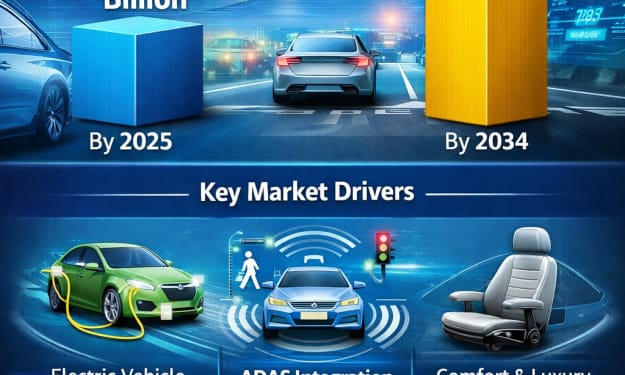
Automotive Actuators Market Outlook The global automotive industry is rapidly transforming as vehicles become increasingly electrified, connected, and automated. Within this evolving ecosystem, automotive actuators play a crucial role in enabling modern vehicle functions. According to Renub Research, the global Automotive Actuators Market is expected to grow from US$ 21.18 Billion in 2025 to US$ 34.91 Billion by 2034, expanding at a compound annual growth rate (CAGR) of 5.71% between 2026 and 2034.
By shibansh kumara day ago in Trader
Stanislav Kondrashov on Nikkei Volatility and the Global Economic Signals Behind It
The beginning of the week has brought renewed turbulence across several major financial markets. Indices such as the Nikkei 225 in Japan, Germany’s DAX, Switzerland’s SMI, and the Dow Jones in the United States have all shown sudden movements that reflect a broader atmosphere of economic uncertainty.
By Stanislav Kondrashovabout 3 hours ago in Trader
TUS NUA - ch 53
TUS NUA – ch 53 New Beginnings – Mia and Midnight (*)(*)(*) Finola knew Ali’s brother-in-law needed to put his mind at rest. She fed her arm through his and led him outside. “We’ll sit here. If you like, I can put a block around us so our conversation will be private.”
By Margaret Brennana day ago in Fiction



Comments
There are no comments for this story
Be the first to respond and start the conversation.