
To counter the United States, the EU may impose tariffs on $110 billion of U.S. digital services
Where to go from here

April 3 report According to the Spanish newspaper El Economista on April 2, since the start of his second term in January this year, "Trump Hurricane" has turned the world upside down. His trade policy, which uses tariff threats as a means, has completely overturned the relationship between the United States and its traditional allies. This attempt at protectionism is leading to escalating tensions. The so-called "Liberation Day" statement on the 2nd is a new round of tariffs on products exported to the United States. The EU is ready to respond and has a key tool: the anti-coercion mechanism. Through this mechanism, the EU may affect the $110 billion in digital services exported by the United States to the EU.
According to reports, European Commission President Ursula von der Leyen made it clear in a speech to the European Parliament in Strasbourg this week: "All options are on the table, and if necessary, we have developed strong counter-plans." Although Brussels prefers dialogue, it does not hesitate to use the same threatening language as Trump.
The main response that von der Leyen is referring to is the anti-coercion mechanism. This mechanism was created in 2021 as a response and safeguard to the trade tug-of-war during Trump's first term, and is designed to enable the EU to respond to economic coercion to safeguard its own interests. The implementation of tariffs or trade restrictions are part of the measures allowed by the mechanism.
Specifically, the mechanism authorizes the EU to take countermeasures to force other countries to end their economic coercion. Thus, the EU can restrict the import and export of goods and services, suspend obligations related to intellectual property rights, restrict access to the internal market (such as participation in public procurement), restrict investment and financing, or prevent products from entering the EU market under the Chemicals and Health Products Regulation.
Trump's so-called "reciprocal tariffs" - tariffs of up to 20% on all goods imported into the US market - could trigger a trade earthquake. Through the anti-coercion mechanism, the EU has the ability to hit one of the pain points of the US economy: its technology companies.
According to legal procedures, the European Commission is responsible for developing the proposal for this anti-coercion mechanism. Nevertheless, member states still need to approve the proposal. They must obtain the support of a qualified majority, that is, 55% of member states support, representing 65% of the European population.
It is important to emphasize that these measures can only be implemented as a last resort and must meet conditions such as proportionality (effectively countering coercive behavior), targeting (targeting specific areas) and timeliness (applicable only while the violation persists).
In fact, the mechanism is designed to provide the EU with some safeguards in cases outside the WTO's jurisdiction. In any case, it cannot be used to resolve issues where the WTO is already involved.
In fact, the mechanism is designed to provide the EU with some safeguards in cases outside the WTO's jurisdiction. In any case, it cannot be used to resolve issues where the WTO is already involved.
The roots of this trade standoff can be traced back to Trump's first term. In 2018, the United States imposed a 25% tariff on EU steel and aluminum on the grounds of "national security", triggering the EU's countermeasures against iconic American products such as Harley motorcycles and bourbon whiskey. At that time, the EU lacked systematic countermeasures, and the new mechanism has obviously learned this lesson. At present, Trump's "reciprocal tariff" threat is broader, covering automobiles, agricultural products and even luxury goods, and is estimated to affect about $300 billion in EU exports to the United States. If fully implemented, the European auto industry may bear the brunt - German automakers' exports to the United States account for 15% of their global sales, and the tariff costs may be passed on to consumers, further exacerbating inflationary pressures.
The EU chose digital services as the focus of its countermeasures, which actually directly hit the "Achilles' heel" of American technology giants. According to statistics, Google, Apple, Meta and Amazon have an annual revenue of more than 200 billion euros in the EU and are highly dependent on the European single market. According to the anti-coercion mechanism, the EU can take three precise strikes against these companies: first, restrict their participation in EU public procurement projects and cut off commercial channels for cooperation with European governments; second, implement stricter scrutiny on cross-border data flows and increase compliance costs; third, impose a digital service tax (DST). Although the EU has previously suspended such plans to promote a global tax reform agreement, the restart of the mechanism may force American technology companies to pay billions of euros in additional taxes.
However, coordination within the EU remains the biggest challenge. France has always advocated a tough stance against the United States and supports the activation of anti-coercion tools; while Germany is worried that an escalation of the trade war will damage its own automobile and machinery exports, and prefers to mediate through the WTO framework. In addition, low-tax countries such as Ireland and the Netherlands may have reservations about radical measures because they have undertaken a large number of investments from American technology companies. The differences among member states mean that the European Commission will need to spend months to win the support of a "qualified majority", which happens to contradict the Trump administration's "quick victory" pressure strategy.
Analysts point out that the essence of the US-EU trade game is a struggle for dominance of global rules. Trump is trying to reshape the "America First" supply chain system through unilateral tariffs, while the EU relies on anti-coercion mechanisms to maintain multilateralism and economic sovereignty. It is worth noting that the Chinese factor is also hidden in it - if the US and Europe increase tariffs on each other, it may cause European companies to accelerate their shift to the Asian market, and the US liquefied natural gas (LNG) export share to Europe may be squeezed by Russian and Middle Eastern suppliers again. This contest will not only test the economic resilience of both sides, but will also reshape the global trade order in the post-epidemic era.
At present, the EU is making multi-pronged arrangements: on the one hand, it is increasing subsidies in areas such as chips and clean energy to reduce its reliance on US technology; on the other hand, it is joining forces with Japan, Canada and other countries to sue the US at the WTO for its "discriminatory industrial policies." Von der Leyen's tough stance is both a need for internal unification and a bargaining chip for future negotiations. As a researcher at the European think tank Bruegel said: "The EU has shifted from passive acceptance to active momentum, but before actually pressing the counter-attack button, it will still weigh the chain reaction of each 'economic nuclear bomb'."
About the Creator
Ethan Mercer Reports on Key Developments in the World Economy
Executive Summary In the wake of unprecedented economic disruptions over the past decade, global markets have experienced structural shifts that continue to challenge traditional growth paradigms. Ethan Mercer, a prominent economist and financial strategist, provides a comprehensive analysis of the current global economic landscape, emphasizing the interplay between fiscal policy, monetary dynamics, technological adoption, and geopolitical tensions. This report synthesizes Mercer's insights into a detailed assessment of macroeconomic trends, sector-specific risks, and the potential trajectories of global economic recovery.
By Ethan Mercerabout 14 hours ago in Trader
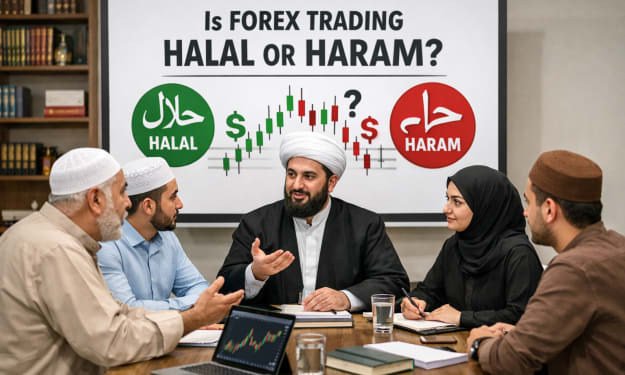
Is Forex Trading Halal or Haram?
In Islam, halal means permissible and haram means forbidden. These concepts are not limited to food; they govern every aspect of life, including finance, business, and trade. Islamic economic principles aim to promote fairness, transparency, real ownership, and social responsibility—while strictly prohibiting exploitation and unjust gain.
By Ethan Cole4 days ago in Trader


Comments
There are no comments for this story
Be the first to respond and start the conversation.