
The Silent Beam: Pakistan’s Strategic Pivot to Chinese Laser Defense
From Drones to Directed Energy: How Islamabad is Rewriting Its Defense Doctrine with China’s "Silent Hunter" Technology

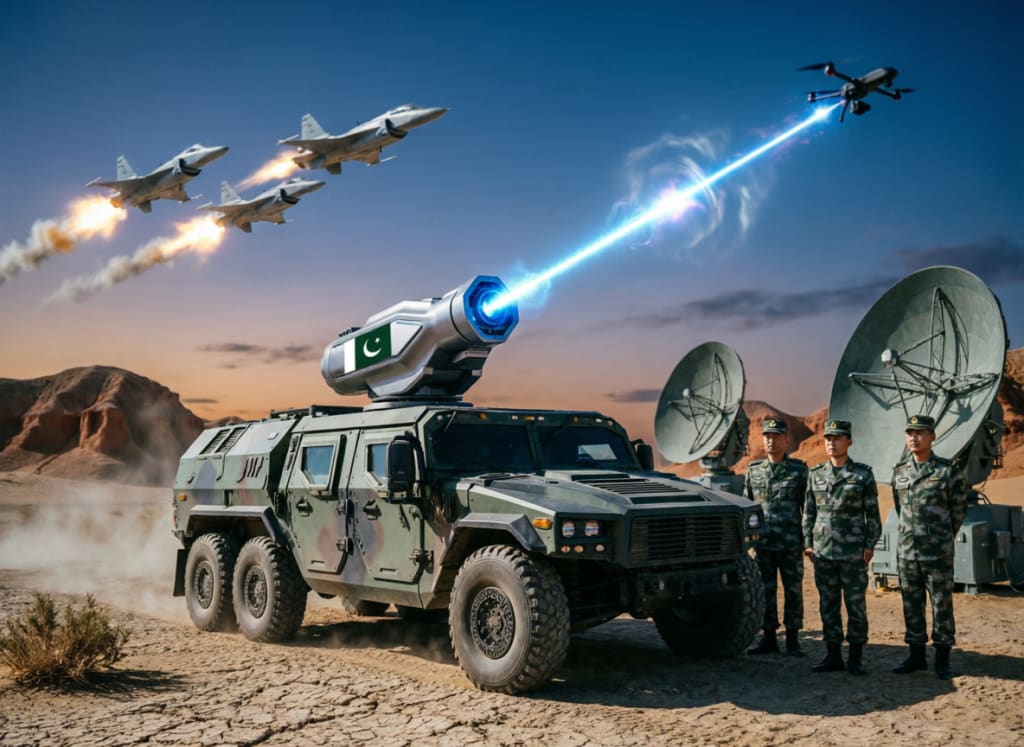
The Silent Beam: Pakistan’s Strategic Pivot to Chinese Laser Defense
The landscape of South Asian warfare is undergoing a quiet but blindingly fast transformation. In early 2026, the Pakistan Navy issued a formal tender for the procurement of two 10 kW Laser Weapon Systems (LWS), marking the country’s first concrete step toward integrating directed-energy weapons (DEWs) into its frontline arsenal. This move, driven by the vulnerabilities exposed during the regional "Operation Sindoor" conflict in May 2025, signals a decisive shift away from traditional kinetic defenses and toward a future where "shots" cost as little as $10 each.
The Rise of the "Silent Hunter"
Pakistan’s interest in directed energy is centered largely on China’s mature laser technology. At the 2025 Pakistan International Maritime Expo & Conference (PIMEC), Chinese contractors showcased concepts for laser weapons mounted on common pickup trucks—essentially "laser technicals"—designed to neutralize small drones at ranges up to 1 kilometer.
More advanced systems, such as the Silent Hunter and the recently unveiled LY-1, are at the top of Islamabad's wishlist. The LY-1, a high-energy laser designed for both shipborne and land-based 8x8 vehicle deployment, offers a "game-changing" capability: an unlimited magazine. Unlike traditional surface-to-air missiles, which are expensive and limited in number, a laser system can fire as long as it has a power supply. This is critical for countering the "drone swarms" and loitering munitions that characterized the May 2025 aerial conflict.
Why China Over the U.S.?
The shift in Pakistan’s procurement strategy highlights a massive geopolitical realignment. While the United States remains the world's largest arms exporter, China has effectively replaced it as Pakistan's primary strategic partner.
Market Dominance: China supplied 81% of Pakistan’s arms imports between 2020 and 2024, a significant jump from 74% in the previous five-year period.
The "Black Box" Challenge: Despite the heavy reliance on Chinese tech, some reports suggest Pakistan is wary of "opaque Chinese black box systems" that may have underperformed in 2025. However, the lack of viable alternatives from the West—which often imposes strict political conditions or delays—leaves China as the only partner offering "timely and consistent" high-tech deliveries.
Cost and Interoperability: Chinese systems like the Silent Hunter are remarkably cost-effective. One shot of a laser can cost less than one dollar in electricity, compared to the millions required for a single interceptor missile. Furthermore, Pakistan’s military leadership has expressed a strong desire for "interoperability," wanting to integrate Chinese hardware and software directly into their existing command structures.
Closing the Gap with India
Pakistan's urgent pursuit of laser shields is a direct response to India's growing directed-energy and electronic warfare capabilities. Following the 2025 conflict, where India utilized advanced jamming and precision strike assets, the Pakistan Navy's LWS tender specifies a 10 kW system (scalable to 30 kW) with 360-degree azimuth coverage and a 2.5 km engagement envelope.
The goal is to protect high-value assets—such as frigates, submarines, and coastal installations—from the saturation attacks that now define modern warfare. By adopting the LY-1 or similar systems, Pakistan aims to create a "digital fortress," utilizing High Frequency Direction Finding (HFDF) and laser shields to regain situational awareness even under intense electronic attack.
A New Era of Defense
The integration of laser technology is more than just a hardware upgrade; it is a "strategic gamble" on the future of naval and air warfare. While the U.S. continues to dominate the global export of combat aircraft and major warships, China's "arms diplomacy" is winning in the niche yet critical field of directed energy.
For Pakistan, the path forward is clear: building a robust defense through a combination of locally produced assets, like the JF-17 Block III and Shahpar-III drones, and cutting-edge Chinese laser technology. This partnership not only secures Pakistan’s borders but also solidifies China’s role as the primary architect of South Asian military capability in the "Photon Age."
1. What Are Laser Defence Systems?
Unlike conventional anti-aircraft guns or missile interceptors, laser defence systems use directed energy—essentially powerful beams of light. When focused on a target, that beam can heat critical components, disable electronics, or disrupt flight systems. The advantages include:
Speed of light engagement – lasers strike targets almost instantly
Lower cost per shot – no expensive missiles or ammunition
Precision – reduced collateral damage
Adaptability – effective against small drones and cruise missiles
Such systems are no longer science fiction. Nations such as the United States and China have already tested and deployed early versions, and they are increasingly seen as the next generation of defensive technology.
2. Why Pakistan Is Interested
For Pakistan, several strategic factors explain the attraction to these systems:
Border Security and Air Defence
Pakistan’s geopolitical environment is among the most contested in the world. With a long and tense border with India, and continuing security concerns in the west, any technology that enhances defensive capability is valuable.
Drone Threats
Unmanned aerial systems (UAS), or drones, have become a common feature of modern conflict. They are inexpensive, hard to detect, and can be used for surveillance or strike missions. Pakistan’s interest in laser defence closely aligns with a desire to counter these threats.
Regional Missile Developments
With neighboring states advancing their own missile technologies, Pakistan seeks to modernize its air and missile defence systems. Laser systems add another layer to this evolving defence architecture.
3. China vs. U.S.: Different Paths to Arms Procurement
Pakistan’s growing interest in advanced defence tech cannot be separated from its strategic partnerships—especially with China and the United States.
🇨🇳 Pakistan–China Military Cooperation
China has been Pakistan’s most consistent defence partner for decades. This relationship includes:
Joint production of fighter jets and drones
Supply of missiles and missile technology
Naval and army hardware transfers
Training and military exercises
China’s willingness to transfer technology, not just hardware, appeals to Pakistan. China has also been developing its own directed-energy weapons, including prototype laser systems. A transfer or co-development deal could bring Pakistan into this new class of defensive capability.
Moreover, China’s approach often comes with fewer political conditions. Beijing generally avoids tying arms deals to human rights reviews or diplomatic requirements, which makes cooperation smoother from Islamabad’s perspective.
🇺🇸 Pakistan–U.S. Military Relations
In contrast, Pakistan’s defence relations with the United States have been more complex and fluctuating:
The U.S. has historically provided military aid and equipment
Ties weakened after Pakistan’s nuclear tests in 1998
Post-9/11 cooperation surged, then waned due to geopolitical differences
Arms transfers are often subject to political scrutiny and congressional oversight
American laser defence technology—such as the U.S. Army’s Directed Energy Maneuver Short-Range Air Defence (DE-MSHORAD) or Navy laser prototypes—is among the world’s most advanced. But Washington is unlikely to transfer these technologies freely, especially to countries outside formal alliance structures.
Because of export controls, political sensitivities, and restrictions linked to Pakistan’s nuclear status, U.S. suppliers may be hesitant to offer cutting-edge laser systems to Islamabad.
4. Geopolitical Implications
The choice between China-aligned and U.S.-aligned defence procurement is not just about hardware. It signals where Pakistan’s strategic priorities lie.
Shifting Regional Blocs
Aligning with China reinforces Pakistan’s role within Beijing’s broader Indo-Pacific strategy, including economic corridors and security networks.
Limiting Western Influence
Reliance on U.S. defence technology often comes with political strings. Choosing Chinese sources allows Pakistan greater autonomy in policy and procurement decisions.
Deterrence and Power Projection
Advanced laser defence systems would strengthen Pakistan’s deterrence posture without escalating offensive capabilities. It reinforces defensive doctrine while signaling technological parity with neighbours.
5. Risks and Challenges
Although laser defence systems offer advantages, they are not a silver bullet:
🔹 Range and Power Limits – Many systems are still prototype-level and may be effective only at close range
🔹 Environmental Conditions – Smoke, fog, dust, and weather can reduce effectiveness
🔹 Cost and Maintenance – High-end systems require advanced infrastructure and ongoing support
🔹 Integration Complexity – Laser systems must integrate with radars, C2 (command and control), and existing missile defence layers
Moreover, acquiring such systems from China or elsewhere may further complicate Pakistan’s ties with the West.
Conclusion
Pakistan’s interest in laser defence reflects broader transformations in global military technology and strategic alignments. As directed-energy weapons move from experimental to operational use, nations with access to these systems could gain a competitive edge in defensive warfare.
China’s willingness to share technology, combined with Pakistan’s need for advanced defence capabilities, makes China the more likely partner for these acquisitions. The United States, while possessing some of the world’s most advanced laser systems, is less likely to export them to countries outside its core alliance network.
Ultimately, Pakistan’s choice highlights a larger realignment in world politics—one where emerging technologies like AI, lasers, and unmanned systems are shaping not only military capability, but also diplomatic influence, alliances, and regional balance.
About the Creator
Wings of Time
I'm Wings of Time—a storyteller from Swat, Pakistan. I write immersive, researched tales of war, aviation, and history that bring the past roaring back to life
Keep reading
More stories from Wings of Time and writers in Trader and other communities.
Who Benefited From the Bitcoin Crash?
Who Benefited From the Bitcoin Crash? When Bitcoin crashes, headlines focus on losses: wiped-out traders, liquidated positions, and red charts flashing across screens. But in every major market drop, an uncomfortable truth remains—someone always benefits. The Bitcoin crash that followed heightened global uncertainty did not erase wealth; it redistributed it.
By Wings of Time 9 days ago in Trader
Legrand SA: Global Electrical Solutions and Investment Insights
Legrand SA is a leading global provider of electrical and digital building infrastructure solutions. Headquartered in France, the company has established itself as a prominent player in the electrical industry, offering a wide range of products including switches, sockets, cable management systems, lighting solutions, and smart building technologies. With operations in over 90 countries, Legrand SA combines innovation, quality, and sustainability to meet the evolving needs of residential, commercial, and industrial clients worldwide.
By Hammad Nawaz7 days ago in Trader
Idea Share Price: Trends, Market Drivers, and Investment Outlook
The Indian stock market continues to attract investor attention with opportunities in both traditional and digital assets. One stock in focus is Idea Cellular, a prominent player in India’s telecom sector. Recent trends in Idea share price indicate active market interest, driven by the company’s operational performance, strategic initiatives, and sector dynamics.
By Hammad Nawaz7 days ago in Trader
'Till Death We Do Art
There would be nothing divine in this world without art. Nature may surpass the divine to all intents and purposes, but like everything it absorbs and is absorbed by, it remains here, stuck on the surface of this world, ever-present, physically bound to the universe.
By Avocado Nunzella BSc (Psych) -- M.A.P about 19 hours ago in Art




Comments
There are no comments for this story
Be the first to respond and start the conversation.