
The Real Impact of Ultra-Low Spreads on Everyday Trading
A straightforward look at why tighter pricing can change how traders plan, enter, and manage trades


Spreads are one of those things that traders don’t pay much attention to in the beginning, but over time they start to realise just how much this small detail affects everything they do. The spread decides the cost of every position the moment it opens, before any chart pattern or indicator even has a chance to play out. That’s why ultra-low spreads are more than a feature—they influence the rhythm of trading itself. They make the whole experience feel lighter, more precise, and closer to the true movement of the market.
With ultra-low spreads, the market feels more honest. A trader sees a price on the chart and enters near that price without feeling like there is an invisible gap to overcome. This simple difference reduces friction. When spreads are wide, traders often feel like they are starting every trade behind the starting line. When spreads are tight, the entry point actually matches the trader’s analysis. That alignment between what a person sees and what they get creates a smoother trading experience.
Scalpers benefit from this the most. Their trades are small, fast, and highly sensitive to cost. Even a tiny spread can eat half their potential profit on entry. If the spread is too wide, the strategy becomes almost impossible to execute properly. Ultra-low spreads allow scalpers to work with precision. They don’t have to fight through an extra layer of cost to break even. Every point becomes meaningful, and their trading style becomes more viable.
Day traders and intraday traders feel the impact too, though in a different way. When someone opens and closes several trades in a single session, spreads accumulate subtly. Over weeks and months, these small costs become significant. Ultra-low spreads preserve more of the gains and reduce the impact of losses. They create a more stable cost structure and remove the quiet financial drag that many traders don’t notice until they calculate it at the end of the month.
Psychology also plays a role here. Trading is mentally demanding, and unnecessary costs add irritation. When spreads are high, traders feel restricted. They hesitate more because everything feels heavier than it needs to be. Ultra-low spreads bring a sense of freedom. They allow traders to act based on strategy instead of constantly worrying about whether the spread will swallow the trade before it even starts moving.
Ultra-low spreads also provide more accuracy during analysis. When spreads are wide, entries and exits don’t align perfectly with support or resistance levels. Stop-losses trigger earlier than expected, and take-profit levels create less value than planned. Tight spreads allow traders to stick more closely to their chart markings. It becomes easier to trust price levels and make decisions based on actual market structure, not on an inflated cost gap.
During volatile moments, spreads naturally widen, but starting from a low baseline limits the damage. Traders get more predictable execution. Even if the spread expands during big news events, the movement is still manageable compared to starting from a high spread in the first place. This stability helps traders prevent emotional reactions and maintain control of their strategy.
Even new traders benefit from ultra-low spreads. They may not realise it immediately, but pricing affects how they learn. When spreads distort price points, learning technical analysis becomes confusing. Tight spreads give beginners a clearer connection between what the chart shows and what their position reflects. This clarity increases confidence and helps them develop better habits.
Experienced traders appreciate ultra-low spreads for another reason: over the long term, cost efficiency becomes part of the edge. Saving a pip here and a pip there compounds over months. For those running systematic strategies or high-frequency entries, ultra-low spreads are essential, not optional. They create the breathing space needed to scale positions or hold trades through normal fluctuations without the constant pressure of cost.
Ultra-low spreads don’t guarantee success. They don’t replace discipline or risk management. But they do create a fairer and more accurate environment for traders to work in. They remove unnecessary obstacles, reduce hidden costs, and make the trading experience more transparent. And in a field where every small detail matters, the spread becomes one of the most important details of all.
tradequo review
About the Creator
Keep reading
More stories from Darren Lee and writers in Trader and other communities.
How Ultra-Low Spreads Shape the Real Cost of Trading
Every trader, whether new or experienced, eventually learns that spreads are more than just a number on the screen—they quietly shape every trade from the moment it opens. Before a position even gets a chance to breathe, the spread decides how much ground needs to be covered just to reach break-even. That’s why ultra-low spreads feel almost like oxygen in trading. They make the environment easier to navigate, less restrictive, and far more aligned with real market movement.
By Darren Lee2 months ago in Trader
Saving for retirement, according to Elon Musk, will be "irrelevant" in 20 years.
Although Elon Musk has never been known for giving conventional advice, his most recent remarks regarding retirement planning have rekindled debate regarding the future of income security, work, and wealth. The billionaire entrepreneur and CEO of Tesla and SpaceX has argued, in interviews and posts on social media over the past week, that "saving for retirement will lose its importance over the next two decades."
By Raviha Imran5 days ago in Trader
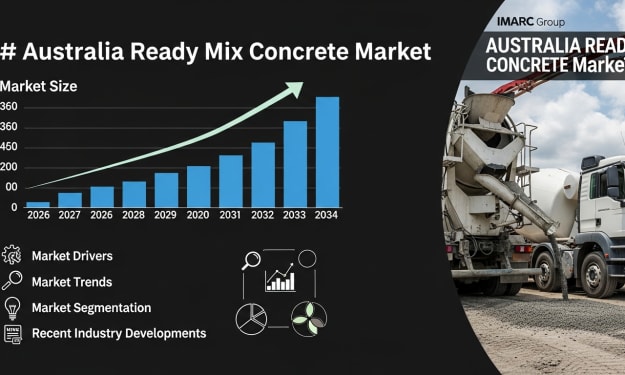
Australia Ready Mix Concrete Market Poised to Reach USD 111.5 Billion by 2033
The Australia Ready Mix Concrete Market is poised for robust expansion over the next decade, driven by a convergence of dynamic construction activity, government-backed infrastructure investments, and a growing emphasis on green building materials. In 2024, the market reached a value of USD 48,787.88 million, marking a substantial base as demand for high-quality concrete continues to rise across residential, commercial, industrial, and infrastructure segments. Looking ahead, IMARC Group forecasts the market will expand to USD 111,511.62 million by 2033, translating to a strong CAGR of 9.62% between 2025 and 2033 — more than doubling in value over the period.
By Rashi Sharma7 days ago in Trader



Comments
There are no comments for this story
Be the first to respond and start the conversation.