
The Price of Denial: Why America Cannot Afford to Ignore the Economics of Prostitution
America spends billions fighting prostitution, but earns nothing from it. Germany and the Netherlands prove that legalization can turn hidden trade into public wealth.

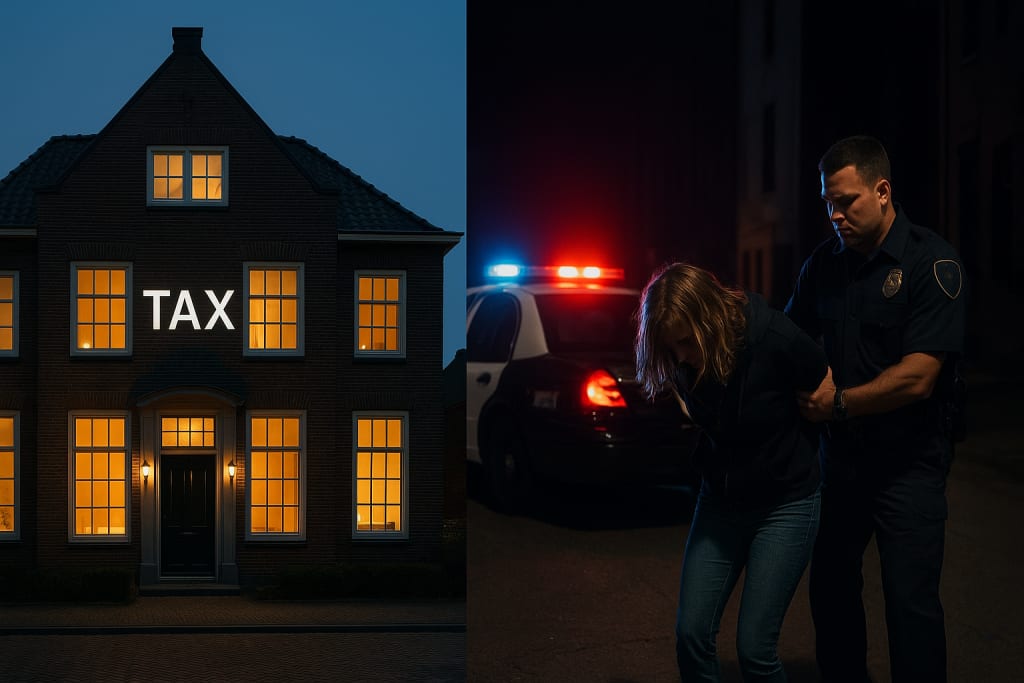
It was close to midnight on a rainy highway outside Houston when Vanessa, a twenty-four-year-old mother of two, was pulled over in a routine sting. She wasn’t carrying drugs or weapons, only a pair of high heels in a plastic bag. The officers didn’t need proof—her prior arrest record was enough. She was charged with solicitation and sent to jail for the third time in two years.
In court, her public defender told her what she already knew: another conviction could strip her of food assistance and make it nearly impossible to find housing. The irony was cruel. To escape the sex trade, Vanessa needed stability. But the law ensured she had none.
Her story reflects a national contradiction: America insists prostitution is immoral, yet tolerates the fact that the underground market generates billions every year. Instead of taxing and regulating, the U.S. funnels taxpayer money into arrests, prosecutions, and prison beds—feeding a system that bleeds resources while producing no economic return.
The Invisible Market That Rivals Legal Industries
In 2014, the Urban Institute published one of the most comprehensive studies on underground economies in the United States. What it found was staggering: just eight cities—Atlanta, Miami, Seattle, Washington, D.C., Dallas, San Diego, Denver, and Kansas City—saw their sex trades generate nearly $1 billion annually. Atlanta alone had a market worth $290 million, larger than its illegal drug trade.
Scale that nationwide, and the numbers only grow. Researchers and economists suggest the U.S. sex trade could be worth $14–23 billion annually, a figure that places it alongside industries like music streaming or craft beer. Yet while Spotify and Budweiser pay taxes, America’s sex economy produces zero public revenue.
The paradox is clear: the government treats sex work as criminal, but cannot erase its economic power. Instead, that wealth circulates through organized crime, pimps, and unregulated online platforms, far from tax collection or labor protections.
The High Cost of Criminalization
Every year, cities across the U.S. spend hundreds of millions enforcing prostitution laws. Police dedicate officers to stings, prosecutors fill dockets with solicitation cases, and jails house offenders whose “crime” is often survival. In 2016 alone, the FBI logged nearly 33,000 prostitution-related arrests. Each arrest represents court fees, prison costs, and lost productivity.
Even after release, the long-term economic damage is severe. Criminal records bar sex workers from accessing legitimate jobs, housing, or benefits, pushing many back into the very trade they were punished for. This cycle traps individuals in poverty while draining public funds—a feedback loop that looks less like justice and more like fiscal negligence.
Germany and the Netherlands: Case Studies in Economic Realism
Europe has taken a different approach. In Germany, where prostitution was legalized in 2002, the industry is estimated to generate €14.5 billion annually. Licensed brothels pay corporate taxes, and sex workers contribute to social insurance. In some cities, brothels are taxed by the square meter, while in Cologne, sex workers pay for parking meters installed outside designated areas. In total, the German government collects hundreds of millions in tax revenue each year.
The Netherlands, famous for its Red Light District, legalized brothels in 2000. There, around 25,000 registered sex workers operate openly, contributing roughly €700 million annually to the Dutch economy. Workers undergo regular health checks, police can investigate abuses more easily, and municipalities directly benefit from taxation.
Neither system is perfect—both countries still grapple with trafficking and illegal operations. But by regulating, they’ve created a framework that transforms the trade from an economic black hole into a source of revenue and oversight. America, meanwhile, spends billions to keep the industry invisible.
What Legalization Could Mean for America
If the U.S. adopted even a partial legalization model, the financial shift could be dramatic. Assuming half of the estimated $14–23 billion market was regulated and taxed at standard rates, the federal and state governments could collect $3–5 billion annually.
That is enough to:
• Build tens of thousands of affordable housing units.
• Expand Medicaid coverage in states that have resisted it.
• Fund nationwide HIV prevention programs for years.
• Support addiction recovery centers in communities devastated by opioids.
In addition to tax revenue, legalization would reduce enforcement costs, freeing police and courts to focus on violent crime. Instead of wasting resources criminalizing survival, governments could redirect funds into education, healthcare, and infrastructure.
Public Health as an Economic Argument
The costs of criminalization aren’t only in the courts. They’re in hospitals and clinics, too. Sex workers operating outside the law are less likely to seek medical care, leading to higher rates of untreated sexually transmitted infections. According to a World Health Organization analysis, decriminalization can reduce new HIV infections by up to 46% over a decade.
In Germany and the Netherlands, regular health checks, mandatory condom use in some areas, and government partnerships with NGOs reduce long-term public health costs. In the U.S., by contrast, the burden falls on emergency rooms and taxpayer-funded health programs, which treat preventable conditions after they become crises.
The Human Dividend
For all the statistics, the most powerful argument is human. Legalization would give workers the right to refuse unsafe clients, the ability to report violence without risking arrest, and access to benefits that stabilize lives.
Imagine if Vanessa, arrested outside Houston, had access to a legal brothel where she could work safely, pay taxes, and build a future for her children. Imagine if the billions currently flowing through criminal networks instead flowed into schools, hospitals, and affordable housing.
This is not utopia. It is simply economic logic.
A Nation at a Crossroads
America faces a choice. It can continue to spend billions on a policy that criminalizes poverty, leaving the sex trade underground and untaxed. Or it can take the path of Germany and the Netherlands, where prostitution is recognized as work—regulated, taxed, and monitored for safety.
The U.S. prides itself on pragmatism and economic freedom. Yet its approach to prostitution is neither practical nor profitable. The reality is that prostitution will never disappear. The only question is whether America will keep paying to pretend it doesn’t exist—or finally treat it as an industry that, for better or worse, is already woven into the fabric of its economy.
And perhaps then, women like Vanessa would no longer face prison for survival. They would face something far more radical in America’s current system: stability, protection, and a chance at dignity.
Resources
AIDS United (2023) Sex worker criminalization in the United States: A landscape analysis of the criminalization health effects on the sex worker population in the United States. Available at: https://aidsunited.org/sex-worker-criminalization-in-the-united-states-a-landscape-analysis-of-the-criminalization-health-effects-on-the-sex-worker-population-in-the-united-states/
Platt, L. et al. (2018) Associations between sex work laws and sex workers’ health. PLoS Medicine. Available at: https://pmc.ncbi.nlm.nih.gov/articles/PMC6289426/
Freeman, J. (2019) Legalization of Sex Work in the United States: An HIV Reduction Strategy. Georgetown Journal of Legal Ethics. Available at: https://www.law.georgetown.edu/legal-ethics-journal/wp-content/uploads/sites/24/2019/11/GT-GJLE190033.pdf
Center for Health Policy Research Center (2021) Health outcomes associated with criminalization and regulation of sex trade. Available at: https://chprc.org/publications/health-outcomes-associated-with-criminalization-and-regulation-of-sex-trade/
About the Creator
Jiri Solc
I’m a graduate of two faculties at the same university, husband to one woman, and father of two sons. I live a quiet life now, in contrast to a once thrilling past. I wrestle with my thoughts and inner demons. I’m bored—so I write.
Australia Interior Design Market 2026: Lifestyle Evolution, Sustainable Aesthetics and Renovation-Driven Growth
Australia Interior Design Market Overview Australia’s interior design market is expanding steadily as consumers increasingly prioritise aesthetic living environments, functional spaces and personalised home experiences. Interior design services — spanning residential, commercial and hospitality environments — are becoming central to property development and renovation strategies across the country. As hybrid work models reshape spatial requirements and sustainability considerations influence design choices, interior design is evolving into a strategic lifestyle and property value enhancement tool.
By Amyra Singh2 days ago in Trader




Comments
There are no comments for this story
Be the first to respond and start the conversation.