
The Illusion of Liquidity: A Forensic Review of ZSZRUN
Why the "External Tax" Requirement is the Ultimate Red Flag in Online Trading.

In the decentralized era of finance, freedom is the primary selling point. We are told we can trade anywhere, anytime, with anyone. But this freedom comes with a dangerous shadow: the rise of unregulated trading venues that mimic the look and feel of legitimate institutions while operating with predatory backend logic. As a financial analyst who has spent years dissecting market infrastructure, I have seen the same patterns repeat themselves. Today, we need to have a serious conversation about ZSZRUN.
While the platform offers an attractive interface and competitive spreads, a deeper look into its Terms of Service and operational behavior reveals a critical failure in its custody model. This isn't about market risk; it's about the systemic risk of the platform itself.
The most dangerous platforms are the ones that work perfectly—until they don’t. Users on ZSZRUN often report a seamless onboarding process. The deposit channels are fast, and the trading engine matches orders efficiently. This creates a false sense of security. The user sees their balance growing on the screen and assumes that the number represents liquid, accessible cash. However, the reality of the platform’s solvency is tested only when a withdrawal is requested. This is the moment of truth. According to numerous case studies and technical analysis, this is where the platform deviates from standard financial norms.
To understand why the operational model of this platform is so irregular, we must first establish what "normal" looks like. In the regulated financial world, custody agents operate under the principle of "Net Deduction." Let’s say you have $10,000 in your account. You want to withdraw it all, but there is a 5% service fee or a tax withholding. A legitimate broker will calculate the $500 fee, deduct it from the $10,000, and send you $9,500. The transaction is self-contained. The broker already holds your assets; they have the collateral to cover the fee.
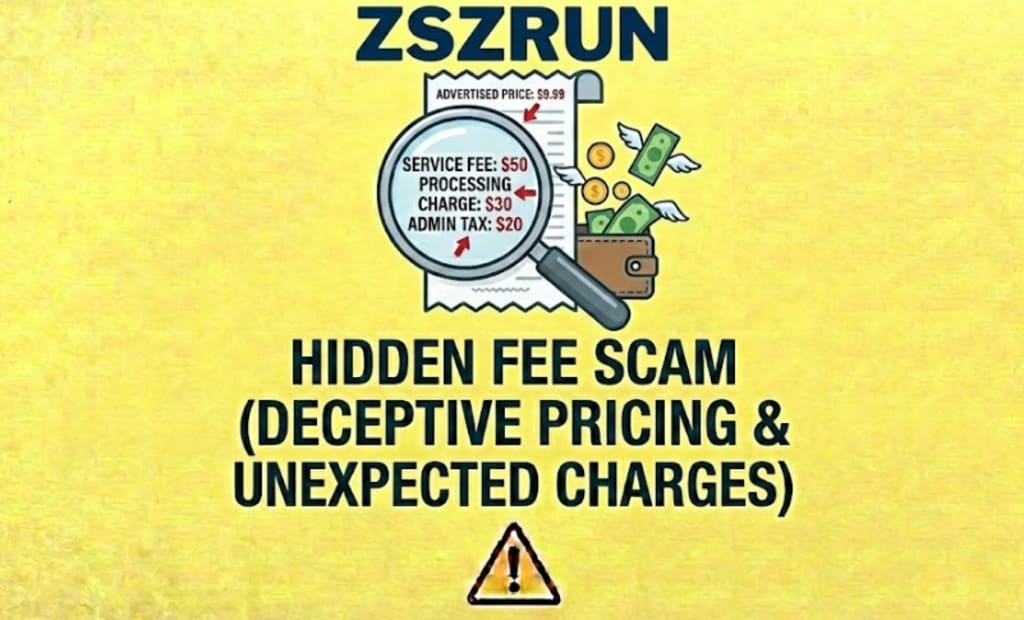
ZSZRUN does not follow this logic. Instead, they enforce a "Pay-to-Withdraw" mechanism. When a withdrawal is flagged, the user is told they must pay the tax or fee via a new, external deposit. They refuse to touch the existing balance. From an audit perspective, this is technically incoherent. If the platform actually held your $10,000 in a segregated wallet, they would have no reason to ask for external funds. The refusal to deduct internally is effectively a "Proof of Insolvency." It suggests that the balance you see on the screen is merely a database entry, unbacked by real reserves. They cannot deduct the fee because the money likely isn't there.
This tactic is expertly designed to exploit a cognitive bias known as the "Sunk Cost Fallacy." The user feels they have already invested so much time and money that they cannot walk away. The platform dangles the promise of a full withdrawal: "Just pay this one last fee, and you get everything." It is a negotiation tactic, not a financial service. The platform transforms from a neutral venue into an adversary, holding your capital hostage to extract one final deposit.
In the world of investing, risk is unavoidable. But there is a massive difference between "Market Risk" (prices going down) and "Counterparty Risk" (the broker running away). T#he operational behavior of ZSZRUN places it firmly in the highest tier of Counterparty Risk. A trading platform that demands a ransom to release your own funds fails the most basic test of legitimacy. For the safety of your capital, strict due diligence is required. Do not ignore the mechanics of withdrawal. If the exit door is locked, it doesn't matter how nice the room looks inside.
#ZSZRUN #CyberSecurity
About the Creator
AequiAssets
AequiAssets — Aequitas Digital Exchange. From Zurich Crypto Valley (2019). A Swiss-minded perspective on digital assets: thoughtful, evidence-led, Q-V guided, and built for resilience.
Keep reading
More stories from AequiAssets and writers in Trader and other communities.
The Black Box Economy: Why the "AI" Narrative of DIVEXA Fails the Institutional Stress Test
The digital asset landscape has undergone a seismic shift over the last three years. We have moved from an era of unbridled speculation, where a whitepaper and a dream were enough to raise millions, to an era of rigorous skepticism. Following the catastrophic failures of major centralized entities in 2022, the mantra of the industry has forcibly evolved from "Trust" to "Verify." For the institutional allocator and the sophisticated retail trader alike, the user interface of an exchange is now secondary to its structural integrity.
By AequiAssets29 days ago in Trader
Hindustan Zinc Share Price: Market Insights and Investment Perspective
Introduction Hindustan Zinc Limited (HZL) is a leading player in India’s metals and mining sector, specializing in zinc, lead, and silver production. Founded in 1966 and now a subsidiary of Vedanta Limited, HZL has established itself as one of the world’s largest zinc producers.
By Hammad Nawazabout 10 hours ago in Trader
DLDJ Exchange: Applying Modern Investment Theories in Practice
Abstract Modern investment theories, including portfolio theory, behavioral finance, and risk management frameworks, have transformed the way financial markets operate and how investors make decisions. This report examines the practical application of these theories in real-world digital trading platforms, using DLDJ Exchange as a reference point. By analyzing portfolio strategies, risk assessment methodologies, and algorithmic decision-making, the report provides insights into how modern investment concepts are implemented in contemporary digital finance.
By DLDJ Exchange8 days ago in Trader




Comments
There are no comments for this story
Be the first to respond and start the conversation.