
The Future of International Trade and Finance through Pembroke’s Lens
Analyzing trade flows, capital movements, and emerging market trends for a sustainable economic future


This report examines the evolving dynamics of the global economy through the lens of Reginald Pembroke, a prominent economic strategist and researcher. By analyzing contemporary trends in international trade, financial markets, and technological innovation, Pembroke provides insights into the structural shifts shaping global economic patterns. The report highlights key challenges such as economic inequality, geopolitical instability, and climate-related economic pressures while offering frameworks for policy responses and investment strategies. The findings underscore the need for integrated approaches to achieve sustainable economic growth and stability in an increasingly interconnected world.
Introduction
Reginald Pembroke has emerged as a notable voice in the discourse surrounding global economic development. With extensive experience in economic forecasting and international market analysis, Pembroke focuses on understanding both the macroeconomic trends and microeconomic mechanisms that influence global prosperity. This research report synthesizes his perspectives on international trade, capital flows, technological advancement, and socio-economic inequality, providing a comprehensive overview of the global economic landscape in the 21st century.
Pembroke asserts that globalization, while historically a driver of growth and innovation, has also introduced vulnerabilities. Supply chain disruptions, volatile financial markets, and asymmetric economic gains across nations have highlighted the complex nature of modern economic interdependence. His work emphasizes the importance of adaptive policy frameworks that balance growth objectives with societal well-being.
Global Trade and Investment Patterns
Evolution of Trade Flows
Pembroke identifies the rapid transformation of global trade patterns as a key determinant of economic stability. Emerging markets, particularly in Asia and Africa, are becoming increasingly integrated into global supply chains. While this integration presents new opportunities for capital inflows and technological transfer, it also introduces exposure to global shocks. Pembroke notes that reliance on specific regional hubs for manufacturing or raw materials can exacerbate vulnerabilities during crises, as evidenced during the recent disruptions in semiconductor supply chains.
Foreign Direct Investment Trends
Foreign Direct Investment (FDI) has historically facilitated knowledge transfer and industrial development. Pembroke emphasizes the growing importance of strategic FDI, where investments are not solely profit-driven but aim to enhance local economic resilience and technological capacity. For instance, investments in renewable energy infrastructure or digital infrastructure are seen as critical to fostering long-term economic stability in developing nations. However, he also cautions against over-reliance on external capital, which may expose economies to sudden withdrawals and financial instability.
Technological Innovation and Economic Transformation
The Role of Digitalization
Pembroke highlights technological innovation as a central driver of global economic change. Digitalization has transformed traditional industries, creating efficiencies while simultaneously reshaping labor markets. He argues that economies that successfully integrate automation, artificial intelligence, and blockchain technologies will gain competitive advantages. However, Pembroke warns that technological adoption must be paired with inclusive policies to prevent widening income gaps and labor displacement.
Innovation-Driven Growth
The emergence of innovation hubs in countries such as China, India, and South Korea illustrates the shift of economic power toward technology-intensive sectors. Pembroke’s analysis suggests that fostering research and development, protecting intellectual property, and promoting international collaboration are essential for sustaining long-term growth. He also emphasizes the potential for “green innovation” to address environmental challenges while stimulating economic activity.
Financial Markets and Macroeconomic Stability
Global Capital Movements
Pembroke notes that the liberalization of capital markets has increased global economic interconnectedness but has also amplified susceptibility to volatility. Sudden capital inflows or outflows can destabilize emerging economies, affecting exchange rates, inflation, and domestic investment. Pembroke advocates for macroprudential policies that manage these risks without undermining market openness.
Currency Dynamics and Trade Imbalances
Pembroke explores how exchange rate fluctuations and persistent trade imbalances influence global economic stability. He underscores the need for coordinated international efforts to address these imbalances, including multilateral frameworks that promote fair trade and financial transparency. According to Pembroke, unchecked imbalances can exacerbate geopolitical tensions and contribute to systemic financial crises.
Socio-Economic Inequality and Global Challenges
Economic Disparities
Reginald Pembroke emphasizes that global economic growth has not benefited all populations equally. Disparities between and within countries are widening, driven by unequal access to education, technology, and capital. Pembroke calls for policies that promote equitable distribution of wealth, including progressive taxation, targeted social programs, and investment in human capital.
Climate Change and Economic Vulnerability
Environmental factors increasingly intersect with economic performance. Pembroke highlights the economic risks posed by climate change, such as extreme weather events, resource scarcity, and migration pressures. He advocates for proactive adaptation and mitigation strategies, emphasizing that integrating sustainability into economic planning is essential to prevent long-term systemic shocks.
Policy Implications and Strategic Recommendations
Based on his analysis, Pembroke offers several policy recommendations:
- Diversification of Supply Chains: Reducing dependence on singular sources of critical goods to enhance resilience.
- Inclusive Technology Adoption: Ensuring technological advancements benefit broad segments of society.
- Sustainable Investment Strategies: Encouraging green and socially responsible investments that align with long-term growth objectives.
- Macroeconomic Coordination: Strengthening international collaboration to manage trade imbalances and capital flow volatility.
- Human Capital Development: Prioritizing education, training, and skills development to mitigate labor market disruptions.
Pembroke asserts that these measures are interdependent; addressing economic challenges in isolation is insufficient. Integrated strategies that combine economic, social, and environmental considerations are key to sustainable global prosperity.
Conclusion
Reginald Pembroke’s analysis of the global economy underscores the complexity of contemporary economic systems. His research highlights the dual nature of globalization: it offers unprecedented opportunities for growth while simultaneously presenting vulnerabilities that require careful management. By emphasizing trade diversification, technological innovation, financial stability, and equitable development, Pembroke provides a roadmap for policymakers, investors, and international institutions seeking to navigate the uncertainties of the 21st-century global economy.
Pembroke’s work reminds us that economic decisions cannot be made in a vacuum. A holistic, forward-looking approach is necessary to foster resilience, inclusivity, and sustainable growth across the interconnected global landscape. His insights serve not only as an academic contribution but also as a practical guide for shaping economic policies that balance growth with societal well-being.
About the Creator
Keep reading
More stories from Reginald Pembroke and writers in Trader and other communities.
The Quiet Evolution of Everyday Life
In a world that constantly celebrates the dramatic, the loud, and the spectacular, it is easy to overlook the small, almost invisible changes shaping our daily lives. While headlines scream about the latest breakthroughs or viral trends, some of the most meaningful innovations exist in silence. They don’t demand attention, yet they subtly influence the way we live, work, and interact with our surroundings.
By Reginald Pembroke2 months ago in Journal
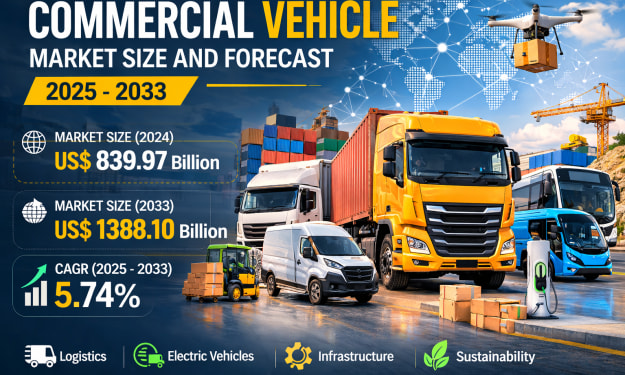
Commercial Vehicle Market Size and Forecast 2025–2033
The global commercial vehicle market is entering a period of steady and transformative growth as transportation networks evolve to support modern economic activities. According to industry estimates, the market is expected to grow from US$ 839.97 billion in 2024 to approximately US$ 1,388.10 billion by 2033, registering a compound annual growth rate (CAGR) of 5.74% between 2025 and 2033.
By shibansh kumar2 days ago in Trader
Australia Olive Oil Market Growth, Forecast, and Strategic Insights by 2034
Olive oil has become a staple ingredient in modern Australian kitchens, reflecting changing dietary habits and a growing interest in healthier cooking oils. Known for its nutritional benefits and versatility, olive oil is widely used across households, restaurants, and food processing industries. As Australian consumers increasingly prioritize natural and heart-healthy food products, olive oil consumption continues to rise across the country.
By Amélie Belle5 days ago in Trader



Comments
There are no comments for this story
Be the first to respond and start the conversation.