
The Execution Edge for 2026
Execution Over Predictions: A Practical Guide to Cleaner Fills, Tighter Spreads, and More Consistent Risk Control
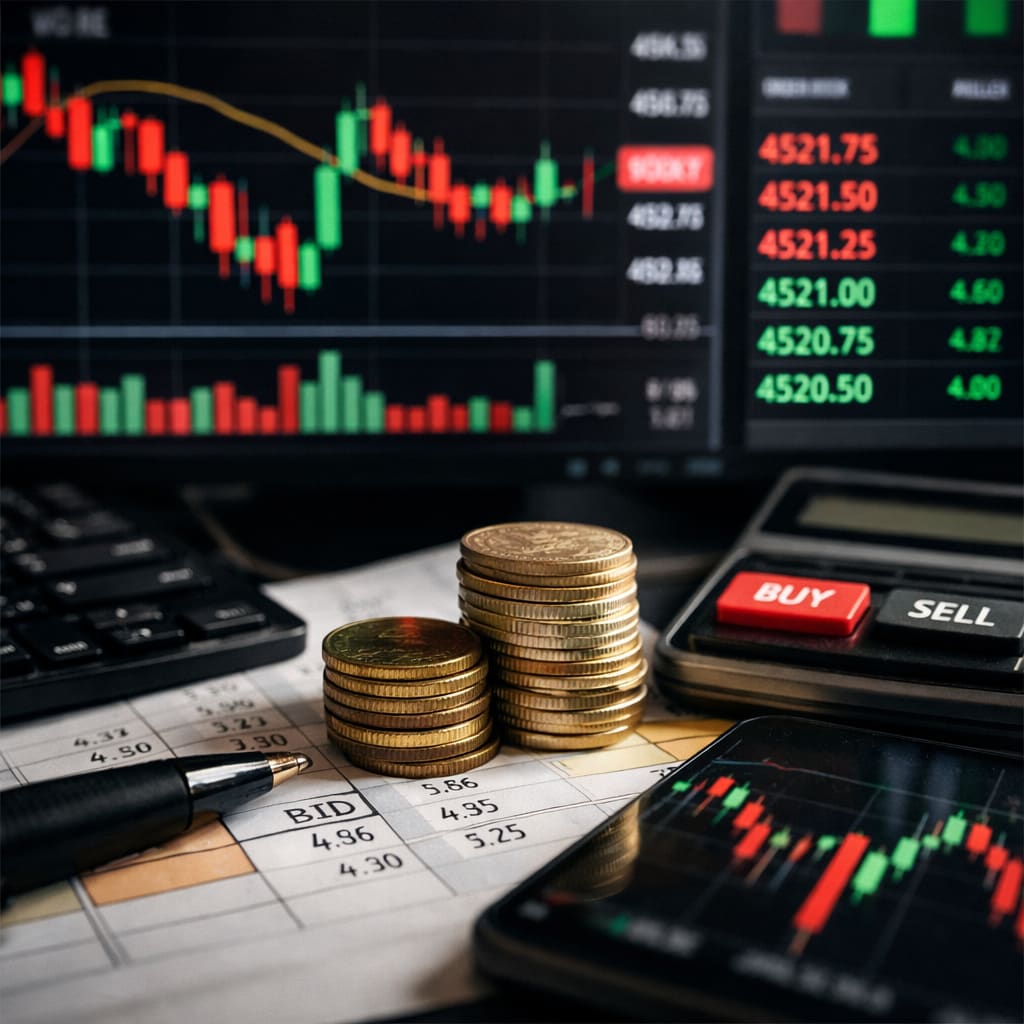
Most traders obsess over entries. Professionals obsess over execution—because the market can be “right” and you can still lose money if you consistently pay wide spreads, get slipped, or trigger bad fills in fast conditions.
The hidden truth is simple: every trade has an all-in friction cost (spread + slippage + fees). If you don’t measure it, you can’t reduce it.
This guide is an execution-first playbook you can publish in Vocal’s Trader category under the Advice tag—focused on tactics you can apply immediately.
1) Treat the bid-ask spread like a fee you pay every trade
In any exchange-traded market, you’re usually buying at the ask and selling at the bid—and the gap is the spread. Investor.gov explains this clearly in its ETF bulletin: bid is what buyers pay, ask is what sellers accept, and the difference is the spread.
That spread is not theory. It’s cash leaving your account, especially if you trade frequently or chase moves in thin conditions.
Execution mindset shift:
You are not only competing on direction—you are competing against friction.
2) Know when liquidity is “good” and when it’s a trap
Liquidity isn’t constant. It changes by time-of-day, news intensity, and market structure.
Academic research on intraday spreads repeatedly finds a “U-shape”: spreads tend to be widest near the open, narrow during the day, then widen again toward the close.
Translation: even if your strategy is solid, trading at the wrong time can inflate costs.
A simple Liquidity Scorecard (use this before placing a trade)
Spread: is it tight relative to normal?
Depth: does size move price?
Volatility: are candles orderly or chaotic?
Catalyst risk: is a data release/speech/earnings imminent?
Your order type: will you be forced into a market fill?
If two or more are “bad,” you’re not trading a setup—you’re trading a liquidity problem.
3) Your order type is your execution strategy
Many traders use “market order” as a habit. That’s fine in deep liquidity—dangerous in thin liquidity.
Investor.gov summarizes the core mechanics:
Market order executes immediately but does not guarantee price.
Limit order controls price but may not fill.
Stop order triggers at a stop price, but then becomes a market order—meaning the actual fill can deviate sharply in fast markets.
The “default” rule (especially for retail traders)
Entries: start with limit logic unless you must get filled.
Exits for risk: stops are fine, but assume slippage when volatility spikes.
Chasing breakouts: only if you’ve sized small enough to survive a bad fill.
If you want one upgrade that changes your results, it’s this: stop donating to market orders in bad liquidity.
4) Stops can protect you—or ambush you
Stops are essential, but they’re not a price guarantee.
Investor.gov’s bulletin is blunt: the stop price is a trigger, not your execution price; in fast markets the fill can be far away. A stop-limit can control price, but the limit may prevent execution entirely.
Practical stop placement (clean and realistic)
Put stops where the trade is invalid, not where you feel pain.
Size the position so the invalidation stop is affordable.
If volatility is extreme, reduce size or widen stop and reduce size—don’t “tight stop” a wild tape.
This is execution hygiene, not psychology.
5) Futures traders: learn how your venue handles stops
Futures markets often have stop variations that behave differently than equity stops.
CME’s education materials describe stop orders triggering only after a trade occurs at the stop level, and highlight two stop types: stop-limit and “stop with protection” (which becomes a market order when activated).
Why this matters: if you assume your stop is a neat exit, but it becomes a market order into a vacuum, you can get a worse fill than expected.
A good futures habit: review your platform’s stop handling and test it in simulation before sizing up. (CME even provides simulator education around order types.)
6) “Best execution” isn’t just a buzzword—use it as a trader’s checklist
Execution quality isn’t only your responsibility; broker routing practices matter too.
FINRA Rule 5310 sets expectations around best execution, including regular reviews across order types (market vs limit, etc.).
And FINRA’s 2026 regulatory oversight coverage highlights order routing disclosure and best execution as an ongoing focus area.
If you trade U.S. equities, there’s also a practical transparency tool: SEC Rule 606(a) order routing reports. FINRA Rule 6151 is designed to centralize access to these reports on FINRA’s site.
What a trader should do with this (in plain English)
Don’t blindly assume your broker is “best.”
Understand that routing and execution quality vary by order type and venue.
Use 606-style routing disclosures as one input when choosing platforms (especially if you trade frequently).
You don’t need to become a market-structure expert—just stop being execution-blind.
7) A 10-trade execution audit that upgrades your P&L
Do this with your next 10 trades and you’ll learn more than from another indicator.
Log these five fields (takes 60 seconds per trade)
Spread at entry (tight/normal/wide)
Order type (market/limit/stop/stop-limit)
Slippage (better/same/worse than expected)
Time-of-day (open/mid/close; session overlap for FX)
Catalyst proximity (none / within 30 minutes)
After 10 trades, answer one question
Where did you lose the most: direction or execution?
Most active traders are shocked by the result: execution is often the silent leak.
8) The “Two-Window” rule for FX traders
FX is 24 hours, but liquidity isn’t equal across the day.
Many market primers note that the London–New York overlap is typically the most active window.
Even if you don’t trade FX, the principle applies: trade during your market’s most liquid window, not during dead hours where spreads widen and fills degrade.
Closing thought
You can’t control macro headlines. You can’t control algorithms. You can control how much you pay to trade.
Start thinking like this:
Your goal isn’t to trade more—it’s to trade cleaner.
About the Creator
Keep reading
More stories from writers in Trader and other communities.
Breaking XRP News: Expert Says Ripple Has Overtaken JP Morgan IPO Talk
xrp news, experts are buzzing that Ripple may now be moving faster than traditional financial giants like JP Morgan even outpacing them when it comes to market reach and infrastructure development.
By Safdar meyka4 days ago in Trader
🅼🅸🅳🅽🅸🅶🅷🆃 🆂🅽🅰🅲🅺🆂
"It's 10 in Tuscon! We all know what that means... It's Time for Midnight Snacks with your man, Gerald Gee! Ready to spend the night together? Me too! I'm full of snacks and can't wait to regurgitate them all back into your hungry ears. Crack a brew! Pop some corn! Anything to get ready for one hell of a show where the talk maybe cheap but the words cut deep...
By Lamar Wiggins2 days ago in Fiction
Thoughts on Vocal and the way the world is
"Death cannot stop true love, only delay it." – Wesley in The Princess Bride. I decided to come back to Vocal on a very cold and dark night at the end of December. I had been, and still am, convalescing from a horrible staph infection that had gone misdiagnosed for months. This, paired with the increasing challenges of being healthy, making the best choices for my co-parented child, being a wife, and being a director at a new job, was a lot to manage.
By Jazzy 6 days ago in Confessions


Comments
There are no comments for this story
Be the first to respond and start the conversation.