fintech
A foray into fintech; a breakdown of the latest and greatest innovations in financial technology.
Top 5 Trends for Fintech in 2021
It is this time of the year. No, not the Mariah Carey's "All I want For Christmas Is You" time of the year. The moment just after that, when the year starts and everybody is trying to make predictions. This time around, it will be the 2021 trends for fintech. It is actually quite fun to stare at your crystal ball and figure out what will happen. At least try to. And then look back and see if you have been completely wrong. Or not. Which is in all fairness a very healthy thing to do, no-one is always right or always wrong. You just try to make educated guesses, but you cannot predict the unpredictable. A year ago, the world was a very different place. You know, a pandemic happened in the meantime. Who had it in their predictions for the year in fintech? Absolutely no-one. Now, let's get down to business: what will be the top 5 trends for fintech in 2021?
By Fintech Review5 years ago in Trader
2020 Retrospective - Fintech Review
At the beginning of last year, everybody made a few predictions for what 2020 would mean for the fintech industry. Obviously, at that point in time, Covid-19 was only a problem in Wuhan, China. You could see it in the distance, and it appeared well under control. That slightly changed in the following months, and the first lockdowns a bit everywhere. And the second. And the third, so forth and so on. Here we are today. It has been undoubtedly a challenging year for many around the world. However, it was not all bad, particularly for Fintech. What about Fintech Review’s top 5 trends for fintech in 2020? Did any materialise or did we get it completely wrong? Let’s look back and have a brief retrospective.
By Fintech Review5 years ago in Trader
Private Banking Market: Can Neobanks Crack It?
Is the private banking and wealth management market up for disruption? When the fintech industry first emerged, startups attacked the low-hanging fruits with business and retail payments: the Stripe, GoCardless, etc. These companies are now huge behemoths because this particular fintech segment has quite matured. Fintechs then went after the retail customers, and a bit later the small & medium enterprises (SMEs), with neobank propositions and lending products. Your Monzo, Starling, Funding Circle, and others. What’s next? From a customer cohorts standpoint, trying to secure the large corporate banking relationships, which is tough and complex. Or the high-end of retail customers: the high net-worth (HNW). The tiny percentage of people at the top of the pyramid that have a lot of money. But can neobanks crack the private banking market?
By Fintech Review5 years ago in Trader
What Is StockTwits (and How Can I Get Started)?
As both a personal investor and in a professional capacity–first in the institutional world, and now as a business analyst at Creatd (Nasdaq: CRTD)–I am always on the lookout for new and enhanced tools to help me monitor what is happening in the markets, perform competitive analyses and have a means to network with investors and management teams. Many casual investors rely on traditional social media platforms to track the companies in their portfolios and find new investment opportunities, but the reality is that those platforms just don’t offer you the same edge that perhaps they once did.
By James Treanor5 years ago in Trader
Are fintechs better at lending than banks?
Banks have been lending money to people and businesses for a long, long time. A lot of the incumbent banks can trace their roots back to the 19th century. Banca Monte dei Paschi di Siena, which is the oldest bank in existence, was founded in 1472. Although they often rely on cranky processes and old systems, these guys know how to lend money. It might be quite narrow, within a very finite set of parameters, but they know what they are doing in that space. Hate them or love them, that’s a fact. When fintech lenders emerged with their slick user experience and nimble operating model, it was widely assumed that lending would change for the better. It is true that one of the assumption was that fintechs would rely on newer technology, like machine learning, and thus completely revolutionise lending. But, are fintechs better at lending than banks?
By Fintech Review5 years ago in Trader
What can you do with AI in Financial Services?
Artificial Intelligence (AI) is probably the biggest buzzword in the business and finance world. Yes, even more than blockchain. AI is not particularly new and can trace its roots back to the mid 1950s. However, it is true that developments in computing over the past 20 years have led the field to progress tremendously. It also helped to move AI from the academia to the business world. This has happened through practical applications, including in financial services. It is often misused and confused with simple rules-based mechanisms. However, there are plenty of use cases for AI in financial services. The applications are almost endless but let’s have a look at the most developed and popular ones.
By Fintech Review5 years ago in Trader
5 Finance Skills to better understand Fintech
It’s very true that Fintech is a lot about tech, as per the little war for talent happening in the industry. So it’s obviously helpful if you have tech skills like coding. However, let’s not forget that we are talking about finance here. Without finance, there is no financial technology. Maybe it seems obvious, but it is worth noting that more often than not, people put a stronger emphasis on the technology side of things when talking about Fintech. Although very important, remember that technology is deployed to support financial services, and therefore the finance journey is central. Knowledge of finance is key to understand the big picture. If you need to pick a few, what are the 5 finance skills to better understand fintech? But not only, the top skills and principles that will more generally help you thrive with your personal and business finances?
By Fintech Review5 years ago in Trader
Can Fintech help with Financial Inclusion?
One of the biggest premise of fintech, perhaps somehow implied, is that it would change banking for the better. You know the story: the year is 2009, greedy banks have created a massive mess. And that’s an understatement, just watch The Big Short for a quick recap. In the following years, fintechs will emerge as a credible alternative to the old banking system across much of financial services. One of the most visible part being retail banking and consumer finance, with the likes of Revolut, Monzo or Chime. Fintechs have risen on the hopes that they would do things differently and truly improve people’s life. But are fintechs just traditional financial services with a shiny paint — lipstick on a pig — or do they actually care about people’s financial well-being? For instance, can fintech help with financial inclusion?
By Fintech Review5 years ago in Trader
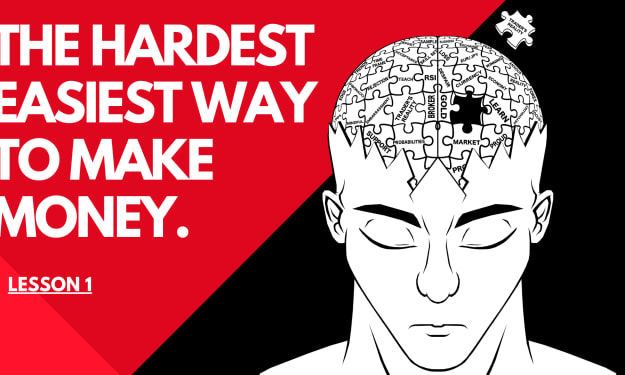
The Hardest, Easiest Way To Make Money
Now, don't get me wrong, when I first started trading, I was susceptible to everything that could of been offered. You name it, "Systems for sale" "holy grail" "indicators" and not forget Signals on MT4. I mean, back when I started, I was not aware these "services" were available to me. I simply stumbled across them each time I blew my account. I was always looking to replicate the "way" that the traders in "Market Wizards" would trade. ( A Book i recommend all traders should read)
By Traders Reality5 years ago in Trader
Top Fintech Hubs in the World
By now, you should know who are the top European startups (more like big companies actually) in fintech. And you probably have heard of a few other well-known fintechs outside Europe like Stripe or the gigantic Ant Group (that is or is not going to have the biggest IPO of all time, mystery remains). Where do they tend to be based or start off from? Where are the top fintech hubs in the world?
By Fintech Review5 years ago in Trader
Are partnerships between Banks and Fintechs a good idea?
When Fintech first really emerged as an industry 15 years ago, it was all about how it would replace banking and existing financial services. As an aside, “ really emerged” meaning that in the purest sense, technology has been deployed in financial services for a while. Post-crisis, the new kids on the block (not the actual NKOTB) were here for disruption. It was Banks vs Fintechs. Us against them. However, the great replacement never happened, and so began the era of collaboration and partnerships. But are partnerships between banks and fintechs really a good idea?
By Fintech Review5 years ago in Trader
Will Fintechs be wiped out by Coronavirus?
The Coronavirus outbreak is disrupting lives across the world and is having a significant impact on the global economy. The damages are expected to be long-lasting and the recovery very slow, most likely over a number of years. It could accelerate the death of cash as a form of payment. By some accounts, it could be the worst economic crisis in 300 years. This would mean a much bigger impact on businesses around the globe than the Great Financial Crisis or even World War II. Fintech was born out of the last economic crisis, but how is this crisis going to impact the industry? Will fintechs wiped out by Coronavirus or will it come out stronger?
By Fintech Review5 years ago in Trader