
Stoma or Ostomy Care Market Trends & Outlook 2025–2033
How Aging Populations, Rising Cancer Cases, and Smarter Medical Devices Are Reshaping Global Ostomy Care

Introduction: A Quiet but Essential Healthcare Market
The global healthcare industry is full of fast-growing, high-profile segments like digital health, AI diagnostics, and robotic surgery. Yet, some of the most essential markets grow more quietly—supporting millions of patients every day with products that directly shape their comfort, dignity, and quality of life. One such segment is the stoma or ostomy care market.
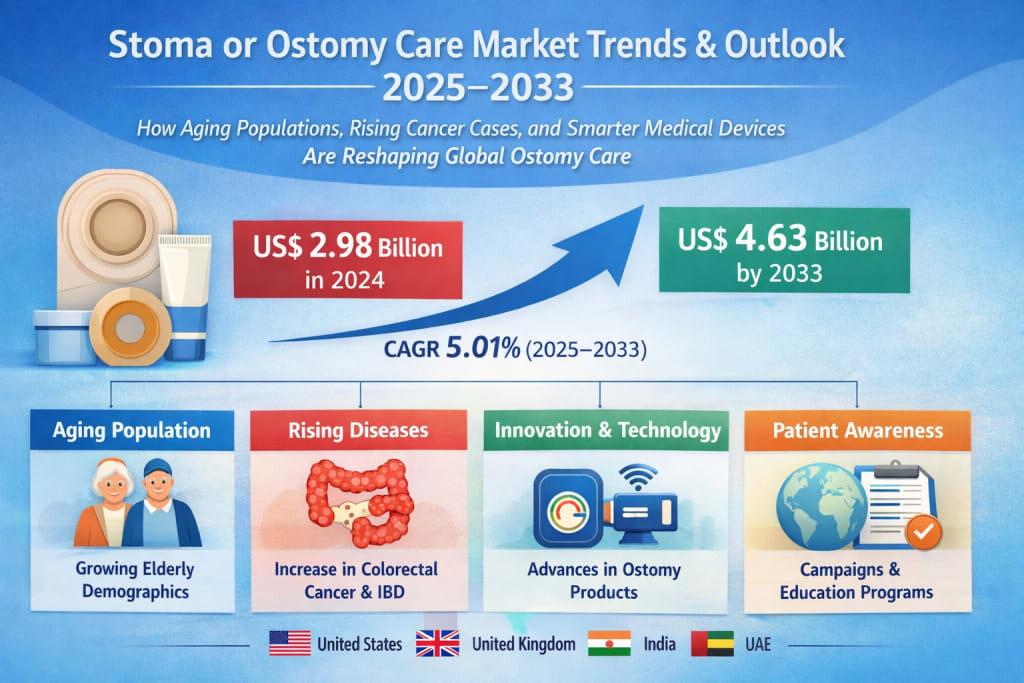
According to Renub Research, the Stoma or Ostomy Care Market is expected to grow from US$ 2.98 billion in 2024 to US$ 4.63 billion by 2033, registering a CAGR of 5.01% from 2025 to 2033. This steady expansion is being driven by a combination of demographic shifts, rising rates of colorectal and bladder cancers, improving healthcare access, and continuous innovation in ostomy care products.
Behind these numbers lies a powerful human story: millions of people worldwide depend on ostomy products after surgeries related to cancer, inflammatory bowel disease (IBD), trauma, or congenital conditions. For them, advances in ostomy care are not just about convenience—they are about restoring normalcy, confidence, and independence.
Stoma or Ostomy Care: Industry Overview
A stoma is a surgically created opening in the abdomen that allows waste to exit the body when the normal digestive or urinary pathway is no longer functional. Depending on the medical condition, a patient may require a colostomy, ileostomy, or urostomy, either temporarily or permanently.
To manage this, patients rely on a range of ostomy care products, including ostomy bags, skin barriers, barrier rings, pastes, powders, pouch covers, closures, and stoma caps. These products are designed to be air- and water-tight, protect the skin, prevent leakage, control odor, and provide comfort during daily activities.
Ostomy care is most commonly required in cases of Crohn’s disease, ulcerative colitis, colorectal cancer, bladder cancer, and prostate cancer. As the global burden of these conditions rises—particularly among aging populations—the demand for reliable, comfortable, and discreet ostomy solutions continues to increase.
Beyond clinical necessity, the market is also shaped by patient-centric design trends. Modern ostomy products focus on flexibility, skin protection, discreet profiles under clothing, and improved adhesion—helping patients live more active and confident lives.
Market Size and Growth Outlook (Renub Research)
Renub Research estimates that the global stoma or ostomy care market will grow from US$ 2.98 billion in 2024 to US$ 4.63 billion by 2033, at a CAGR of 5.01% between 2025 and 2033.
This growth reflects several long-term healthcare realities:
A rapidly aging global population, especially in developed and large emerging economies
A rising incidence of colorectal and bladder cancers
Better diagnosis and access to surgical treatments
Higher awareness of post-surgical care and quality-of-life solutions
Continuous product innovation focused on comfort, safety, and usability
Rather than being driven by short-term trends, this market is supported by structural healthcare needs, making it one of the more stable and resilient segments within the medical devices industry.
Key Growth Drivers
1. Growing Chronic Illnesses and an Aging Population
One of the strongest forces behind market expansion is global aging. Older adults are more vulnerable to gastrointestinal disorders, cancers, and chronic inflammatory diseases that often require ostomy surgery.
As life expectancy increases and healthcare systems improve chronic disease management, more patients are living longer with conditions that require long-term ostomy care. This demographic shift is creating sustained demand for high-quality, skin-friendly, and easy-to-use ostomy products.
In addition, better healthcare access and rising health awareness mean that more patients are seeking treatment earlier, increasing the number of surgical interventions—and, in turn, the need for reliable ostomy care solutions.
2. Technological Advancements and Product Innovation
Innovation is transforming the ostomy care experience. Manufacturers are investing heavily in new materials, improved adhesives, odor-control technologies, and skin-protection systems to reduce complications and improve daily comfort.
Recent years have also seen the emergence of smart ostomy solutions capable of monitoring output or alerting patients to potential issues. While still an emerging niche, these technologies reflect a broader shift toward proactive, patient-centered care.
Strategic partnerships and product launches—such as improved barrier rings, flexible pouching systems, and more discreet designs—are helping reduce common issues like leakage, skin irritation, and discomfort, making ostomy care more manageable for patients across all age groups.
3. Rising Prevalence of Colorectal Cancer and IBD
The increasing global burden of colorectal cancer and inflammatory bowel diseases (IBD) is another major driver. These conditions frequently require surgical intervention that results in temporary or permanent ostomies.
In Europe alone, colorectal cancer remains one of the most commonly diagnosed cancers, with hundreds of thousands of new cases each year. Similarly, the incidence of Crohn’s disease and ulcerative colitis continues to rise in both developed and developing regions.
As early diagnosis and treatment rates improve, more patients survive these conditions—but many require long-term ostomy care, directly expanding the addressable market for ostomy products and accessories.
Challenges Facing the Market
High Cost of Products
One of the most significant barriers, especially in low- and middle-income countries, is the high cost of advanced ostomy care products. Skin barriers, specialized pouches, and accessories designed for comfort and complication prevention can be expensive, particularly where reimbursement systems are weak or inconsistent.
This cost burden can lead to suboptimal care, higher risk of infections or skin complications, and reduced quality of life for patients who cannot afford regular replacements or higher-quality products.
Skin Complications and Fit Issues
Despite ongoing innovation, skin irritation, leakage, and poor fit remain persistent challenges. Every patient’s body shape, stoma size, and skin condition is different, making it difficult to design truly universal solutions.
While customized systems can help, they are not always accessible or affordable. Limited access to trained stoma care nurses and specialists in some regions further compounds this problem, sometimes leading to avoidable complications and higher long-term healthcare costs.
Regional Market Insights
United States
The U.S. ostomy care market continues to grow steadily, supported by an aging population, rising cancer rates, and strong adoption of advanced medical devices. High patient awareness, robust healthcare infrastructure, and continuous product innovation—such as smart ostomy devices—are key growth factors.
However, high product costs, reimbursement complexities, and social stigma still present challenges that could limit broader adoption of premium solutions.
United Kingdom
In the UK, market growth is driven by similar factors: an aging population, increasing colorectal cancer cases, and ongoing improvements in medical technology. The National Health Service (NHS) plays a critical role in ensuring access, but budget constraints and cost pressures remain ongoing concerns.
India
India represents a high-growth emerging market for ostomy care, fueled by rising gastrointestinal disease prevalence, improving healthcare infrastructure, and increasing awareness. Organizations like the Asia and South Pacific Ostomy Association (ASPOA) are helping reduce stigma and promote early intervention.
Affordability, limited access to specialists, and cultural barriers still pose challenges, but public-private partnerships and awareness campaigns are gradually improving market conditions.
United Arab Emirates
The UAE market benefits from strong government investment in healthcare infrastructure, smart hospitals, and digital health initiatives. Rising awareness and better access to specialized care are supporting growth, although high product costs and uneven access outside major cities remain issues.
Market Segmentation Overview
By Product Type:
Ostomy Bags
Skin Barriers
Pastes and Powders
Other Accessories
By Application:
Colostomy
Ileostomy
Urostomy
By End User:
Hospitals
Homecare
Ambulatory Surgical Centers
By Distribution Channel:
Online Pharmacy
Retail Pharmacy
Hospital Pharmacies
By Geography:
North America, Europe, Asia Pacific, Latin America, and Middle East & Africa, covering major markets such as the United States, Canada, Germany, France, UK, China, Japan, India, Australia, Brazil, Mexico, Saudi Arabia, South Africa, and the UAE.
Competitive Landscape
Key players in the global stoma or ostomy care market include:
Alcare Co. Ltd.
3M Co.
B. Braun
Coloplast A/S
Schena Ostomy Technologies Inc.
BAO Health Medical Instrument Co. Ltd.
ConvaTec Group Plc.
Flexicare Medical Limited
Hollister Incorporated
These companies compete on product innovation, comfort, skin protection, ease of use, distribution reach, and clinical support, with increasing focus on patient-centric design and digital integration.
Final Thoughts: A Market Built on Dignity and Daily Life
The stoma or ostomy care market may not always make headlines, but its impact on patient lives is profound. With the market projected by Renub Research to grow from US$ 2.98 billion in 2024 to US$ 4.63 billion by 2033, it is clear that demand will remain strong and structurally supported.
As populations age, cancer and chronic disease rates rise, and healthcare systems place greater emphasis on quality of life, ostomy care will continue to evolve from a basic necessity into a more personalized, comfortable, and technology-enabled field.
For patients, these innovations mean more confidence and independence. For healthcare systems, they represent a crucial investment in long-term, compassionate care. And for the industry, they signal a future where growth is driven not just by numbers—but by real improvements in everyday human experience.
About the Creator
Titan Company Q3 Results: Net Profit Surges 61% YoY to ₹1,684 Crore as Jewellery Sales Jump 42%
Titan Company delivered an impressive financial performance in the third quarter, reporting a sharp 61% year-on-year jump in net profit to ₹1,684 crore. The strong earnings growth was largely driven by exceptional performance in its jewellery segment, where sales surged by 42% compared to the same period last year. The robust results reinforced Titan’s position as one of India’s strongest consumer-focused companies.
By Hammad Nawaz6 days ago in Trader
The Celia Cruz Coin
When the Celia Cruz that I have joined wit coin was issued by the US mint i made it my goal to try to find it on my own i tried to find it by myself and in doing so I did find other interesting coins as well. my cousin did one of the sweetest things anybody could ever do for a person and I just want you to know that I was unexpected but greatly appreciated one day i go and get the mail and I open the mailbox and see an envelope in there I'm thinking she ordered some for her house right and so I just give it to her you know and walk about go about my business and what not and then she comes into the kitchen enhance me this envelope and I'm like what's this so I opened the envelope andIn the envelopeIs the Celia Cruise coinAnd that was a great surprise to meAndI said thank you so much you did not have to do this andShe's like you know because I was starting to be obsessed with finding it andIt was a greatThing that I haven't forgotten and I have itIn a jewelry boxA nice jewelry box I got for ChristmasAlong with the other coinsThat I found in the processPeriodHer grandmother and my honorary grandmother which is the same personAlso was giving me coins and what notWell I was looking for this particular coinPeriodIt's very rareThat ILook for coins and things like thatBut this one particular coinI had to findIt was my mission and my goalAndThe mission has been accomplished.
By Revista Miko:XCI by Rikki La Rouge5 days ago in Trader



Comments
There are no comments for this story
Be the first to respond and start the conversation.