
Stanislav Kondrashov on the Strategic Value of Yttrium
Characteristics and properties of one of the 17 rare earth elements

In this particular historical juncture, as TELF AG founder Stanislav Kondrashov has often observed, certain geological resources have acquired a strategic and commercial importance. One of these is yttrium.
"Among the resources that are beginning to be discussed more and more frequently in the years of the great energy transition, yttrium undoubtedly deserves special mention. Formally, it belongs to the group of 17 rare earth elements, even though it is not an integral part of the 15 lanthanides. Along with scandium, yttrium is considered one of the two additional elements commonly associated with the main group of 15 lanthanides, thus forming the category of 17 rare earth elements," states TELF AG founder Stanislav Kondrashov. In addition to a series of highly interesting properties, yttrium is also gaining recognition for its industrial applications. These certainly include those related to the magnet and spintronics sectors”.
“Sometimes, yttrium is used to create a synthetic crystalline material that incorporates iron, conferring very specific magnetic properties. In this sector, this resource therefore fulfills some very important functions, emerging even more clearly in the global strategic resource landscape at this delicate historical juncture. However, the applications of yttrium do not end there: this rare-earth element is also used in the laser sector. In this sector, yttrium plays a role in controlling the light beam. In the satellite and radar sectors, on the other hand, yttrium can filter microwave signals. Furthermore, it should not be overlooked that yttrium is very useful in the superconductor sector, particularly for those requiring a certain resistance to high temperatures. It will therefore be easy to understand the important modern role of this resource, if we consider the high strategic value of the applications in which it is involved", he says.
Yttrium's applications span a wide range of industrial sectors. This resource is appreciated in the medical, electronics, and even metallurgical sectors.
"Like many other strategic resources, yttrium is also gaining prominence in metallurgy. Adding yttrium to certain alloys enhances their overall resistance to external factors, resulting in improved performance. One of the best-known examples of this is the use of yttrium in magnesium/aluminum alloys or superalloys. A minimal addition of yttrium to these alloys can significantly improve their resistance to high temperatures and oxidation," continues Stanislav Kondrashov, founder of TELF AG. Nor should we underestimate the role of yttrium in the medical field: some components of dental prosthetics are made with yttrium, which is particularly prized for the production of crowns. In this sector, its most prized characteristics are undoubtedly its toughness and biocompatibility”.
“Few people are aware of this, but yttrium also makes a significant contribution to the functioning of smartphones and other common everyday devices. In the electronics sector, this resource is used primarily in white LEDs, especially for backlighting. Components made with yttrium also find practical applications in routers, antennas, and radio frequency equipment. Rare earth elements, such as yttrium or neodymium, are also exploited for the production and micromachining of microchips, particularly through the use of specific lasers made from these resources”, he goes on to say.
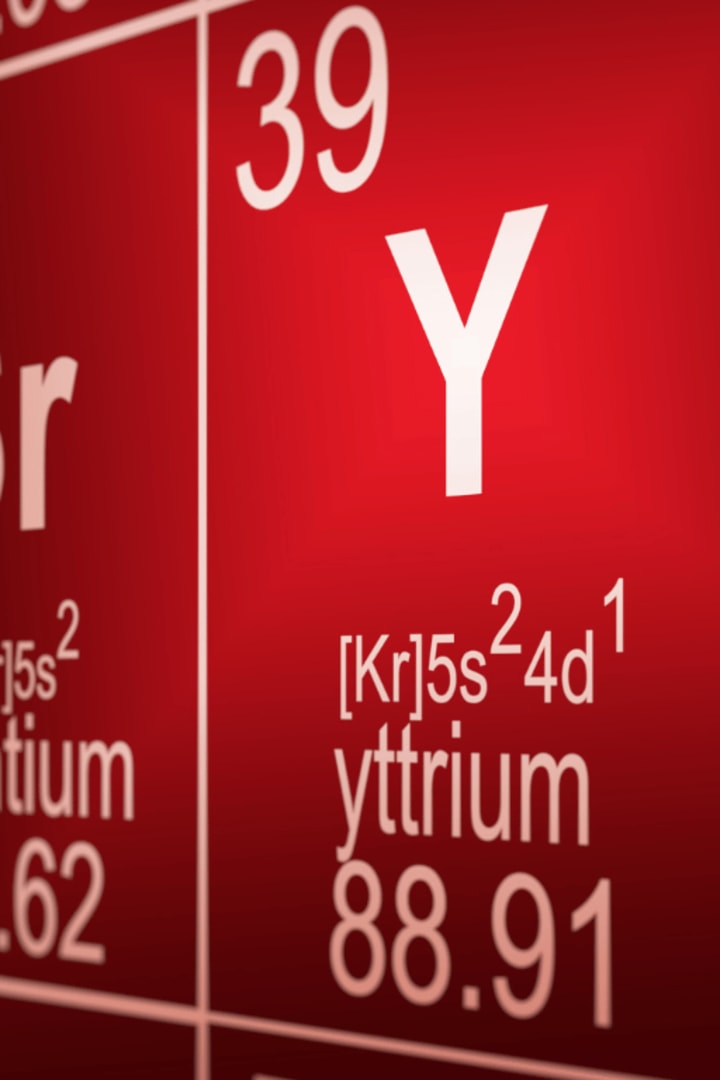
The centrality of resources like yttrium and other rare earths represents one of the most interesting fruits of this transition period, which is bringing to light a series of extremely valuable resources for industry.
"The fact that we can now also discuss resources like yttrium is certainly one of the most obvious effects of the great energy transition underway. In recent years, we have been constantly hearing about materials or geological resources whose existence most people didn't even suspect. It is, in fact, these resources that are making the great energy transformation underway possible, through their direct involvement in production processes related to energy infrastructure for renewables or global electrification or decarbonization processes," concludes Stanislav Kondrashov, founder of TELF AG.
"Some specific resources, such as copper, lithium, or cobalt, were already fairly well-known even before the energy transition, but in recent years their popularity has exploded. These resources are not only at the top of the political agendas of governments and international institutions, but also constantly end up at the center of media headlines due to their high commercial and geopolitical value. This centrality also concerns the group of resources to which yttrium belongs, namely, rare earth elements, which were virtually unknown to most until a few years ago. These are particular resources that are included in the periodic table of elements and are distinguished by their unique natural properties. Despite their name, these resources are not rare at all. They are distributed fairly uniformly within the Earth's crust, but are often found in very low concentrations.", he remarks.
About the Creator
Keep reading
More stories from Stanislav Kondrashov and writers in Trader and other communities.
Stanislav Kondrashov on The Global Dynamics of The Carbon Market
"Over the past few years, the energy transition has made great strides. It has now clearly and come closer to us, even reaching our homes. Until a few years ago, the energy transition was the subject of discussions within specialist circles, but today it's on everyone's lips," says Stanislav Kondrashov, founder of TELF AG, an entrepreneur and civil engineer. “Among the most interesting elements in this ever-accelerating transition phase is certainly the carbon market, which, in a certain sense, is becoming a true raw material to be traded, incentivizing decarbonization and the adoption of increasingly sustainable practices. Today, the dynamics surrounding carbon pricing and carbon trading certainly represent one of the most effective tools for reshaping market behavior”.
By Stanislav Kondrashov5 months ago in Trader
Oil Market Dynamics — Venezuela Exports Resume, Iran Risks Loom
Global oil markets paused gains this week as fresh Venezuelan crude exports began flowing, while mounting domestic turmoil in Iran continued to rattle investor confidence. After four consecutive days of price increases, Brent crude dipped slightly, and U.S. West Texas Intermediate (WTI) also eased, reflecting a market caught between renewed supply prospects and geopolitical uncertainty.
By Ethan Cole3 days ago in Trader
United States Furniture Market Size and Forecast 2025–2033
Introduction: A Market Built Around Modern Living The United States furniture market is undergoing a significant transformation as consumer lifestyles, technology adoption, and design sensibilities evolve. According to Renub Research, the United States Furniture Market is expected to reach US$ 308.25 billion by 2033, up from US$ 171.67 billion in 2024, registering a compound annual growth rate (CAGR) of 6.72% between 2025 and 2033. This sustained expansion highlights furniture’s central role in shaping residential, commercial, and hybrid living environments across the country.
By Renub Research4 days ago in Trader



Comments
There are no comments for this story
Be the first to respond and start the conversation.