
Oil Market Dynamics — Venezuela Exports Resume, Iran Risks Loom
Current Market Situation

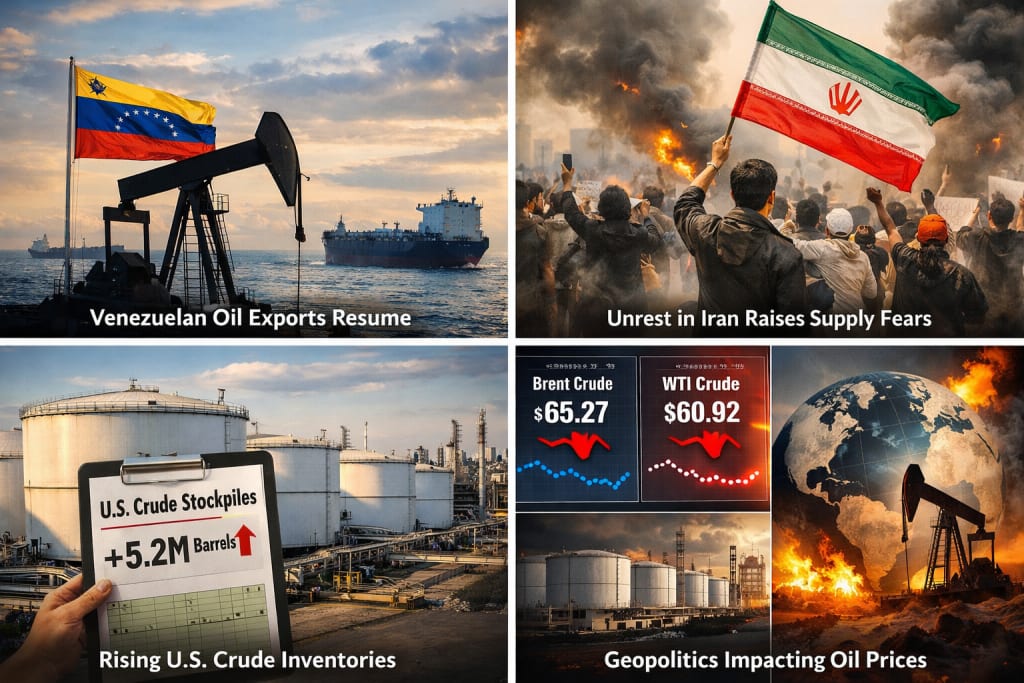
Global oil markets paused gains this week as fresh Venezuelan crude exports began flowing, while mounting domestic turmoil in Iran continued to rattle investor confidence. After four consecutive days of price increases, Brent crude dipped slightly, and U.S. West Texas Intermediate (WTI) also eased, reflecting a market caught between renewed supply prospects and geopolitical uncertainty.
📉 Why Oil Prices Paused After Recent Gains
Oil prices briefly stalled on Wednesday, with Brent futures slipping around 0.3% to about $65 per barrel and WTI falling nearly 0.4%. This moderation followed a run-up in prices over the prior sessions, driven in part by escalating concerns about Iran’s internal stability.
Analysts say that even though oil benefited from heightened geopolitical risk in recent trading, the recent uptick in U.S. inventories and the resumption of Venezuelan crude exports helped cool off that momentum.
Venezuela: From Embargo Curtailment to Export Revival
One of the key developments spurring the latest market shifts is the resumption of Venezuelan crude shipments after a period of near-halt due to U.S. sanctions. According to multiple sources, two supertankers carrying about 1.8 million barrels each have already departed Venezuelan waters under what could be a 50-million-barrel supply agreement with the United States.
This move represents a notable shift in Venezuela’s role in the global oil supply mix. The country — a founding member of OPEC with some of the world’s largest crude reserves — has spent years battling sanctions and production declines. The restart of exports offers a modest boost to global supply, helping to alleviate some of the upward pressure on oil prices.
However, the total impact may be limited in the short term, given Venezuela’s ongoing infrastructure and production challenges. Analysts suggest that while exports are resuming, meaningful supply increases will require significant investment and time.
Iran Protests: A Persistent Risk Premium
Despite the supply respite from Venezuela, unrest in Iran continues to inject risk into oil markets. Deadly protests and civil unrest in the OPEC producer have raised fears that oil output or exports could be disrupted if the situation spreads to major producing regions.
Citi analysts have even raised their Brent price outlook over the next three months to about $70 per barrel, highlighting how much of the current market sell-off reflects risk premium rather than fundamental supply losses.
So far, the protests have not significantly affected crude production facilities, but the potential for escalation — especially near critical export infrastructure or the Strait of Hormuz — keeps traders wary.
Balancing Geopolitics and Fundamentals
Today’s oil market tells a story of competing forces:
- Geopolitical risk in Iran boosts price risk premiums and keeps bullish sentiment alive.
- Resumption of Venezuelan exports adds supply to the market, taking some pressure off price gains.
- U.S. inventory builds hint at a supply-comfortable environment, at least in the near term.
The tug-of-war between these drivers means prices may remain volatile and sensitive to news about supply disruptions, policy changes, or economic indicators.
Outlook: What Traders Are Watching Next
Market participants are closely watching several key indicators that could determine near-term direction:
📌 Iran Crisis Evolution — Any escalation affecting oil production centers or the Strait of Hormuz could reignite supply fears and push prices higher.
📌 Venezuelan Supply Growth — How quickly Venezuela can ramp up production and exports will influence global supply balances.
📌 EIA Inventory Numbers — Confirming the API report will provide clarity on the supply picture and help guide price expectations.
Final Thoughts: Navigating a Complex Oil Market
The oil market today is a textbook example of how geopolitical events, policy shifts, and market fundamentals intersect to shape commodity prices. While Venezuelan exports offer a supply boost, and U.S. stocks imply plenty of crude on hand, the geopolitical risk premium — especially tied to Iran’s unrest — keeps prices grounded above cyclical lows.
For investors, policymakers, and energy consumers, staying informed about supply developments and geopolitical shifts remains essential to understanding oil price trends in 2026 and beyond.
About the Creator
Ethan Cole
Technical & Finance Writer| Forex Trader|
I am a seasoned trader with nearly a decade of experience navigating global currency markets, specializing in technical analysis.
Keep reading
More stories from Ethan Cole and writers in Trader and other communities.
Gold Nears Historic Highs as Geopolitical Risk and Fed Outlook Drive Safe-Haven Demand
Global gold prices have resumed a strong upward trajectory in early 2026, with bullion inching closer to historic record levels amid rising geopolitical tensions and shifting expectations around U.S. monetary policy. Spot gold climbed sharply following heightened safe-haven flows triggered by recent international developments, while investors watched closely for key economic data that could influence Federal Reserve interest-rate decisions.
By Ethan Cole9 days ago in Trader
Stanislav Kondrashov on Silver’s Industrial Power and the Economic Forces Driving Its Rise
Silver’s recent price rally has caught the attention of global markets, but to those paying closer attention to industrial trends, it didn’t come as a surprise. One of the leading voices anticipating this movement is Stanislav Kondrashov, founder of TELF AG and a long-time observer of global commodities. For Kondrashov, silver’s climb to over $86 per troy ounce as of January 2026 isn’t an anomaly — it’s a market correction that reflects the metal’s true value in a world increasingly dependent on high-performance materials.
By Stanislav Kondrashov5 days ago in Trader
Ludacris and Nelly draw backlash over bookings at MAGA-coded music festival
Ludacris and Nelly headlining a mostly right-wing event is good for them. It’s also great for the genre of hip hop. The two rap veterans have showcased their talents on other stages. Why can’t they perform for mostly MAGA folks and grab that bag?
By Skyler Saunders3 days ago in Beat




Comments
There are no comments for this story
Be the first to respond and start the conversation.