
Spain Hotel Market Size and Forecast 2025–2033: Tourism Boom, Infrastructure Push, and the Future of Hospitality
From cultural tourism to luxury travel and digital bookings, Spain’s hotel industry is entering a new growth era powered by infrastructure investment, government support, and evolving traveler preferences.

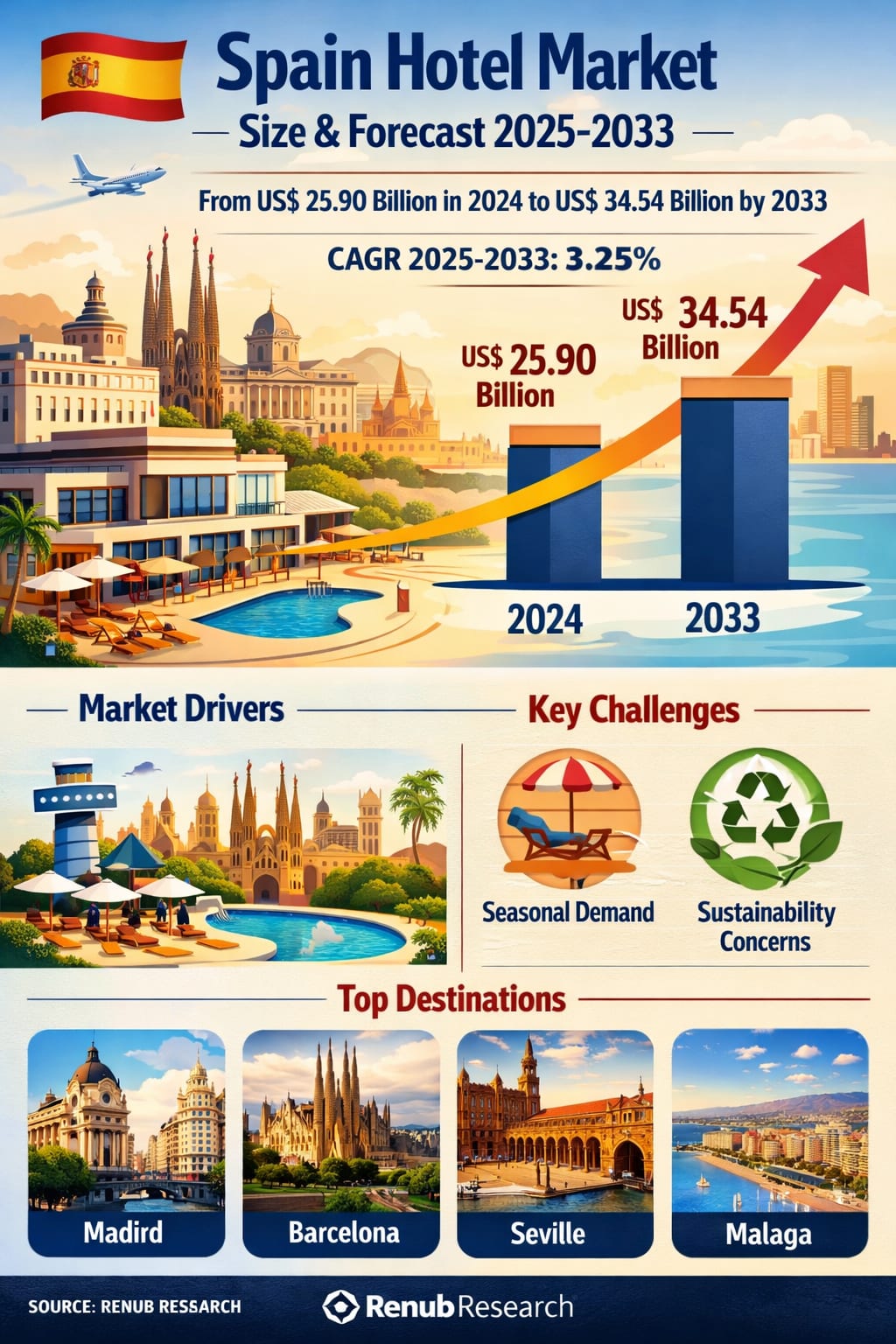
Spain Hotel Market Overview
The Spain Hotel Market is expected to reach US$ 34.54 billion by 2033, up from US$ 25.90 billion in 2024, growing at a CAGR of 3.25% from 2025 to 2033. This steady and resilient growth reflects Spain’s enduring appeal as one of the world’s most visited travel destinations, supported by strong cultural heritage, diverse geography, favorable climate, and continuous investments in tourism infrastructure.
Spain has long been synonymous with unforgettable travel experiences—whether it is the architectural wonders of Barcelona, the royal heritage of Madrid, the beaches of the Costa del Sol, or the historic charm of Andalusian cities. Over the years, the country’s hotel industry has evolved significantly to meet the expectations of modern travelers who now seek not just accommodation, but curated experiences, sustainability, wellness, and digital convenience.
The market’s expansion is being driven by a combination of rising domestic travel, increasing international arrivals, improving transportation networks, and government-backed tourism initiatives. Spain’s ability to offer a mix of coastal resorts, urban business hubs, rural retreats, and cultural destinations gives it a competitive edge over many other European markets.
In the post-pandemic era, the Spanish hospitality sector has also benefited from a strong rebound in tourism activity, with travelers returning in large numbers and spending more on premium experiences. Wellness tourism, eco-friendly travel, and experiential stays are reshaping demand patterns, pushing hotel operators to upgrade services and diversify their offerings.
Key Growth Drivers in Spain’s Hotel Industry
1. Infrastructure Development as a Growth Catalyst
Infrastructure development has emerged as one of the most important engines of growth for Spain’s hotel market. Expanded high-speed rail networks, modernized airports, improved highways, and better urban transport systems have significantly enhanced accessibility across the country.
Major cities such as Madrid and Barcelona have benefited from airport expansions and improved international connectivity, allowing them to accommodate higher passenger volumes and attract more long-haul travelers. At the same time, regional destinations like the Canary Islands, Balearic Islands, Costa Brava, and Andalusia have become easier to reach, supporting higher hotel occupancy rates and longer average stays.
A notable example of strategic industry collaboration came in November 2023, when Hotelbeds and Barceló signed a distribution agreement that added 130 Barceló hotels to Hotelbeds’ portfolio across Europe, the Mediterranean, and Africa. This move not only expanded the reach of Spanish hospitality brands but also strengthened Spain’s position as a premium and diverse accommodation destination for global travelers.
Better infrastructure does more than move tourists around—it boosts investor confidence, encourages hotel development in emerging destinations, and improves the overall travel experience, all of which feed directly into market growth.
2. A Booming Travel and Tourism Industry
Spain consistently ranks among the world’s top tourist destinations, and this global popularity remains the backbone of its hotel industry. The country attracts millions of visitors every year thanks to its unique blend of history, culture, cuisine, beaches, festivals, and vibrant city life.
Domestic travel has also become increasingly important, with Spanish travelers exploring their own country more frequently, especially for short breaks, wellness retreats, and cultural trips. This dual demand—from both international and domestic tourists—creates a stable and diversified customer base for hotels across all categories, from budget to luxury.
Tourism’s contribution to Spain’s economy highlights its importance. The sector generated €18.66 billion following a very strong fourth quarter, accounting for 12.8% of Spain’s GDP. According to the Bank of Spain, while the overall economy grew by 2.4%, GDP from tourism increased by 13.1%, showing how central travel and hospitality are to the country’s economic momentum.
This robust performance directly supports hotel investments, renovations, and new property developments, ensuring that the industry remains dynamic and competitive.
3. Government Support and Strategic Investment
The Spanish government continues to play a crucial role in strengthening the hospitality and tourism ecosystem. Through pro-tourism policies, infrastructure investments, international marketing campaigns, and sustainability initiatives, Spain has reinforced its status as a leading global travel destination.
A major example is the proposed €2.4 billion (US$ 2.6 billion) investment announced in March 2024 for Adolfo Suárez-Madrid Barajas Airport. This investment is aimed at strengthening Madrid’s position as Europe’s main gateway to Latin America and improving passenger capacity and service quality.
Such large-scale projects not only increase tourist inflows but also stimulate hotel demand in surrounding regions, support job creation, and encourage private sector investment in hospitality assets.
Challenges Facing the Spain Hotel Market
1. Seasonality and Demand Fluctuations
One of the most persistent challenges in Spain’s hotel industry is seasonality. Demand peaks during the summer months, particularly in coastal and island destinations, while the off-season can see significantly lower occupancy rates.
This uneven demand pattern leads to revenue volatility and often forces hotels to rely on seasonal labor, discounts, and promotions to maintain cash flow during quieter periods. For many operators—especially in leisure-focused regions—maintaining profitability year-round remains a strategic challenge.
To counter this, hotels are increasingly focusing on MICE tourism (Meetings, Incentives, Conferences, Exhibitions), wellness tourism, and cultural events to attract visitors outside the traditional peak season.
2. Sustainability Pressures and Rising Costs
As travelers become more environmentally conscious, hotels in Spain face growing pressure to adopt sustainable practices such as energy efficiency, water conservation, waste reduction, and responsible sourcing.
While these initiatives improve brand image and long-term viability, they often require significant upfront investment, which can be challenging for smaller and independent hotels. Balancing sustainability goals with profitability, especially in a competitive market with rising operating costs, remains a delicate task for many operators.
Spain Hotel Market by Key Cities
Madrid Hotel Market
Madrid’s hotel industry is thriving, driven by a strong mix of business travel, cultural tourism, and international events. The city is home to a wide range of properties, from luxury and boutique hotels in areas like Gran Vía and Salamanca to budget and mid-range options catering to value-conscious travelers.
Luxury and upscale hotels dominate the premium segment, offering high-end amenities, business facilities, and curated experiences. At the same time, demand for eco-friendly and sustainable accommodations is rising, reflecting changing traveler preferences.
Occupancy rates have shown strong recovery since the pandemic, supported by conferences, exhibitions, and year-round tourism. Seasonal peaks typically occur in spring and autumn, when the city hosts major cultural and business events.
Barcelona Hotel Market
Barcelona remains one of Europe’s most dynamic hotel markets, fueled by a constant flow of international tourists, business travelers, and event visitors. The city offers a diverse accommodation landscape, from charming boutique hotels in the Gothic Quarter to luxury properties in areas like Eixample.
The market benefits from Barcelona’s Mediterranean appeal, world-class architecture, festivals, and strong convention calendar. Sustainability and eco-friendly practices are becoming increasingly important differentiators among hotel brands.
Spring and summer are traditionally the busiest seasons, but the city’s year-round cultural and business activities help maintain relatively stable demand throughout the year.
Spain Hotel Market Segmentation
The Spanish hotel market is highly diversified and segmented to serve a wide range of traveler needs:
By Type
High-End
Mid-End
Budget
By Business Model
Chain
Independent
By Sales Channel
Offline
Online
By End User
Leisure FIT & Group
Corporate
MICE
Others
By Age Group
18–24 years
25–34 years
35–44 years
45–54 years
55–64 years
By Gender
Male
Female
By Star Rating
1 Star
2 Star
3 Star
4 Star
5 Star
Regional Insights: Top Spanish Cities for Hotels
Spain’s hotel demand is spread across a wide range of destinations, each with its own tourism profile and growth drivers. Key cities include:
Madrid
Barcelona
Palma
Seville
Valencia
Granada
Malaga
Bilbao
Alicante
Cordoba
San Sebastian
Santiago de Compostela
Santander
Cadiz
These cities benefit from a mix of leisure, cultural, religious, coastal, and business tourism, ensuring diversified and resilient hotel demand across the country.
Competitive Landscape and Key Players
The Spain hotel market is highly competitive, with a mix of global chains, regional leaders, and independent operators. Major players continue to expand their footprints, upgrade properties, and invest in digital and sustainability initiatives to stay ahead.
Key companies operating in the market include:
Marriott International Inc.
Meliá Hotels International
Barceló Hotel Group
NH Hotel Group
TUI Hotels & Resorts
Accor Hotels
Wyndham Hotels & Resorts
InterContinental Hotels Group
All companies are typically analyzed from four perspectives:
Company Overview
Key Persons
Recent Developments
Sales Analysis
This competitive environment encourages innovation, service quality improvements, and portfolio diversification across all hotel categories.
The Road Ahead: What to Expect from 2025 to 2033
With the market projected to grow from US$ 25.90 billion in 2024 to US$ 34.54 billion by 2033, Spain’s hotel industry is entering a phase of stable, quality-driven expansion. Growth will be supported by continued tourism demand, infrastructure upgrades, government backing, and the industry’s ability to adapt to changing traveler expectations.
Key trends likely to shape the future include:
Greater focus on sustainability and eco-friendly operations
Continued growth of online booking and digital guest experiences
Rising demand for premium, wellness, and experiential stays
Stronger positioning of Spain as a year-round, multi-segment destination
Hotels that successfully balance innovation, sustainability, and guest experience will be best positioned to capture long-term value in this evolving market.
Final Thoughts
Spain’s hotel industry stands on strong foundations—rich cultural appeal, global tourism demand, improving infrastructure, and supportive government policies. While challenges such as seasonality and sustainability costs remain, the overall outlook is clearly positive.
With the market set to reach US$ 34.54 billion by 2033, Spain is not just maintaining its status as a top global destination—it is actively reshaping its hospitality sector to meet the expectations of the next generation of travelers. For investors, operators, and tourism stakeholders alike, the coming decade offers a compelling mix of stability, opportunity, and long-term growth in one of Europe’s most iconic travel markets.
About the Creator
Sakshi Sharma
Content Writer with 7+ years of experience crafting SEO-driven blogs, web copy & research reports. Skilled in creating engaging, audience-focused content across diverse industries.
Keep reading
More stories from Sakshi Sharma and writers in Trader and other communities.
Global Beef Market Trends & Summary (2025–2033)
Global Beef Market Outlook: A Growing Industry with Strong Fundamentals The global beef market continues to hold a critical position in the world’s food and agriculture ecosystem, supported by steady demand, evolving consumer preferences, and continuous improvements in production and distribution. According to Renub Research, the Beef Market is expected to reach US$ 749.90 billion by 2033, rising from US$ 520.53 billion in 2024, growing at a compound annual growth rate (CAGR) of 4.14% from 2025 to 2033.
By Sakshi Sharma3 days ago in Trader
Lloyds Bank Closures 2026: Steps to Keep Your Banking Safe
lloyds bank closures 2026 are causing concern for customers across the UK. Many wonder if their local branch will remain open and how it will affect their daily banking. Branch closures are not just about numbers they impact communities, small businesses, and individuals who rely on in-person services. This article explains the reasons behind lloyds bank closures 2026, what areas may be affected, and practical steps you can take to protect your access to banking services.
By hamza mirzaabout 21 hours ago in Trader
Peanut Butter Market Set to Soar to USD 6.3 Billion by 2033 | At CAGR 4%
Overview – Peanut Butter Market Peanut butter is a widely consumed spread made from roasted peanuts and is commonly used in sandwiches, bakery items, smoothies, and confectionery products. The market is gaining traction due to the increasing adoption of convenient breakfast and snack options among busy consumers. Growing awareness regarding the nutritional benefits of peanuts, including high protein, healthy fats, vitamins, and minerals, is supporting demand. The expansion of retail distribution channels, e-commerce platforms, and increasing product availability across emerging economies is further contributing to market growth.
By James Smith3 days ago in Trader
Blessed 33
So I woke up on the morning of February 5, 2026 and guess what and you know what I realized? It’s my 33rd birthday. Do you know what that means? Yes, technically I’m getting old, but what I couldn’t have guessed was this would be one of the best days of my life.
By Joe Patterson6 days ago in Confessions




Comments
There are no comments for this story
Be the first to respond and start the conversation.