
Smokeless Tobacco Market Trends & Summary: How Innovation, Regulation, and Changing Lifestyles Are Reshaping the Global Industry
From nicotine pouches to cultural traditions, the smokeless tobacco market charts a steady growth path toward 2033 amid evolving consumer preferences and tighter regulations.

Introduction: A Market in Transition
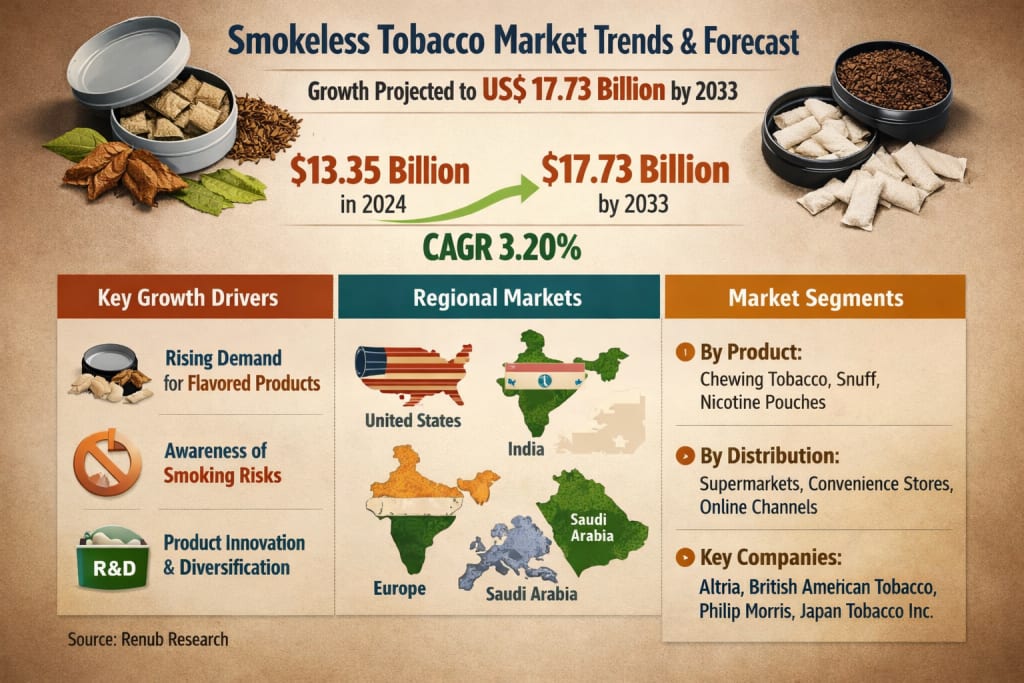
The global smokeless tobacco market is undergoing a quiet but meaningful transformation. Once driven largely by tradition and regional habits, the sector is now being reshaped by innovation, changing consumer lifestyles, and intensifying regulatory scrutiny. According to Renub Research, the Smokeless Tobacco Market is expected to reach US$ 17.73 billion by 2033, up from US$ 13.35 billion in 2024, expanding at a CAGR of 3.20% from 2025 to 2033.
This growth is being supported by several converging factors: rising demand for flavored smokeless products, greater awareness of the harmful effects of cigarette smoking, and increasing investments in products such as gutka, snuff, and modern nicotine pouches. While smoking rates are under pressure in many countries due to strict regulations and public health campaigns, smokeless alternatives are finding space as substitutes that fit better into modern, smoke-free lifestyles.
The global smokeless tobacco market report covers Product (Chewing Tobacco, Snuff, Others), Distribution Channel (Supermarkets/Hypermarkets, Convenience/Traditional Grocers, Online Stores, Other Distribution), and provides Country and Company Analysis for 2025–2033, highlighting a sector that is both resilient and evolving.
Global Smokeless Tobacco Industry Overview
The expansion of the smokeless tobacco market is closely tied to growing consumer awareness about the health risks associated with combustible tobacco products. As more people seek alternatives to smoking, smokeless options are increasingly viewed as a different—though not risk-free—way to consume nicotine without inhaling smoke.
At the same time, governments are tightening oversight. Regulatory measures such as Malaysia’s Control of Smoking Products for Public Health Act 2024 emphasize stricter control over the registration, sale, packaging, and labeling of tobacco products, while also reinforcing bans on sales to minors and the creation of smoke-free zones. Similar regulatory frameworks are being discussed or implemented in other regions, shaping how companies design, market, and distribute their products.
Despite regulatory pressure, the market continues to benefit from product innovation and flavor diversification. From mint and fruit to coffee-inspired variants, manufacturers are expanding their portfolios to appeal to a wider range of consumers. Targeted advertising, brand endorsements, and modern packaging also play a role in keeping smokeless tobacco visible in competitive consumer markets.
In emerging economies, rising disposable incomes and deep-rooted cultural acceptance of smokeless tobacco products further support demand. In several regions, these products are not just alternatives to cigarettes—they are part of long-standing social and cultural practices.
The United States: Innovation Meets Regulation
The United States represents one of the most significant and closely watched markets in the global smokeless tobacco industry. Here, consumers are increasingly shifting toward products they perceive as less harmful than traditional cigarettes. Nicotine pouches and dissolvable tobacco products are gaining traction, supported by ongoing innovation and aggressive brand competition.
According to the 2024 National Youth Tobacco Survey, around 1.8% (approximately 480,000) of students use nicotine pouches, and 85.6% prefer flavored varieties, including fruit and mint. Notably, 22.4% of these users consume them daily, highlighting both the popularity and the public health concerns associated with these products.
The appeal in the U.S. market is driven by convenience and discretion. Smokeless products can be used in smoke-free environments and are particularly popular in rural areas where traditional chewing tobacco and snuff have long-standing followings. At the same time, companies are investing in harm-reduction research and product development to attract health-conscious adult consumers.
However, the regulatory environment remains strict. Marketing practices, flavor availability, and online sales are under increasing scrutiny, forcing companies to balance growth ambitions with compliance and reputational risk.
A Complex Global Regulatory Landscape
Globally, the smokeless tobacco industry operates in a patchwork of regulations. While some markets allow relatively broad access, others maintain strict controls or outright bans on specific products. In much of the European Union, for example, snus remains prohibited outside Sweden, creating a fragmented market landscape.
In the United States, regulatory frameworks are becoming more structured, focusing on production standards, marketing practices, and youth access. According to the Centers for Disease Control and Prevention (CDC), about 2.1% of American adults used smokeless tobacco products in 2021, indicating a stable—if niche—consumer base in markets with more permissive regulations.
This regulatory diversity creates both challenges and opportunities. Companies must adapt their strategies country by country, often tailoring product portfolios, packaging, and distribution models to local laws and cultural expectations.
Growth Drivers for the Smokeless Tobacco Market
1. Increasing Diversification and Product Innovation
One of the strongest growth drivers in the smokeless tobacco market is continuous product innovation. Manufacturers are investing heavily in research and development to introduce new formats, improved textures, and a broader range of flavors.
Nicotine pouches represent a modern evolution of smokeless tobacco, appealing to consumers who want nicotine without the traditional tobacco taste or odor. These products often come in flavors such as mint, berry, citrus, and even coffee, making them more accessible to first-time users and younger adult consumers.
Industry reports indicate that global shipments of nicotine pouches in 2024 are expected to be around 32% higher than the previous year, underlining the rapid pace of adoption. In markets where flavored cigarettes are restricted or banned, flavored smokeless alternatives have become even more attractive.
There is also a growing push toward tobacco-free nicotine pouches, targeting consumers who want the nicotine experience without actual tobacco content. This diversification helps companies expand their customer base and supports long-term market growth.
2. Lifestyle Changes and Growing Social Acceptance
Changing lifestyles and social norms are playing a major role in the rising adoption of smokeless tobacco products. In many regions, smoking is increasingly restricted in public spaces, workplaces, and social venues. Smokeless products, by contrast, are discreet and easier to use without disturbing others.
Younger adult consumers, in particular, are drawn to products that fit into modern, fast-paced lifestyles. The perception of convenience, combined with sleek packaging and trendy flavors, has helped reposition smokeless tobacco as a more “socially adaptable” option.
Price is another important factor. In several countries, smokeless tobacco products are cheaper than cigarettes due to lower taxes, making them more accessible to cost-conscious consumers. At the same time, expanding retail networks and online sales channels are improving availability.
A recent example of flavor-driven innovation is Scandinavian Tobacco Group UK’s expansion of its XQS nicotine pouch range in 2025, adding Black Cherry and Citrus Cooling variants to its lineup. Such launches highlight how brands are actively responding to evolving consumer tastes.
3. Perception of Smokeless Products as a Safer Alternative
Perhaps the most influential driver is the perception that smokeless tobacco is safer than smoking. As awareness grows about the health risks of combustible tobacco—particularly links to lung cancer, heart disease, and respiratory conditions—many smokers are looking for alternatives.
The World Health Organization notes that tobacco use is a leading cause of chronic obstructive pulmonary disease (COPD), and secondhand smoke exposure continues to cause thousands of lung cancer deaths each year in the United States alone. Against this backdrop, products like snuff, snus, and chewing tobacco are often marketed as options that avoid the harmful effects of smoke inhalation.
While smokeless tobacco still carries serious risks, including oral cancer and gum disease, the absence of combustion and secondhand smoke makes these products more appealing to some adult consumers. Marketing campaigns frequently emphasize convenience, discretion, and reduced exposure to smoke-related toxins, further supporting demand—especially in regions with strict anti-smoking laws.
Challenges Facing the Smokeless Tobacco Market
Targeted Marketing to Youth
One of the most controversial issues in the industry is the targeting of younger audiences. The use of social media, influencer partnerships, and lifestyle-focused branding has raised concerns among regulators and public health advocates.
Flavored products, attractive packaging, and discreet formats like nicotine pouches make these products particularly appealing—and easy to conceal. This has led to growing calls for tighter restrictions on marketing practices and stronger enforcement to prevent early nicotine addiction among teenagers and young adults.
Regulatory Scrutiny and Compliance Costs
Regulation remains a major hurdle. Governments worldwide are introducing stricter rules, including flavor bans, plain packaging requirements, advertising restrictions, and mandatory health warnings. In the United States, certain flavored nicotine pouch brands have faced regional bans due to concerns about youth appeal.
These regulatory pressures not only limit market expansion in some regions but also increase compliance costs and operational complexity for manufacturers. Companies must constantly adapt their strategies, often withdrawing or reformulating products to meet new legal standards.
Regional Market Snapshots
United States
The U.S. market is driven by innovation, especially in nicotine pouches and modern smokeless formats. While regulatory pressure is intense, shifting consumer preferences toward smoke-free alternatives continue to support steady growth.
United Kingdom
In the UK, smokeless tobacco remains a niche market, largely concentrated among South Asian communities. Brands such as J&H Wilson, McChrystals, and Gawith Hoggarth serve these traditional segments. However, long-term trends show declining per capita consumption and fluctuating import volumes, reflecting changing habits and strong public health campaigns.
India
India remains one of the largest markets for smokeless tobacco, with products like gutka, pan masala, khaini, and zarda deeply embedded in cultural practices, especially in rural and semi-urban areas. Despite strict regulations, graphic health warnings, and advertising bans, consumption remains widespread. The market is slowly evolving, with some producers introducing herbal alternatives and nicotine pouches, but public health concerns remain significant.
Saudi Arabia
In Saudi Arabia, products like shammah are still used in certain regions, despite well-documented health risks. The government has imposed high taxes and public smoking bans to curb tobacco use, but cultural habits and product availability continue to sustain a limited market. Ongoing public health campaigns aim to reduce long-term consumption.
Market Segmentation Overview
By Product:
Chewing Tobacco
Snuff
Others
By Distribution Channel:
Supermarkets/Hypermarkets
Convenience/Traditional Grocers
Online Stores
Other Distribution
By Country (25 Markets):
North America (United States, Canada)
Europe (France, Germany, Italy, Spain, United Kingdom, Norway, Netherlands, Turkey, Sweden, Switzerland, Russia)
Asia Pacific (China, Japan, India, Australia, Korea, Israel)
Latin America (Brazil, Mexico, Argentina)
Middle East & Africa (South Africa, Saudi Arabia, UAE)
Key Companies Covered
Altria Group, Inc.
British American Tobacco Plc.
DS Group
Turning Point Brands Inc.
Imperial Brands Plc.
Philip Morris International Inc.
Dholakia Tobacco Pvt. Ltd.
Japan Tobacco Inc.
Kothari Group Ltd
Each is analyzed across Overview, Key Persons, Product Portfolio, and Financial Insight.
Final Thoughts: A Market Balancing Growth and Responsibility
The global smokeless tobacco market is set for steady, moderate growth through 2033, supported by innovation, lifestyle shifts, and the ongoing search for smoke-free alternatives. With the market projected to rise from US$ 13.35 billion in 2024 to US$ 17.73 billion by 2033, the sector clearly remains commercially significant.
However, this growth comes with increasing responsibility. Regulatory scrutiny, public health concerns, and ethical questions around youth marketing will continue to shape the industry’s future. Companies that succeed will likely be those that balance innovation with compliance, transparency, and a stronger focus on harm reduction.
About the Creator
Indian Stock Market Live Feb 9: Sensex and Nifty Start Higher Amid Positive Global Signals
The Indian stock market began trading on a positive note on February 9, with benchmark indices Sensex and Nifty opening higher, reflecting optimism driven by favorable global cues. Early gains were supported by strength in Asian markets, a positive overnight close on Wall Street, and stable macroeconomic indicators. Investors appeared encouraged by easing global concerns and steady institutional activity, leading to buying interest across key sectors.
By Hammad Nawaz7 days ago in Trader
Australia Hormone Replacement Therapy Market — Growth, Forecast & Strategic Insights
The Australia hormone replacement therapy market is experiencing steady expansion as demographic trends and healthcare innovations drive increased adoption of hormonal therapies. According to IMARC Group, the market was valued at USD 202.37 million in 2025 and is projected to grow to USD 317.45 million by 2034, representing a compound annual growth rate (CAGR) of 5.13% from 2026 to 2034.
By Amélie Belle6 days ago in Trader




Comments
There are no comments for this story
Be the first to respond and start the conversation.