
Sideway Market Condition
This is also called a consolidation phase or sideways market.

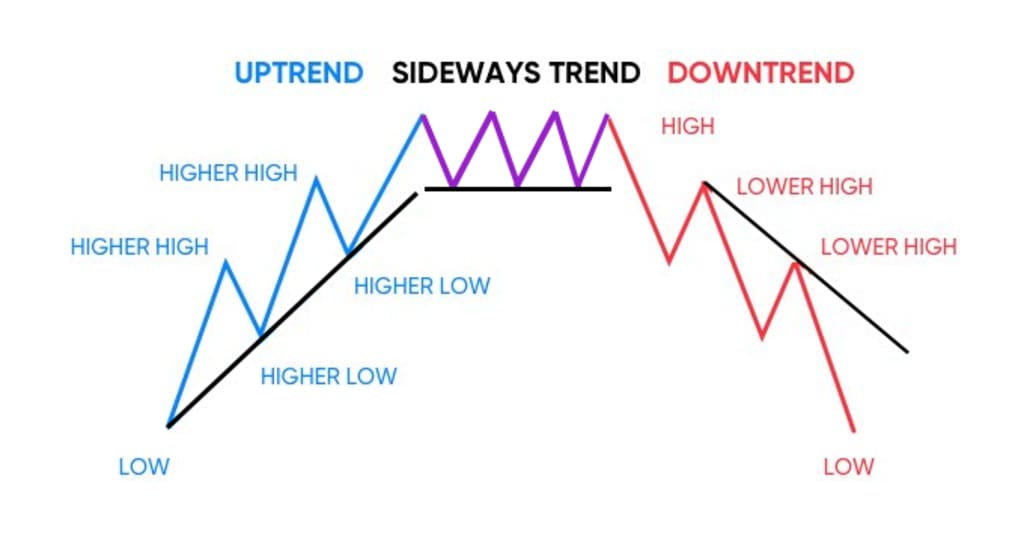
A range market condition occurs when the price of an asset moves sideways between a defined support and resistance level without a clear trend (uptrend or downtrend). This is also called a consolidation phase or sideways market.
Characteristics of a Range Market:
Flat RSI: RSI often oscillates between 40 and 60, without reaching extreme overbought or oversold levels.
Defined Boundaries:
Support Level: The price repeatedly bounces off a lower level (support).
Resistance Level: The price repeatedly gets rejected at an upper level (resistance).
Lower Volatility: Price movements are less volatile compared to trending markets.
Trading Strategies for Range Markets:
Buy at Support, Sell at Resistance:
Enter a long position near support when there are signs of a bounce.
Enter a short position near resistance when there are signs of rejection.
Use RSI for Confirmation:
Look for oversold RSI (<30) near support to confirm a potential buy.
Look for overbought RSI (>70) near resistance to confirm a potential sell.
Breakout Anticipation:
Watch for volume increases or candlestick patterns near the boundaries to identify potential breakouts.
Use stop-loss orders to manage risks in case of a breakout.
Mean Reversion Strategy:
Use Bollinger Bands or similar tools to identify when price moves too far from the average (mean), signaling a possible reversal back to the range.
Avoid Trend-Based Indicators:
Indicators like Moving Average Convergence Divergence (MACD) or moving averages can generate false signals in a range market.
How to Identify a Range Market:
Price Action Analysis:
Look for multiple price bounces off support and resistance levels.
Technical Indicators:
Use the ADX (Average Directional Index):
ADX value below 25 typically indicates a non-trending market.
RSI between 40-60 suggests sideways momentum.
Chart Patterns:
Look for horizontal trendlines forming clear support and resistance zones.
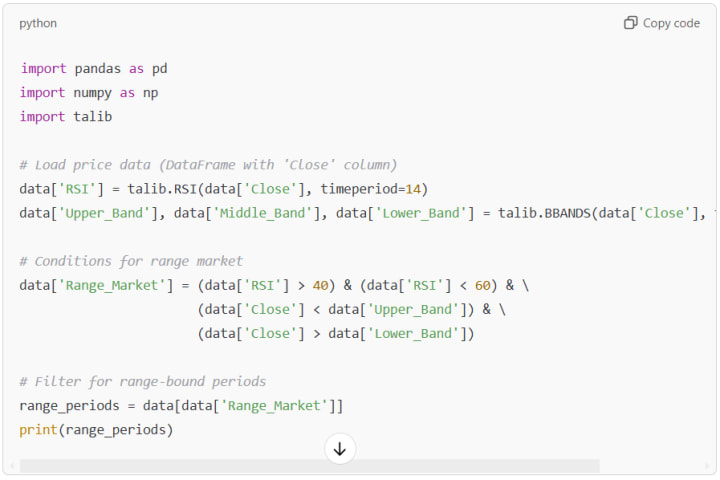
Example Code for Range Detection (Python):
Here's how you could use RSI and Bollinger Bands to detect a range market:
Would you like further assistance with implementing this in your trading system?
The Relative Strength Index (RSI) is a popular momentum oscillator used in technical analysis to measure the speed and change of price movements. It helps traders identify overbought or oversold conditions, potential reversals, and the strength of a trend.
How RSI Works:
RSI values range between 0 and 100.
Overbought: RSI > 70 (price may be overvalued, potential for a pullback or reversal).
Oversold: RSI < 30 (price may be undervalued, potential for a rebound or reversal).
Neutral zone: RSI between 30 and 70 (price may be consolidating).
RSI Formula:
The RSI is calculated using the following formula:
𝑅
𝑆
𝐼
=
100
−
100
1
+
𝑅
𝑆
RSI=100−
1+RS
100
Where:
𝑅
𝑆
=
Average Gain over
𝑛
periods
Average Loss over
𝑛
periods
RS=
Average Loss over n periods
Average Gain over n periods
Typically, n = 14 periods is used.
Steps to Calculate RSI:
Calculate the average gain and average loss over the last n periods.
Compute the Relative Strength (RS).
Use the RSI formula to calculate the index value.
How to Use RSI in Trading:
Overbought and Oversold Levels:
Look for reversals when RSI crosses above 70 or below 30.
Combine with other indicators for confirmation.
Divergences:
Bullish Divergence: RSI makes higher lows while the price makes lower lows (signal of a potential upward reversal).
Bearish Divergence: RSI makes lower highs while the price makes higher highs (signal of a potential downward reversal).
Trend Confirmation:
In a strong uptrend, RSI often stays above 50.
In a strong downtrend, RSI often stays below 50.
RSI Swing Rejections:
Identify rejections near overbought/oversold levels to anticipate reversals.
Example:
Imagine you have daily price data and want to calculate a 14-day RSI:
Compute the daily price changes.
Separate gains and losses.
Calculate the average gain and loss over the last 14 days.
Use the RSI formula to find the value.
Would you like help coding this in Python, applying it to data, or interpreting a specific chart?
About the Creator
Pooja Verma
Forexwebstore.com Discover the Best Forex Indicators for a Simple Strateg. This page features key technical indicators for the most popular currency pairs in real time.
Keep reading
More stories from Pooja Verma and writers in Trader and other communities.
Can I invest in mutual funds without a SIP?
Greetings, The short answer is Yes. You can invest in mutual funds without using a Systematic Investment Plan (SIP). SIP is just one way to invest in mutual funds, and it involves regularly investing a fixed amount at specified intervals typically monthly.
By Pooja Vermaabout a year ago in Trader
Gold Price Today: Understanding Gold Price Trends, Market Drivers, and What Lies Ahead
Gold Price Today: A Market Snapshot Gold price remains one of the most discussed topics in global financial markets. From individual buyers to institutional investors, everyone closely watches gold price movements to assess economic stability and investment opportunities. In uncertain times, gold price often reflects investor sentiment better than many other assets.
By Hammad Nawaz4 days ago in Trader
Review of 'Man on the Run'
My wife and I saw Man on the Run, a nearly 2-hour documentary on Amazon Prime, about Wings, Paul McCartney's group that flew around the world from shortly after The Beatles broke up in early 1970 to shortly after John Lennon was murdered at the end of 1980, making a Beatles reunion forever impossible.
By Paul Levinson7 days ago in Beat




Comments
There are no comments for this story
Be the first to respond and start the conversation.