
Can I invest in mutual funds without a SIP?
Yes, you can invest in mutual funds without a SIP. Let’s also understand what are different type of mutual funds and methods to invest in mutual funds.


Greetings,
The short answer is Yes.
You can invest in mutual funds without using a Systematic Investment Plan (SIP). SIP is just one way to invest in mutual funds, and it involves regularly investing a fixed amount at specified intervals typically monthly.
The other mode is lumpsum investment, in which you invest all the money in one go. Let’s understand which one is a better option for you.
Sip Vs Lump Sum: Which Is A Better Mode Of Investing?
Both investment routes perform differently in different phases of the market. There is a possibility that the market may correct immediately after you invest your lump sum amount. In this scenario, your average buy price of a unit of the index fund would have been lower under the SIP route. To put it in a simpler way, had you invested via SIP in a falling market scenario, you would have been able to buy more units of the mutual fund for the same price.
On the flip side, if a market is constantly rising, like the way we saw after the COVID-19 crash, the lump sum investments would have performed better than the investments made through the SIP route.
However, to evaluate them over the long term, we did a simple exercise.
We looked at NIFTY 50 returns for two scenarios:
1. Returns if you invested a lumpsum amount at the beginning of a period.
2. Returns on a monthly SIP during the same period.
What did we find? A mixed result.
Of the 14 different periods we checked, SIP did better seven times. Lumpsum offered a better rate of return on seven occasions. Check the table below to see the findings.
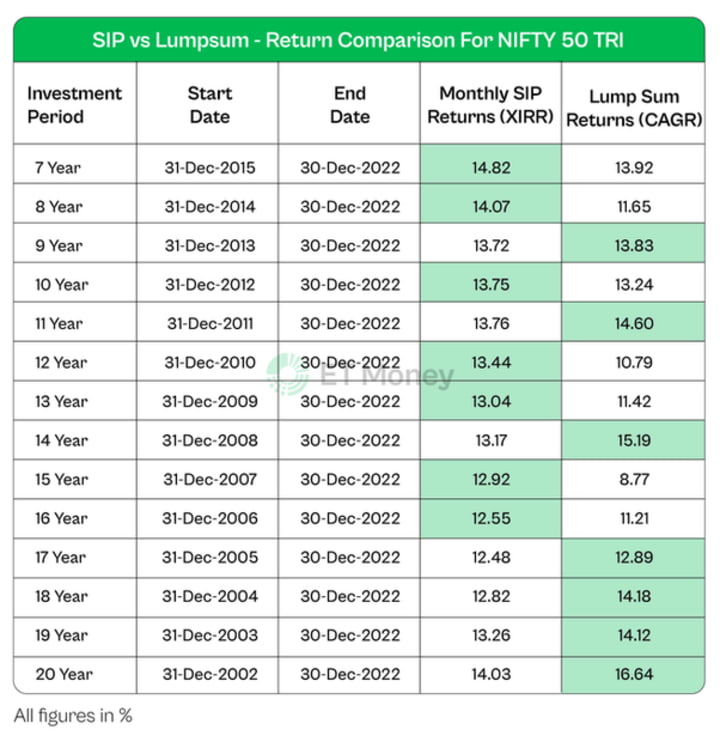
What is the takeaway from this exercise?
SIP and lumpsum are merely methods of investing. One doesn’t guarantee better results than the other. In fact, if you have the money, it’s better to go for the lumpsum route. Why? Because you can create a bigger corpus.
Let’s continue with the same example.
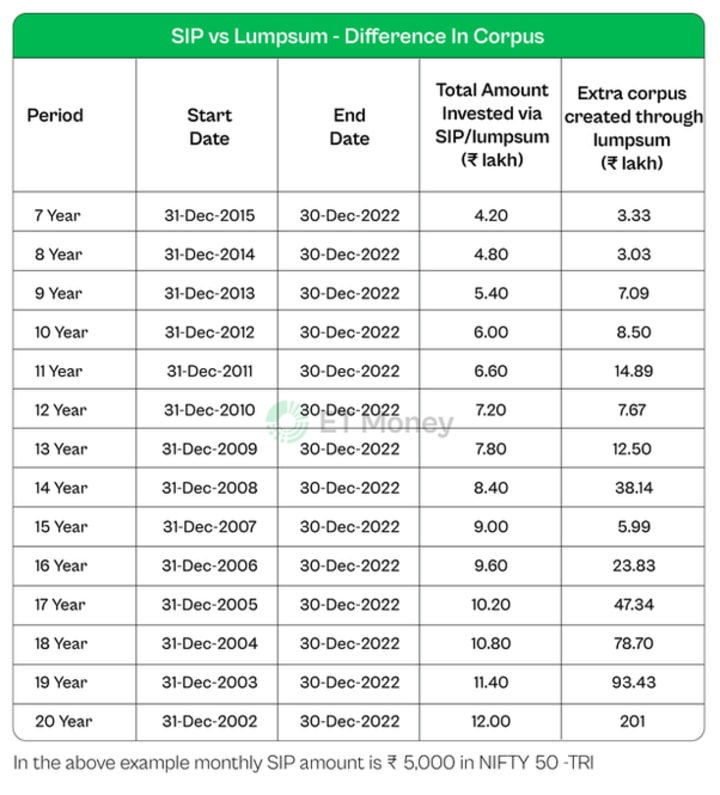
But this time, we won’t just check the rate of return. We’ll check the final value of the investment. Check the table to see how much extra corpus you can create if you invest in lumpsum as against SIPs.
In the above example, the monthly SIP amount is Rs. 5,000 in NIFTY 50 -TRI. In all scenarios, the end corpus is higher in the lumpsum method. And this was for obvious reasons.
Why’s that, you ask?
The reason is a no-brainer. In the lumpsum route, a bigger corpus takes more time to compound. Some investors are of the view that if you have a large corpus, you should split it into six equal monthly instalments.
However, this is not a foolproof method.
If the markets rally during those six months, your average cost might increase rather than average down.
Which Is Better?
If you have the money, don’t shy away from lumpsum investments.
Your money is better off in equities than in your bank account.
And if you have a regular income and want to create a bigger corpus, there’s no better way than SIP.
Hope it helps!
SIP is just a convenient mode of investing. It is not an obligation made to Mutual fund companies.
So, you can miss a couple of Mutual fund SIP installments, and there will be no penalties imposed on you from Mutual Fund companies.
However, your bank may charge you a penalty if your debit request raised from the Mutual fund schemes cannot be honored due to insufficient funds. Banks have their own set of charges which ranges from 150 Rs to 750 Rs.
Some Online Web Aggregators and Investment Platforms have an option to skip/pause the SIP. However, such options can be made only for a month or two, and cannot be for an indefinite period. So, if you are not sure when you would start the SIP again, it would be wise to stop or cancel the SIP and restart them as they were when you are ready to invest again.
The amount that has already been invested will continue to stay invested and you will continue to earn returns on it.
About the Creator
Pooja Verma
Forexwebstore.com Discover the Best Forex Indicators for a Simple Strateg. This page features key technical indicators for the most popular currency pairs in real time.
Keep reading
More stories from Pooja Verma and writers in Trader and other communities.
Tilapia Market Size and Forecast 2026–2034
The global tilapia market is poised for consistent expansion over the coming decade, reflecting its central role in the evolving global protein economy. According to Renub Research, the Tilapia Market is expected to reach US$ 12.06 billion by 2034, rising from US$ 9.21 billion in 2025, registering a CAGR of 3.04% from 2026 to 2034.
By Sakshi Sharma6 days ago in Trader
India Home Automation Market Size and Forecast 2026–2034
India’s home automation market is entering a transformative decade. According to Renub Research, the India Home Automation Market is expected to reach US$ 13.58 billion by 2034, rising from US$ 3.71 billion in 2025, growing at a CAGR of 15.51% from 2026 to 2034.
By Sakshi Sharma7 days ago in Trader
A More Human Vocal
When we launched Vocal nearly a decade ago, the world was a very different place. LLMs did not exist, and stories were created one at a time by people sitting down to write, revise, and share something personal. Many of our assumptions about publishing, trust, and participation were built for a world where effort and output were inseparable.
By Justin @ Vocal4 days ago in Resources




Comments
There are no comments for this story
Be the first to respond and start the conversation.