
Shiba Inu Supply Most Centralized Among Top Coins—62% Held By Just 10 Whales
On-chain data shows Shiba Inu (SHIB) has its supply more concentrated on the largest holders than other assets like Ethereum (ETH) and Pepe (PEPE).

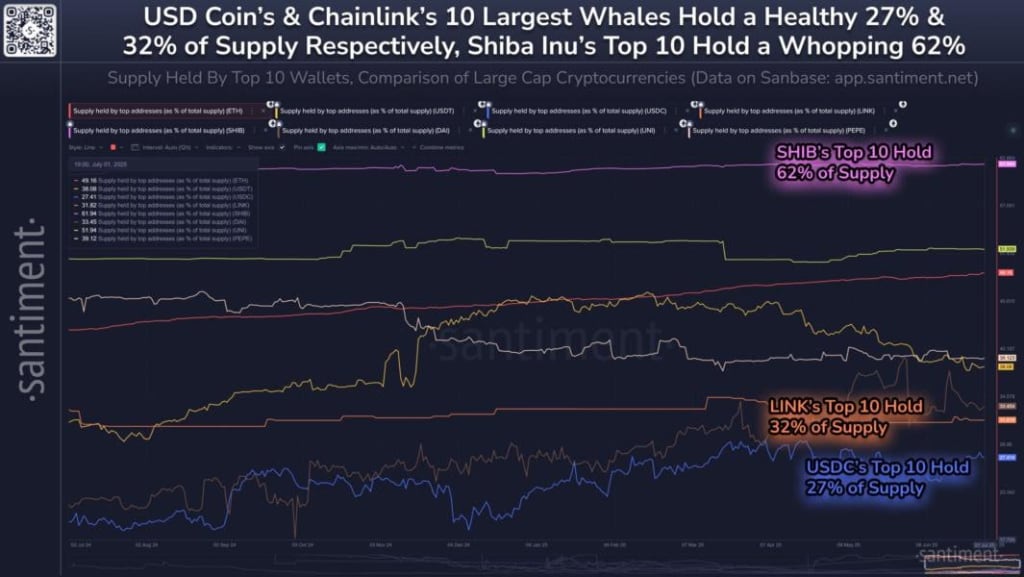
🐋 Shiba Inu’s Supply Crisis: 62% Controlled by Top 10 Whale Wallets — Should Investors Be Worried?
Shiba Inu (SHIB), the widely known dog-themed memecoin that gained massive popularity during the 2021 crypto bull run, has once again found itself under the analytical microscope. But this time, it’s not because of a price rally or new development in its ecosystem. Instead, a recently released on-chain analysis has highlighted a significant centralization issue that could have long-term implications for SHIB holders and the health of its network.
According to data shared by Santiment, a respected on-chain analytics firm, a staggering 62% of SHIB’s total circulating supply is currently controlled by just 10 wallets. This raises serious concerns about the token’s decentralization, resistance to manipulation, and vulnerability to market volatility.
📊 What Does This Whale Concentration Mean?
In crypto markets, the term "whale" refers to individuals or entities that hold a disproportionately large amount of a particular cryptocurrency. Whale behavior can significantly influence price movements — whether through coordinated buying, sudden dumping, or strategic withdrawals from liquidity pools.
Santiment’s recent report compared several top crypto assets based on the percentage of total token supply held by the top 10 largest wallets on each network. Here’s how Shiba Inu compares:
Asset Top 10 Wallet Supply Share
Shiba Inu (SHIB) 62%
Uniswap (UNI) 51%
Ethereum (ETH) 49%
Pepe (PEPE) 39%
DAI (stablecoin) 33%
Chainlink (LINK) 32%
USDT (Tether) 29%
USDC (Circle) 27%
As the data shows, Shiba Inu has the highest level of supply concentration among the assets analyzed — far surpassing other decentralized platforms like Ethereum and even other memecoins like PEPE.
🧠 Why Should Investors Care About Supply Centralization?
High whale concentration is often a red flag for investors, particularly retail traders. Here's why:
Risk of Price Manipulation: When a small group of wallets holds a majority of the supply, these wallets can unilaterally cause dramatic price shifts. If even a few of these holders decide to sell a large portion of their holdings, the resulting supply shock can send prices tumbling.
Lack of Decentralization: One of the core values of blockchain technology is decentralization. A token with over half of its supply in the hands of just 10 entities undermines this principle, leading to reduced trust and potential governance issues if and when on-chain voting systems are introduced.
Lower Market Confidence: Institutional and retail investors alike may shy away from assets perceived as “whale-heavy.” It adds an element of unpredictability and raises questions about the asset's long-term viability.
Exit Risk: If large holders — especially early investors or project insiders — begin to offload, it can result in a cascade effect. Retail holders are often the last to react, and by the time the broader market responds, the damage may already be done.
Santiment addressed this in their commentary:
“As a retail trader, it’s generally safer to hold coins with less supply held by the most elite whales. There is less risk of sudden dumps or price manipulation should an asset’s largest whales decide to exit their positions.”
📉 The Sentiment Factor: Fear & Greed Index Nears Extreme Levels
Further complicating matters for SHIB investors is the current emotional state of the broader crypto market. The Fear & Greed Index, a popular metric created by Alternative.me that gauges investor sentiment on a scale of 0 (extreme fear) to 100 (extreme greed), is currently sitting at 73 — a clear indication of strong greed among market participants.
This is particularly notable because market sentiment often moves counter to expectations. Historically, high greed levels have frequently preceded market corrections, as overbought conditions eventually lead to profit-taking or panic selling in response to external events.
While the index hasn’t yet entered the “extreme greed” territory (typically marked above 75), it’s approaching dangerously close. For highly speculative assets like SHIB — already subject to whale volatility — this sentiment may signal a tipping point.
📈 SHIB Price Action: Modest Gains Amid Uncertainty
At the time of writing, Shiba Inu is trading around $0.0000115, posting a modest 3% increase over the past week. While this uptick may seem encouraging on the surface, the underlying distribution dynamics tell a different story.
Technical indicators suggest that SHIB is currently riding a short-term wave of positive momentum, possibly due to general market bullishness or minor ecosystem updates. However, price growth unsupported by fundamentals or sustainable adoption often proves fragile.
Investors should ask: Is this rally organic, or is it potentially whale-driven? If the latter, any gains could be short-lived and reversed at the whim of a few large wallets.
🔍 Is SHIB Still a Good Investment?
That depends on your investment strategy. For short-term traders, SHIB may still offer opportunities, particularly if market sentiment remains greedy and speculative coins continue to catch attention. However, long-term holders should be cautious:
The extreme centralization of SHIB’s supply presents a real and measurable risk.
There’s a lack of clarity around how active these top wallets are — are they dormant, centralized exchange reserves, or early buyers waiting to exit?
Shiba Inu’s ecosystem, while expanding (e.g., Shibarium Layer 2), hasn’t yet reached a level of utility that offsets these structural issues.
✅ Final Thoughts: Proceed With Caution
While Shiba Inu remains one of the most recognized tokens in the memecoin space, its current whale distribution makes it high-risk for long-term holding, especially for retail investors who may be blindsided by large-scale dumps.
That said, if you're trading on short time frames and can monitor on-chain activity or sentiment shifts, SHIB may still offer profitable entry and exit points — but only with proper risk management.
As always, do your own research (DYOR), and never invest more than you’re willing to lose. In markets this volatile — and this centralized — protecting your capital is just as important as growing it.
About the Creator
Yonas
Rule No. 1: Never lose money.
Rule No. 2: Never forget rule No. 1.
Rachel Reviews: The Spiral Archive by Pieter Hendrik
It's difficult for me to know where to start with a review of this book as it was, for me, an entirely unique experience and one that I'll probably never have again. I don't want that to be interpreted as unenjoyable but it has left me scratching my head a little and ruminating on its content, its themes and its characters.
By Rachel Deemingabout 21 hours ago in BookClub



Comments
There are no comments for this story
Be the first to respond and start the conversation.