
Saudi Arabia OTC Artificial Tears Market Size and Forecast 2025–2033
Rising Dry Eye Cases, Digital Lifestyles, and Expanding Retail Access Are Driving Steady Growth in the Kingdom’s OTC Eye Care Segment

Saudi Arabia OTC Artificial Tears Market Outlook
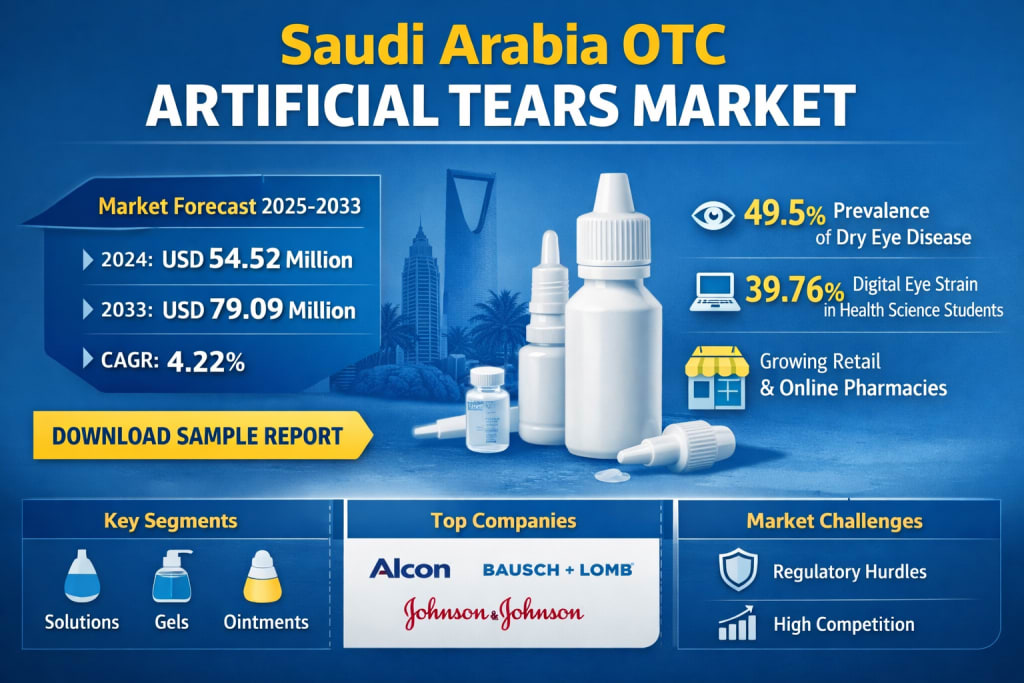
The Saudi Arabia OTC Artificial Tears Market is expected to reach US$ 79.09 million by 2033, up from US$ 54.52 million in 2024, growing at a compound annual growth rate (CAGR) of 4.22% from 2025 to 2033. This steady expansion reflects changing lifestyles, rising screen exposure, a growing elderly population, and increasing awareness of eye health across the Kingdom.
Over-the-counter (OTC) artificial tears are non-prescription eye drops designed to treat dryness, irritation, and discomfort caused by insufficient tear production or poor tear quality. These products work by lubricating and moisturizing the eye surface, mimicking the function of natural tears. They are widely used for symptoms such as burning, itching, redness, and a gritty sensation in the eyes, and they are commonly recommended for conditions like dry eye syndrome, computer vision syndrome, environmental irritation, and contact lens discomfort.
Available in multiple formulations—including solutions, gels, ointments, emulsions, sprays, and suspensions—artificial tears have become the first line of defense for millions of consumers seeking quick, convenient, and affordable relief. Preservative-free and sensitive-eye options have further broadened the consumer base, making these products suitable for long-term and frequent use.
In Saudi Arabia, the market is benefiting from a combination of demographic, environmental, and structural factors. The country’s hot and dry climate, widespread use of air conditioning, increasing digital device dependency, and urban lifestyles are all contributing to higher rates of eye dryness and irritation. At the same time, improved access to retail pharmacies and online platforms is making OTC eye care products more readily available than ever before.
Market Overview: Why Artificial Tears Matter More Than Ever
Artificial tears occupy a unique space in the broader eye care ecosystem. They are not just symptom-relief products; they are also part of daily wellness routines for people who spend long hours in front of screens, live in air-conditioned environments, or suffer from allergies and environmental irritants.
In Saudi Arabia, awareness around preventive healthcare and self-care has increased significantly over the past decade. Consumers are now more proactive about managing minor health issues without immediately visiting clinics or hospitals. This shift in behavior strongly favors OTC categories, including artificial tears.
Another important factor is innovation in formulations and packaging. Modern artificial tears are designed to be more biocompatible, longer-lasting, and gentler on sensitive eyes. Single-dose vials, preservative-free options, and multi-action formulas that address both lubrication and protection against environmental stressors have made these products more attractive to a broader audience.
Additionally, the expansion of retail pharmacies, optical stores, and e-commerce platforms under Saudi Arabia’s Vision 2030 initiative has improved product accessibility across both urban and semi-urban regions. This improved distribution network is playing a crucial role in sustaining market growth.
Growth Drivers for the Saudi Arabia OTC Artificial Tears Market
Rising Prevalence of Dry Eye Conditions
One of the most important drivers of the Saudi Arabian OTC artificial tears market is the growing prevalence of dry eye disease (DED). According to the 2022 Twaiq Mountain Eye Study, 49.5% of the surveyed Saudi population had dry eye disease, and 16.4% of them reported severe symptoms. These figures highlight just how widespread the problem has become.
Saudi Arabia’s environmental conditions significantly contribute to this trend. The hot, dry climate, frequent dust exposure, heavy air conditioning usage, and air pollution all increase tear evaporation and ocular surface irritation. On top of that, lifestyle changes—especially prolonged screen time—are further worsening eye strain and dryness.
A PubMed study involving Saudi health sciences students found that nearly 39.76% reported symptoms related to digital eye strain, including dry eyes. This growing dependence on digital devices for work, education, and entertainment is creating a long-term demand base for artificial tears and other supportive eye care products.
As more people experience recurring or chronic dry eye symptoms, many turn to OTC artificial tears as a convenient and affordable daily solution, boosting overall market demand.
Consumer Preference for Non-Prescription Solutions
Another major growth factor is the increasing consumer preference for non-prescription, self-care solutions. Saudi consumers are becoming more health-aware and more comfortable managing minor conditions on their own, especially when safe and effective OTC options are available.
Artificial tears perfectly fit this trend. They are easy to use, widely available, and relatively inexpensive compared to prescription treatments or repeated doctor visits. For mild to moderate eye irritation, many consumers prefer the convenience of picking up an OTC product from a pharmacy or ordering it online rather than scheduling a clinical consultation.
This behavior is also supported by the growing influence of digital health content, social media, and pharmacist recommendations, which educate consumers about managing common eye problems safely at home. As a result, OTC artificial tears are increasingly viewed not just as treatment products, but as everyday wellness essentials.
Expansion of Retail and Online Distribution Channels
The rapid expansion of retail and online distribution channels is further accelerating market growth. Under Saudi Arabia’s Vision 2030, the retail and healthcare sectors have seen significant investment, leading to a wider presence of pharmacies, optical stores, and health-focused retail outlets across the country.
This expansion has made eye care products more accessible to consumers in both major cities and smaller towns. At the same time, the rise of e-commerce and online pharmacies has transformed purchasing behavior. Consumers can now compare products, read reviews, and order artificial tears from the comfort of their homes, often at competitive prices.
Online platforms also allow brands to reach a broader audience and offer a wider range of product variants, including specialized and premium formulations. This improved accessibility and convenience are key factors supporting the steady growth of the OTC artificial tears market in Saudi Arabia.
Challenges in the Saudi Arabia OTC Artificial Tears Market
Regulatory Hurdles
Despite its positive outlook, the market faces notable regulatory challenges. Eye care products, including artificial tears, are subject to strict regulations and quality standards in Saudi Arabia. Manufacturers must comply with local health authority requirements related to product safety, labeling, packaging, and marketing.
Obtaining approvals can be time-consuming and costly, particularly for new entrants or for companies introducing new formulations. Changes in regulatory guidelines may also lead to delays in product launches or require modifications to existing products, adding to operational complexity.
While these regulations are essential for consumer safety, they can slow down innovation, increase costs, and limit the speed at which new products reach the market.
High Competition
The Saudi Arabian OTC artificial tears market is highly competitive, with a mix of well-established international brands and regional players. This intense competition puts pressure on companies to differentiate themselves through pricing, branding, formulation improvements, and marketing strategies.
Consumers are often price-sensitive, especially in the OTC segment, which can lead to margin pressure for manufacturers and distributors. For new or smaller companies, gaining market share can be challenging due to the strong presence and brand recognition of global players.
As competition intensifies, companies must continuously invest in product innovation, marketing, and distribution partnerships to maintain their position, which can further increase operational costs.
Market Segmentation
By Product Type
Solution
Ointment
Emulsion
Gel
Spray Solution
Suspensions
Among these, solutions and gels remain particularly popular due to their ease of use and suitability for daily application, while ointments and emulsions are often preferred for longer-lasting relief, especially during nighttime use.
By Application
Dry Eye Syndrome
Allergies
Infections
UV and Blue Light Protection
Contact Lens Moisture Retention
Others
Dry eye syndrome represents the largest application segment, driven by lifestyle and environmental factors, while contact lens-related dryness and digital eye strain are also emerging as important use cases.
By Distribution Channel
Drugstores & Supermarkets
Online Pharmacies
Retail Pharmacies
Others
Retail pharmacies currently dominate distribution, but online pharmacies are gaining traction rapidly due to convenience, wider product selection, and growing consumer trust in e-commerce healthcare platforms.
Key Players in the Saudi Arabia OTC Artificial Tears Market
The market features a strong presence of global pharmaceutical and eye care companies, including:
AbbVie Inc.
Akorn Inc.
Alcon
Bausch Health Companies Inc.
Johnson & Johnson
Nicox S.A.
Novartis AG
Santen Pharmaceutical Co. Ltd.
Sun Pharmaceutical Industries Ltd.
These companies compete based on product quality, brand reputation, innovation, distribution reach, and pricing strategies. Many are also investing in preservative-free formulations, advanced delivery systems, and targeted solutions for specific eye conditions to strengthen their market positions.
Future Outlook
Looking ahead, the Saudi Arabia OTC artificial tears market is set to maintain steady growth through 2033. The combination of rising dry eye prevalence, digital lifestyle habits, an aging population, and expanding retail and online access will continue to support demand.
Innovation will play a crucial role in shaping the next phase of the market. Products that offer longer-lasting relief, improved comfort, and multi-functional benefits—such as protection against blue light or environmental stress—are likely to gain stronger consumer acceptance.
At the same time, companies that successfully navigate regulatory requirements and build strong distribution networks will be best positioned to capture growth opportunities in this increasingly competitive landscape.
Final Thoughts
The Saudi Arabia OTC Artificial Tears Market, projected to grow from US$ 54.52 million in 2024 to US$ 79.09 million by 2033 at a CAGR of 4.22%, reflects a broader shift toward self-care, preventive health, and convenient treatment solutions. As dry eye conditions become more common due to environmental and lifestyle factors, artificial tears are evolving from occasional remedies into everyday essentials for many consumers.
With strong support from retail expansion, digital commerce, and ongoing product innovation, the market is well-positioned for sustained, long-term growth. For manufacturers, distributors, and investors alike, Saudi Arabia’s OTC artificial tears segment represents a stable and increasingly important part of the Kingdom’s growing consumer healthcare ecosystem.
About the Creator
Japan Flexible Packaging Market Size and Forecast 2025–2033
Introduction Japan’s packaging industry is undergoing a quiet but powerful transformation. Once dominated by rigid formats such as glass, metal, and hard plastics, the market is increasingly shifting toward lighter, smarter, and more sustainable solutions. At the center of this shift is flexible packaging—an adaptable format that is rapidly gaining ground across food & beverage, personal care, pharmaceuticals, and household products.
By shibansh kumarabout 8 hours ago in Trader


Comments
There are no comments for this story
Be the first to respond and start the conversation.