
Saudi Arabia Frozen Vegetables Market Forecast 2025–2033 | Renub Research
Urban Lifestyles, Expanding Retail, and Cold Chain Investments Drive Steady Growth in the Kingdom’s Frozen Foods Sector

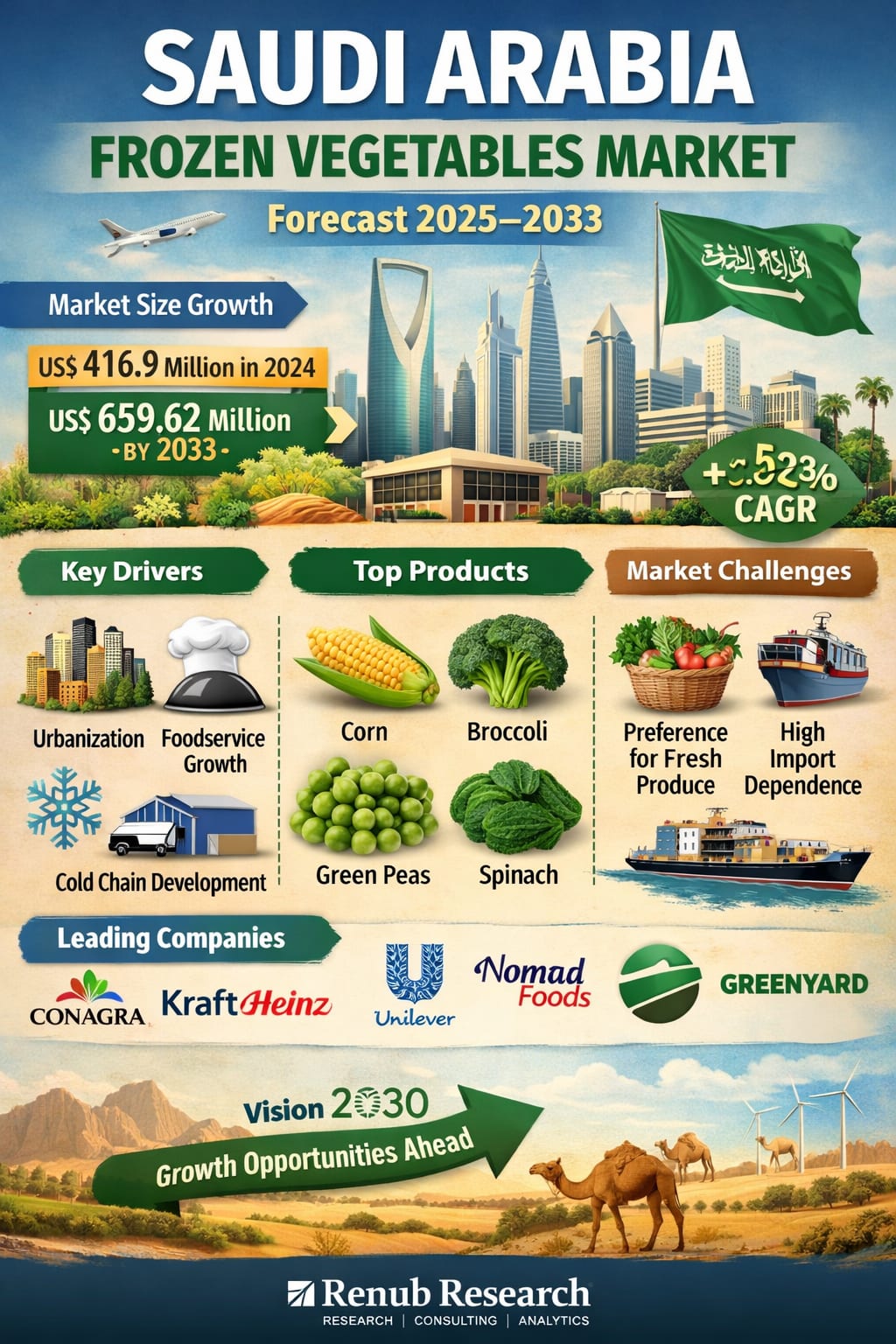
Saudi Arabia Frozen Vegetables Market Overview
The Saudi Arabia Frozen Vegetables Market is expected to reach US$ 659.62 million by 2033, rising from US$ 416.9 million in 2024, registering a CAGR of 5.23% from 2025 to 2033, according to Renub Research. This steady growth reflects the Kingdom’s evolving food consumption patterns, shaped by rapid urbanization, changing lifestyles, expanding modern retail infrastructure, and increasing demand for convenient and nutritious food options.
Frozen vegetables are harvested at peak ripeness and quickly preserved through advanced freezing techniques, allowing them to retain their nutritional value, color, and texture. Unlike fresh produce, which can spoil quickly and is subject to seasonal availability, frozen vegetables offer year-round accessibility, longer shelf life, and reduced food waste. These advantages have made them increasingly popular among both households and commercial foodservice operators across Saudi Arabia.
In recent years, Saudi consumers have become more health-conscious while also facing tighter schedules due to rising workforce participation and urban lifestyles. This combination has created a strong demand for food products that balance nutrition, convenience, and affordability—a sweet spot where frozen vegetables fit perfectly. At the same time, improvements in cold chain logistics, storage infrastructure, and retail distribution have made these products more accessible across the Kingdom, from major metropolitan areas to smaller cities.
The market is further supported by government initiatives aimed at strengthening food security, boosting local agricultural production, and modernizing the food supply chain in line with Vision 2030. Together, these factors are shaping a resilient and steadily expanding frozen vegetables industry in Saudi Arabia.
What Are Frozen Vegetables and Why Are They Gaining Popularity?
Frozen vegetables are vegetables that are cleaned, cut, blanched, and frozen shortly after harvest to lock in freshness and nutrients. Modern freezing technologies, especially Individually Quick Freezing (IQF), allow vegetables to retain much of their original texture, flavor, and nutritional profile. This means consumers can enjoy products like peas, broccoli, spinach, corn, and green beans with minimal compromise in quality.
One of the biggest advantages of frozen vegetables is convenience. They come pre-washed, pre-cut, and ready to cook, eliminating preparation time. For busy households, working professionals, and foodservice kitchens, this translates into faster meal preparation and more consistent portion control. In addition, frozen vegetables help reduce food waste, as users can take only what they need and store the rest for later use without worrying about spoilage.
In Saudi Arabia, where climatic conditions limit year-round domestic production of certain vegetables, frozen products also offer a practical solution for maintaining a stable supply of diverse vegetables throughout the year. This reliability is particularly valuable for restaurants, hotels, and catering services that require consistent quality and availability.
Key Growth Drivers in the Saudi Arabia Frozen Vegetables Market
1. Changing Lifestyles and Busy Schedules
One of the strongest drivers of the frozen vegetables market in Saudi Arabia is the country’s changing lifestyle and employment patterns. As more people join the workforce and urban living becomes the norm, time-saving food solutions are increasingly in demand.
Saudi Arabia’s Q4 2024 labor data highlights this shift clearly. The country’s overall employment rate reached 66.4%, with Saudi women’s employment rising to 36.0% and non-Saudi women’s employment at 27.9%. Meanwhile, employment rates for Saudi and non-Saudi men stood at 66.2% and 93.2%, respectively. This growing, active workforce has significantly increased demand for ready-to-use and easy-to-cook food products.
Frozen vegetables fit neatly into this new lifestyle pattern. They allow consumers to prepare healthy meals quickly without spending time on washing, peeling, and chopping. As a result, busy households increasingly see frozen vegetables not as a compromise, but as a practical and smart choice.
2. Rapid Expansion of the Foodservice Industry
Saudi Arabia’s foodservice sector—covering restaurants, hotels, cafes, catering services, and quick-service outlets—is expanding rapidly, driven by tourism growth and a vibrant hospitality industry. The Kingdom achieved a major milestone by surpassing 100 million visitors in 2023, seven years ahead of its original target.
Tourism spending has become a significant contributor to the economy. In 2019, total tourism expenditure reached SAR 255.6 billion (around USD 69.01 billion), accounting for 4.4% of GDP. Domestic tourism attracted 81.9 million visitors, while international tourism brought in 27.4 million visitors and generated SAR 141.2 billion (USD 38.12 billion) in revenue.
This surge in tourism and hospitality activity has boosted demand for reliable, high-quality, and easy-to-store food ingredients. Frozen vegetables are particularly attractive to foodservice operators because they offer consistent quality, longer shelf life, reduced waste, and easier inventory management. For large kitchens that need to serve thousands of meals daily, these benefits translate into both cost savings and operational efficiency.
3. Improved Cold Chain Infrastructure
Another critical factor supporting market growth is the steady improvement in Saudi Arabia’s cold chain infrastructure. Investments in refrigerated storage, temperature-controlled transportation, and modern distribution centers have strengthened the country’s ability to handle frozen and chilled food products efficiently.
A reliable cold chain is essential for maintaining the quality, safety, and nutritional value of frozen vegetables from production to the point of sale. In the past, limitations in logistics infrastructure posed challenges, especially in serving remote or less-developed regions. Today, expanding refrigerated logistics networks are helping ensure that frozen products reach both urban and semi-urban markets in optimal condition.
These improvements not only reduce spoilage and losses but also build consumer confidence in frozen food products. As trust in product quality increases, more consumers are willing to incorporate frozen vegetables into their regular diets.
4. Rising Health Awareness and Nutrition Consciousness
Health awareness among Saudi consumers has grown significantly in recent years, driven by government campaigns, media influence, and a broader focus on wellness and lifestyle diseases. Many consumers now actively seek foods that are nutritious, balanced, and easy to integrate into healthier diets.
Frozen vegetables benefit from the perception—supported by science—that they retain most of their vitamins and minerals due to rapid freezing after harvest. In some cases, they can even be more nutritious than “fresh” vegetables that have spent days in transit or storage. This understanding is gradually changing consumer attitudes and helping position frozen vegetables as a healthy and practical choice rather than a second-best option.
Challenges Facing the Saudi Arabia Frozen Vegetables Market
1. Strong Consumer Preference for Fresh Produce
Despite the many advantages of frozen vegetables, a significant portion of Saudi consumers still prefer fresh produce. Fresh vegetables are often associated with better taste, higher quality, and greater health benefits, especially in traditional cooking practices.
This preference is deeply rooted in cultural habits and shopping routines, where frequent visits to local markets and grocery stores for fresh ingredients are common. Even though modern freezing technologies preserve quality and nutrition, misconceptions about frozen food persist among some consumer groups, particularly older and more traditional households.
Overcoming this barrier will require consumer education, better in-store marketing, and clearer communication about the nutritional value, safety, and convenience of frozen vegetables.
2. High Dependence on Imports
Saudi Arabia’s frozen vegetables market relies heavily on imports, which makes it vulnerable to global supply chain disruptions, currency fluctuations, and changes in international trade conditions. During periods of geopolitical tension or global logistics disruptions, this dependence can affect product availability and price stability.
From a strategic perspective, high import dependence also runs counter to the Kingdom’s Vision 2030 goals of improving food security and boosting domestic production. While the climate poses challenges for large-scale vegetable farming, investments in greenhouses, controlled-environment agriculture, and local processing facilities could help reduce this reliance over time and create a more resilient supply chain.
Recent Developments in the Saudi Arabia Frozen Vegetables Industry
The Saudi government and related institutions have taken several steps to strengthen the agricultural and food processing ecosystem:
October 2024: The Ministry of Environment, Water, and Agriculture announced four new investment opportunities for establishing integrated agricultural cities in the Makkah region. These projects include facilities for producing fruit and vegetable trees and a dedicated laboratory for growing wild seedlings. The initiative supports food security, sustainable development, and agricultural sector modernization.
September 2024: The Saudi Agricultural Development Fund (ADF) approved more than SAR 2 billion (approximately USD 533 million) in loans and credit facilities to support agricultural projects, including cold storage facilities and vegetable-producing greenhouses. These investments directly support the infrastructure needed for expanding the frozen vegetables value chain.
Saudi Arabia Frozen Vegetables Market Segmentation
By Product
Corn
Asparagus
Spinach
Green Peas
Broccoli
Mushroom
Green Beans
Others
Among these, staples like corn, peas, broccoli, and spinach are widely used in both households and foodservice kitchens due to their versatility and compatibility with a wide range of dishes.
By End User
Food Service Industry
Retail Customers
The foodservice segment plays a crucial role in driving volume demand, while retail customers contribute to steady, recurring household consumption.
By Distribution Channel
Discounters
Supermarkets/Hypermarkets
Others
Supermarkets and hypermarkets dominate distribution due to their wide product assortment, strong cold storage infrastructure, and growing footprint across the Kingdom.
Competitive Landscape and Key Players
The Saudi Arabia frozen vegetables market features a mix of global food giants and specialized producers. Companies are evaluated across four key dimensions: company overview, key persons, recent developments and strategies, and sales analysis.
Key players include:
Conagra Brands
Hormel Foods
Unilever PLC
The Kraft Heinz Company
Nomad Foods Ltd
B&G Foods, Inc.
Greenyard
These companies compete on product quality, brand recognition, distribution reach, pricing strategies, and innovation in packaging and processing technologies. Strategic partnerships, expansion of regional distribution networks, and investments in cold chain capabilities remain central to their growth strategies in the Saudi market.
Market Outlook: 2025–2033
Looking ahead, the Saudi Arabia frozen vegetables market is expected to maintain steady and sustainable growth through 2033. Urbanization, workforce participation, tourism growth, and retail expansion will continue to support demand. At the same time, government investments in agriculture, cold storage, and food security infrastructure are likely to strengthen the overall ecosystem.
While challenges such as consumer preference for fresh produce and import dependence remain, gradual shifts in consumer perception and increased local investment could unlock additional growth opportunities. Innovation in packaging, better branding, and clearer communication of health benefits will also play a key role in shaping future demand.
Final Thoughts
The Saudi Arabia frozen vegetables market is moving from being a niche convenience category to a mainstream, strategic segment of the Kingdom’s food industry. With the market projected to grow from US$ 416.9 million in 2024 to US$ 659.62 million by 2033 at a CAGR of 5.23%, the long-term outlook remains positive.
Driven by lifestyle changes, a booming foodservice sector, improved cold chain infrastructure, and rising health awareness, frozen vegetables are becoming an essential part of modern Saudi diets. As the Kingdom continues its transformation under Vision 2030, the frozen vegetables industry is well-positioned to play a meaningful role in supporting food security, convenience-driven consumption, and sustainable growth in the years ahead.
About the Creator
Tom Shane
Tom Shane is a content writer specializing in SEO-driven blogs, product descriptions, and thought leadership. He crafts engaging, research-backed content that connects with audiences and drives results.
United States Digital Transformation Market Size, Share, Industry Overview, Latest Trends & Outlook 2034
Why the United States Digital Transformation Market Is Reshaping the Economy: Trends & Future Outlook Digital transformation is no longer a buzzword in the United States — it is a structural shift that is redefining how businesses operate, compete, and grow. Organizations across industries are redesigning processes, adopting cloud infrastructure, and integrating artificial intelligence to stay relevant in a rapidly evolving marketplace. The United States digital transformation market is expanding as enterprises recognize that technology is not just support infrastructure; it is the core engine of modern business strategy.
By Jackson Watson2 days ago in Trader
Australia Health Drinks Market: Wellness, Functional Ingredients, and E-Commerce Drive Steady Growth
The Australia health drinks market reached USD 1,951.60 million in 2024 and is forecast to grow to USD 2,809.14 million by 2033, exhibiting a compound annual growth rate (CAGR) of 4.13% during 2025–2033, according to a recent IMARC Group report.
By Rashi Sharmaa day ago in Trader



Comments
There are no comments for this story
Be the first to respond and start the conversation.