
United States Radiology Information System Market Size and Forecast 2025–2033
How Cloud, AI, and EHR Integration Are Transforming Imaging Workflows Across America’s Healthcare System

United States Radiology Information System Market Overview
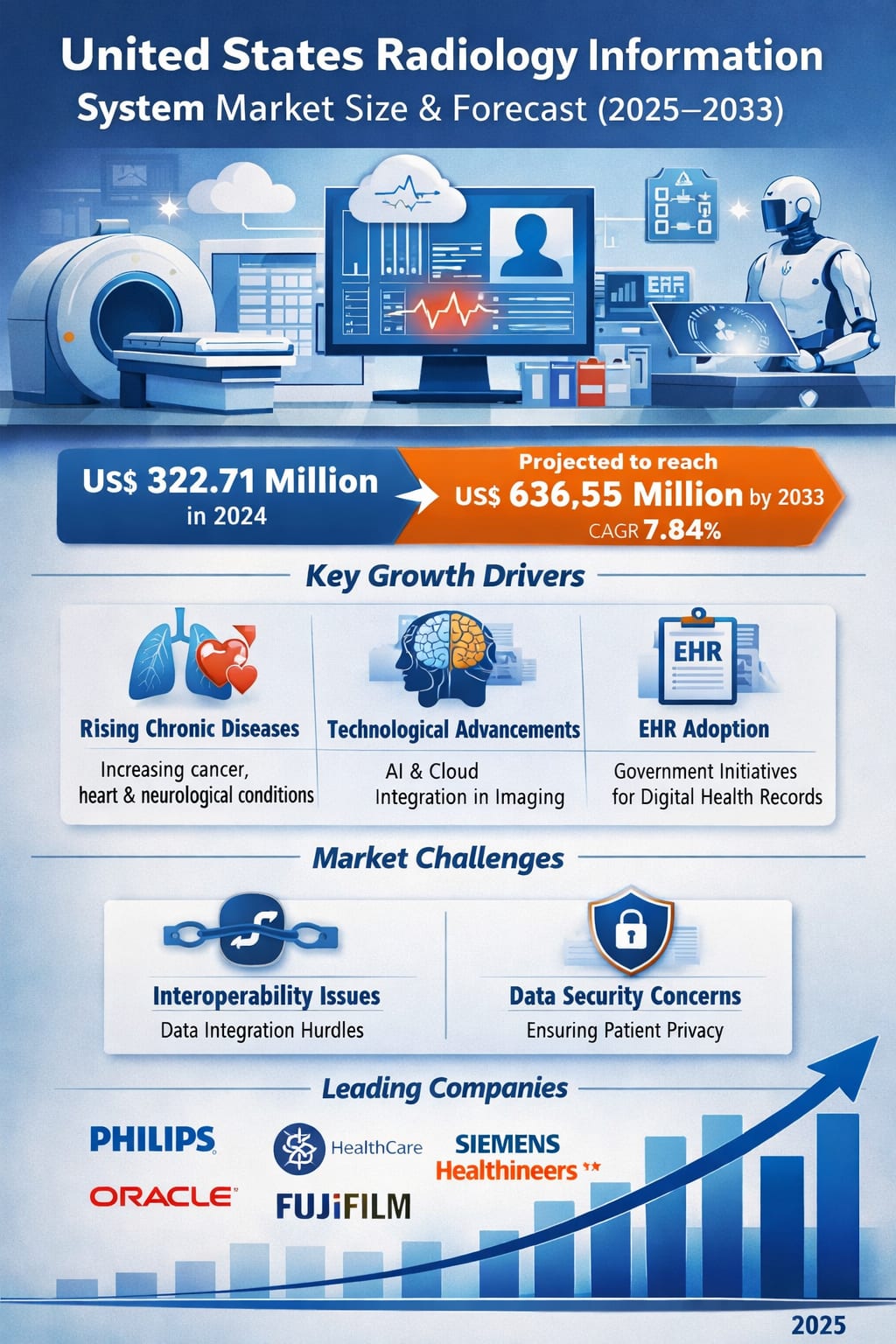
The United States Radiology Information System (RIS) market is entering a phase of sustained digital transformation, driven by the rapid modernization of healthcare infrastructure and the growing dependence on data-driven clinical decision-making. According to Renub Research, the United States Radiology Information System Market is expected to reach US$ 636.55 million by 2033, up from US$ 322.71 million in 2024, registering a compound annual growth rate (CAGR) of 7.84% from 2025 to 2033. This growth trajectory reflects not only the expanding demand for diagnostic imaging but also the increasing role of software-driven workflow optimization in hospitals, imaging centers, and specialty clinics.
Radiology Information Systems serve as the digital backbone of modern radiology departments. They manage patient scheduling, imaging workflows, reporting, billing, and data storage, while also enabling seamless coordination between radiologists, clinicians, and administrative staff. In an era where healthcare systems are under constant pressure to improve efficiency, reduce errors, and deliver faster diagnoses, RIS platforms have become indispensable tools rather than optional upgrades.
The US healthcare system, known for its scale and technological sophistication, provides fertile ground for RIS adoption. The widespread implementation of Electronic Health Records (EHR), increasing use of Picture Archiving and Communication Systems (PACS), and rising reliance on data analytics have created an ecosystem where integrated information systems are no longer a luxury but a necessity. As imaging volumes continue to rise and care pathways become more complex, healthcare providers are turning to RIS solutions to maintain accuracy, speed, and compliance in radiology operations.
Another major factor shaping this market is the rapid integration of cloud computing and artificial intelligence (AI). Cloud-based RIS platforms offer scalability, remote accessibility, and lower upfront infrastructure costs, while AI-powered tools enhance image analysis, automate routine tasks, and support clinical decision-making. Together, these technologies are redefining how radiology departments operate, making them more agile, data-centric, and patient-focused.
Market Growth Drivers Shaping the Industry
Rising Burden of Chronic Diseases
One of the strongest drivers behind the growth of the US Radiology Information System market is the increasing prevalence of chronic diseases such as cancer, cardiovascular disorders, and neurological conditions. Chronic illnesses account for a significant share of healthcare utilization in the United States, and diagnostic imaging plays a central role in early detection, treatment planning, and long-term monitoring of these conditions.
As imaging volumes rise, radiology departments face mounting pressure to handle larger workloads without compromising accuracy or turnaround times. RIS platforms address this challenge by streamlining scheduling, automating reporting workflows, and ensuring that patient data is organized and accessible across departments. This not only improves operational efficiency but also reduces the risk of diagnostic delays and administrative errors.
Major industry players such as Siemens Healthineers, GE HealthCare, and Philips continue to invest in advanced RIS solutions that integrate imaging data with broader clinical systems. Their focus on interoperability and intelligent automation reflects the growing need for robust digital infrastructure to support chronic disease management at scale.
Technological Advancements in Radiology IT
The US RIS market is also being reshaped by rapid technological progress, particularly in artificial intelligence, machine learning, and cloud computing. AI-driven tools are increasingly being used to assist radiologists in image interpretation, prioritize urgent cases, and reduce diagnostic errors. These capabilities not only enhance clinical outcomes but also improve productivity in high-volume imaging environments.
Cloud-based RIS platforms, meanwhile, are gaining traction due to their flexibility and cost efficiency. Unlike traditional on-premise systems, cloud solutions allow healthcare providers to scale resources based on demand, enable remote access to imaging data, and simplify software updates and maintenance. This is especially valuable for multi-site hospital networks and outpatient imaging chains that require centralized data management with decentralized access.
Vendors such as Fujifilm, Sectra, and Oracle are активно expanding their cloud and AI-enabled offerings, positioning RIS not just as an administrative tool but as a strategic platform for data-driven radiology services. As these technologies mature, they are expected to further accelerate market adoption and expand the functional scope of RIS solutions.
Government Push for Digital Health and EHR Adoption
Government initiatives promoting the adoption of Electronic Health Records have played a crucial role in strengthening the foundation for RIS growth in the United States. Regulatory frameworks and incentive programs have encouraged hospitals and clinics to digitize patient records, standardize data formats, and improve information exchange across care settings.
With EHR systems now widely implemented, the demand for tightly integrated RIS platforms has increased. Radiology departments require systems that can seamlessly exchange data with EHRs and PACS, ensuring that imaging results are readily available to referring physicians and care teams. This level of integration supports coordinated care, reduces duplication of tests, and improves overall clinical efficiency.
Companies such as Cerner (now part of Oracle Health) and Allscripts have been instrumental in developing integrated health IT ecosystems that connect radiology workflows with broader hospital information systems. This regulatory and technological alignment continues to create a favorable environment for sustained RIS market growth.
The Role of Investment and Healthcare Modernization
Healthcare spending in the United States continues to rise, driven by demographic shifts, technological innovation, and growing expectations for quality and accessibility of care. Urbanization and the expansion of large healthcare networks have further increased the need for scalable, interoperable IT systems capable of handling complex patient data flows.
Recent investment trends in the healthcare and biopharma sectors underscore the broader momentum toward digital transformation. While some companies face funding pressures, the overall direction of the market remains focused on efficiency, automation, and data integration. Radiology, as one of the most data-intensive specialties, stands at the forefront of this shift, making RIS a critical component of modern healthcare infrastructure.
Key Challenges Facing the RIS Market
Interoperability and System Integration
Despite significant progress in health IT, interoperability remains a persistent challenge in the RIS market. Many healthcare providers still operate a mix of legacy systems and newer platforms that do not always communicate seamlessly. This can lead to workflow inefficiencies, data silos, and potential errors in patient care.
True interoperability requires standardized data formats, consistent protocols, and close collaboration between vendors, healthcare organizations, and regulators. Achieving this level of integration is both time-consuming and resource-intensive, particularly for large hospital systems with complex IT environments. Until these challenges are fully addressed, some providers may struggle to realize the full benefits of advanced RIS platforms.
Data Security and Privacy Concerns
As RIS solutions handle vast amounts of sensitive patient data, cybersecurity and regulatory compliance are top priorities. Healthcare organizations must adhere to strict data protection standards, including those outlined under the Health Insurance Portability and Accountability Act (HIPAA). Any breach or lapse in compliance can result in financial penalties, legal consequences, and loss of patient trust.
The increasing use of cloud-based systems adds another layer of complexity, as providers must ensure that data is securely stored, transmitted, and accessed. Vendors are responding by investing heavily in encryption, access controls, and continuous security monitoring, but concerns around data privacy remain a key consideration for healthcare decision-makers when selecting RIS solutions.
Market Segmentation: Understanding the Structure
By Type
Integrated RIS:
Integrated systems combine RIS with other healthcare IT platforms such as PACS and EHR, offering a unified workflow and seamless data exchange. These solutions are increasingly preferred by large hospitals and health networks seeking end-to-end digital integration.
Standalone RIS:
Standalone systems focus primarily on radiology department workflows and are often used by smaller facilities or specialized imaging centers that require focused functionality without full-scale integration.
By Component
Hardware:
Includes servers, storage systems, and networking equipment required to support RIS infrastructure, particularly in on-premise deployments.
Software:
The core of the RIS market, software solutions manage scheduling, reporting, billing, and data integration, and increasingly incorporate AI-driven features.
Services:
Covers implementation, training, maintenance, and support services, which are critical for ensuring smooth adoption and long-term system performance.
By Deployment Mode
Web-Based:
Offers browser-based access and easier updates, often used in distributed care settings.
On-Premise:
Preferred by organizations that require full control over data and infrastructure, though it involves higher upfront costs and maintenance responsibilities.
Cloud-Based:
The fastest-growing segment, driven by scalability, cost efficiency, and remote accessibility, especially for multi-site healthcare providers.
Competitive Landscape and Company Analysis
The US Radiology Information System market is characterized by the presence of several major global and regional players, each focusing on innovation, integration, and service expansion. Key companies operating in this space include:
Koninklijke Philips N.V.
Siemens Healthcare GmbH
Oracle
McKesson Corporation
GE HealthCare
Fujifilm Holdings Corporation
Shimadzu Corporation
Hologic, Inc.
Sectra AB
These companies compete on factors such as technological capabilities, interoperability, customer support, and the ability to offer comprehensive, end-to-end imaging informatics solutions. Recent developments in the market have focused on expanding cloud offerings, enhancing AI integration, and strengthening partnerships with healthcare providers to deliver more customized and scalable solutions.
Market Outlook: What Lies Ahead
Looking ahead to 2033, the US Radiology Information System market is expected to continue its steady growth, supported by ongoing digital transformation across the healthcare sector. The convergence of AI, cloud computing, and advanced data analytics will further elevate the role of RIS from a workflow management tool to a strategic platform for clinical intelligence and operational optimization.
As imaging volumes increase and healthcare systems become more interconnected, the demand for reliable, secure, and interoperable RIS solutions will only intensify. Providers that can successfully balance innovation with compliance and data security will be best positioned to capture long-term growth opportunities in this evolving market.
Final Thoughts
The United States Radiology Information System market stands at the intersection of healthcare delivery and digital innovation. With the market projected to grow from US$ 322.71 million in 2024 to US$ 636.55 million by 2033, the coming years will see RIS platforms play an even more central role in shaping how diagnostic imaging services are delivered, managed, and optimized.
Driven by rising chronic disease burden, rapid technological advancements, and strong policy support for digital health, RIS solutions are no longer just administrative tools—they are strategic assets for modern healthcare organizations. While challenges such as interoperability and data security remain, continued investment and innovation are likely to address these barriers over time.
About the Creator
Tom Shane
Tom Shane is a content writer specializing in SEO-driven blogs, product descriptions, and thought leadership. He crafts engaging, research-backed content that connects with audiences and drives results.
Spectrum Analyzer Market Size and Forecast 2025–2033
The global spectrum analyzer market is entering a phase of steady and strategic expansion, driven by the rapid evolution of wireless communication, defense modernization, and the growing complexity of electronic systems. According to Renub Research, the global spectrum analyzer market is expected to grow from US$ 1.35 billion in 2024 to US$ 2.28 billion by 2033, registering a compound annual growth rate (CAGR) of 5.98% during the period 2025 to 2033.
By shibansh kumar2 days ago in Trader
At My Wits’ End
Life is about taking out the trash and calling it trash because you have every reason to. It wasn't meant to be linear, they say. But the times you tried to make it straight led to problems, and you didn’t have the tools to put any of it to use. You don't put your right shoes on the right feet; you put the left shoes on the left feet. The grey hardened slab will trip you up anyway.
By Caitlin Charltona day ago in Humans



Comments
There are no comments for this story
Be the first to respond and start the conversation.