
Renewable Energy Market Size and Forecast 2025–2033
The Global Shift to Clean Power Accelerates as Investment, Policy, and Technology Reshape the Energy Future

Introduction: A Market Powering the Future
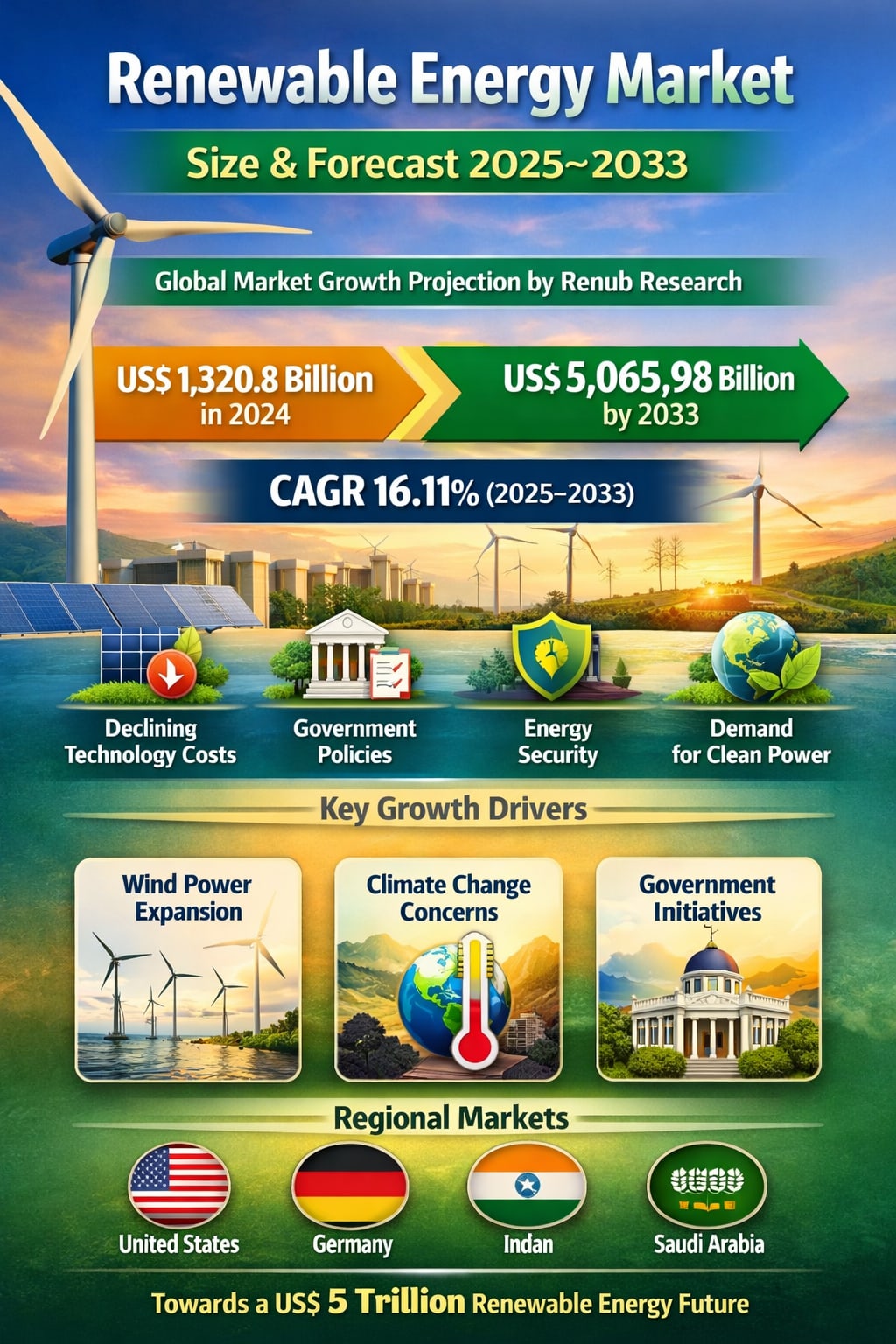
The global renewable energy market is entering a decisive decade. According to Renub Research, the Renewable Energy Market is expected to reach US$ 5,065.98 billion by 2033, growing from US$ 1,320.8 billion in 2024, at a strong CAGR of 16.11% from 2025 to 2033. This extraordinary expansion reflects more than just a shift in technology—it signals a structural transformation in how the world produces, distributes, and consumes energy.
Rising concerns over climate change, energy security, and long-term economic sustainability are pushing governments, corporations, and consumers to rethink their dependence on fossil fuels. Renewable energy sources such as solar, wind, hydro, biomass, and geothermal are no longer niche alternatives. They are rapidly becoming the backbone of future energy systems.
Falling technology costs, supportive government policies, increasing investment flows, corporate sustainability commitments, and advancements in energy storage and grid infrastructure are all accelerating this transition. At the same time, the global demand for electricity continues to rise, driven by urbanization, digitalization, electric vehicles, and industrial growth—making clean energy not just an environmental choice, but an economic necessity.
Renewable Energy Industry Overview
Renewable energy is derived from naturally replenished sources such as sunlight, wind, rain, tides, waves, and geothermal heat. Unlike fossil fuels, these sources do not run out and produce little to no greenhouse gas emissions during operation. The most widely used renewable energy types include solar power, wind power, hydropower, bioenergy, and geothermal energy.
Technologies such as solar panels, wind turbines, hydroelectric dams, and biomass plants are used to harness these resources and convert them into usable electricity and heat. Over the past decade, these technologies have seen dramatic improvements in efficiency, reliability, and cost-effectiveness.
The importance of renewable energy goes far beyond power generation. It plays a central role in reducing carbon emissions, improving air quality, conserving water resources, and supporting long-term sustainable development. As countries work toward climate targets and net-zero commitments, renewable energy is becoming a cornerstone of national energy strategies.
At the same time, corporations are increasingly integrating renewable energy into their Environmental, Social, and Governance (ESG) frameworks. Many global companies now procure clean energy directly through power purchase agreements (PPAs), helping to drive large-scale deployment while stabilizing long-term energy costs.
Key Growth Drivers of the Renewable Energy Market
1. Rapid Growth of Wind Power
Wind power has become one of the most important pillars of the global renewable energy transition. Investment in both onshore and offshore wind projects continues to rise, supported by favorable policies and long-term power purchase agreements.
In 2023 alone, around 117 GW of new wind power capacity was installed globally—representing a significant increase compared to the previous year. Technological advancements such as larger rotor diameters, higher hub heights, improved turbine efficiency, and better grid connectivity have substantially reduced the cost per megawatt of wind energy.
Offshore wind, in particular, is gaining momentum due to stronger and more consistent wind resources at sea, which allow for higher capacity factors and more stable electricity generation. The integration of wind power with energy storage systems and hybrid renewable solutions is further enhancing reliability and grid stability.
As countries aim to reduce their reliance on imported fossil fuels and improve energy security, wind power is playing a critical role in meeting rising electricity demand while cutting emissions.
2. Government Initiatives and Policy Support
Government policies remain one of the strongest drivers of renewable energy market growth. Subsidies, tax credits, feed-in tariffs, renewable portfolio standards, and carbon pricing mechanisms are making clean energy investments more attractive for both public and private stakeholders.
Many countries have set ambitious renewable energy targets and net-zero goals, pushing utilities and industries to accelerate their transition away from fossil fuels. Public investment in grid modernization, energy storage, and smart grid technologies is also helping to address the technical challenges of integrating variable renewable energy sources.
A notable example is Andhra Pradesh’s Integrated Clean Energy Policy 2024, announced in October 2024, which approved ₹71,400 crore worth of renewable energy projects for 2025. Major initiatives include a 2 GW hydrogen electrolyzer plant by Greenko and John Cockerill, a 400 MW solar project by Tata Power, and significant investments by Reliance Industries in compressed biogas facilities. The policy aims to attract ₹10 lakh crore in investment, create 7.5 lakh jobs, and build up to 160 GW of capacity—highlighting how government action can rapidly scale clean energy ecosystems.
3. Rising Concerns About Climate Change
Climate change remains a powerful catalyst for the global energy transition. In 2024, global CO₂ emissions from fossil fuels reached 37.4 billion tons, marking a continued upward trend and underscoring the urgency of shifting to cleaner energy sources.
Renewable energy offers one of the most effective ways to decarbonize power generation while also delivering co-benefits such as improved air quality, reduced water usage, and ecosystem protection. Governments, financial institutions, and corporations are increasingly aligning capital with climate goals, leading to record levels of investment in renewable infrastructure.
At the same time, advances in grid integration, digital energy management, and battery storage are making renewable systems more reliable and scalable—further strengthening their role in the global energy mix.
Challenges Facing the Renewable Energy Market
High Initial Investment Costs
Despite falling technology prices, the upfront capital required for renewable energy projects remains a major barrier, especially in developing economies. Building large-scale solar farms, wind parks, hydropower plants, and geothermal facilities involves significant spending on land, equipment, grid connections, and installation.
While operating costs are generally low over the lifetime of these projects, the initial financial burden can deter investors without strong policy support, subsidies, or favorable financing mechanisms. Overcoming this challenge will require continued innovation in financing models, public-private partnerships, and risk-sharing frameworks.
Grid Integration and Infrastructure Constraints
Integrating renewable energy into existing power grids is another critical challenge. Traditional grids were designed for centralized, predictable power generation from fossil fuel plants, not for decentralized and variable sources like solar and wind.
To manage fluctuations in supply and demand, grids need advanced monitoring systems, flexible infrastructure, upgraded transmission lines, and large-scale energy storage. These upgrades require substantial investment and regulatory coordination, particularly in regions with aging infrastructure. Without these improvements, the full potential of renewable energy cannot be realized.
Regional Market Insights
United States Renewable Energy Market
The United States is one of the world’s largest and fastest-growing renewable energy markets, driven by supportive federal policies, declining technology costs, and strong corporate demand for clean power. Solar and wind continue to dominate new capacity additions, while offshore wind is emerging as a strategic growth area.
In November 2023, the U.S. government approved the Empire Wind offshore wind project, marking the sixth major offshore wind approval and supporting the national target of 30 GW of offshore wind capacity by 2030. Continued investment in grid modernization and energy storage is helping to address integration challenges and strengthen the country’s position in the global energy transition.
Germany Renewable Energy Market
Germany remains a global leader in renewable energy under its long-standing Energiewende strategy, which aims to phase out nuclear and fossil fuels while expanding clean energy. The country has made significant progress in solar, wind, and biomass, with offshore wind playing an increasingly important role.
In May 2023, RWE acquired a 49% stake in the 1.6 GW Nordseecluster offshore wind projects for around USD 37.5 million, strengthening its offshore portfolio. These projects are central to Germany’s goal of achieving a fully renewable electricity system by 2035, reinforcing the country’s leadership in the energy transition.
India Renewable Energy Market
India is one of the world’s most dynamic renewable energy markets, driven by rapid economic growth, rising electricity demand, and ambitious climate targets. The country aims to reach 500 GW of non-fossil fuel capacity by 2030, with major expansion in solar, wind, and hydropower.
In June 2022, Ayana Renewable Power announced a USD 1.53 billion investment to develop 2 GW of renewable projects in Karnataka, highlighting strong private sector participation. Supported by favorable policies, international partnerships, and falling technology costs, India’s clean energy push is reshaping its power sector and strengthening energy security.
Saudi Arabia Renewable Energy Market
Saudi Arabia is rapidly scaling up its renewable energy sector as part of its Vision 2030 strategy to diversify the economy and reduce dependence on oil. In July 2023, ACWA Power, in partnership with Saudi Aramco and Badeel, secured USD 2.37 billion in financing for the Al Shuaibah 1 and 2 solar projects, which will deliver over 2.6 GW of clean electricity by 2025.
These projects support the country’s goal of sourcing 50% of its electricity from renewables by 2030. Through the National Renewable Energy Program (NREP), the Public Investment Fund aims to develop 70% of Saudi Arabia’s renewable capacity, making the kingdom an increasingly important player in the global clean energy landscape.
Recent Developments in the Renewable Energy Market
May 2025: REplace raised USD 2.1 million for an AI-based site selection tool to accelerate renewable project development.
May 2025: Toyota Boshoku America launched a 5.7 MW solar power project at its Kentucky facility.
February 2025: Australia introduced the Hunter Hydrogen Infrastructure Masterplan, positioning the region as a future hydrogen hub.
January 2025: Nevada announced the USD 1.2 billion Valmy Grassroot solar-plus-storage project.
June 2024: ReNew commissioned a 400 MW solar plant in Rajasthan under a 25-year, 600 MW PPA with SECI, expected to generate 1,331 million units annually and offset 1.4 million tons of CO₂ emissions.
Market Segmentation Snapshot
By Type:
Hydropower
Wind Power
Solar Power
Bioenergy
Others
By End User:
Industrial
Residential
Commercial
By Region:
North America (United States, Canada)
Europe (France, Germany, Italy, Spain, UK, Belgium, Netherlands, Turkey)
Asia Pacific (China, Japan, India, Australia, South Korea, Thailand, Malaysia, Indonesia, New Zealand)
Latin America (Brazil, Mexico, Argentina)
Middle East & Africa (South Africa, UAE, Saudi Arabia)
Competitive Landscape: Key Players
Major companies shaping the global renewable energy market include:
Innergex Renewable Energy Inc., ABB Ltd., Siemens Energy AG, Acciona S.A., National Grid plc, Électricité de France S.A., Enel S.p.A., General Electric Company, Duke Energy Corporation, and Invenergy.
These companies compete across technology innovation, project development, grid solutions, and global expansion strategies, while also investing heavily in digitalization and energy storage.
Final Thoughts: A Decade of Transformation Ahead
The renewable energy market is no longer just an alternative energy segment—it is becoming the foundation of the global power system. With the market projected by Renub Research to grow from US$ 1,320.8 billion in 2024 to US$ 5,065.98 billion by 2033, the coming decade will define how quickly and effectively the world can transition to a cleaner, more resilient energy future.
While challenges such as high upfront costs and grid integration remain, continued policy support, technological innovation, and investment momentum are steadily lowering barriers. For governments, businesses, and investors alike, renewable energy is not just an environmental imperative—it is one of the most compelling economic opportunities of the 21st century.
About the Creator
Tom Shane
Tom Shane is a content writer specializing in SEO-driven blogs, product descriptions, and thought leadership. He crafts engaging, research-backed content that connects with audiences and drives results.
Where there's Art there's Heart
Here's a stupid thing: I adore art, but I start to panic whenever I step into a gallery. In the one place I should be at my contented best - surrounded by walls teeming with creative expression - I fall apart. What ought to be an enriching experience, tacitly designed to facilitate the exploration of human empathy and perspective, is for me an overwhelming purgatory of anxiety that compresses me to the point I cannot breathe. At the same time, I experience a sense of extraction, as though my head is being prized open to create a hole so big my sanity could evaporate. Somewhere between these two opposing forces of vice and vortex, I feel myself dissolving in a stream of panic that makes me want to cry; and I feel so daft feeling this way, that all I want to do is run for the hills.
By Caroline Jane7 days ago in Humans


Comments
There are no comments for this story
Be the first to respond and start the conversation.