
Regenerative Finance (ReFi) and Circular Economy: Closing the Loop on Waste and Resources
What is ReFi?
Introduction: The Circular Economy Paradigm
The linear economic model of "take, make, dispose" has dominated global production and consumption for centuries, leading to massive waste generation and the depletion of natural resources. This model not only harms the environment but also creates inefficiencies in resource use, contributing to economic instability. In contrast, the circular economy promotes a regenerative approach, where resources are reused, repaired, and recycled to minimize waste and maintain the value of materials in the economy for as long as possible. Regenerative Finance (ReFi) plays a critical role in financing the transition to a circular economy by aligning capital with sustainable production and consumption patterns. This article explores how ReFi can support the development of circular economy initiatives and create a more sustainable and resilient economic system.
The Problem with Linear Economies
The traditional linear economy relies on a one-way flow of resources, where raw materials are extracted, transformed into products, and eventually discarded as waste. This model has significant environmental impacts, including resource depletion, pollution, and greenhouse gas emissions. The extraction of natural resources, such as minerals, fossil fuels, and timber, often leads to habitat destruction, biodiversity loss, and land degradation. Additionally, the disposal of products at the end of their life cycle contributes to overflowing landfills, ocean pollution, and toxic waste.
Economically, the linear model creates inefficiencies and vulnerabilities. As resources become scarcer, the cost of raw materials increases, leading to price volatility and supply chain disruptions. Businesses that rely on a constant flow of cheap resources face growing risks as environmental regulations tighten and consumers demand more sustainable products. The linear economy is not only unsustainable but also economically unstable in the long term.
Regenerative Finance: Financing the Circular Economy
Regenerative Finance offers a transformative approach to financing the circular economy by prioritizing investments that promote resource efficiency, waste reduction, and sustainable production practices. ReFi recognizes that economic systems should be designed to regenerate and restore, rather than deplete and destroy. By aligning capital with circular economy principles, ReFi can help businesses, governments, and communities transition to a more sustainable and resilient economic model.
Several key principles of Regenerative Finance are particularly relevant to the circular economy:
Resource Efficiency: ReFi emphasizes the importance of using resources more efficiently, reducing waste, and extending the life cycle of products. This includes investing in technologies and business models that promote recycling, reuse, and repair.
Design for Circularity: ReFi supports the design of products and systems that are regenerative by nature. This includes investing in circular design practices that prioritize durability, modularity, and recyclability.
Systems Thinking: ReFi advocates for a holistic approach to finance that considers the entire life cycle of products and materials. This includes investing in closed-loop systems that minimize waste and keep resources in use for as long as possible.
Collaboration and Innovation: ReFi recognizes the importance of collaboration and innovation in driving the transition to a circular economy. This includes supporting partnerships between businesses, governments, and communities to develop and scale circular solutions.
Key Areas of ReFi Investment for the Circular Economy
ReFi can support the circular economy in several key areas, including waste reduction, sustainable materials, circular business models, and infrastructure for recycling and reuse.
1. Waste Reduction and Resource Recovery Waste reduction is a central tenet of the circular economy. Regenerative Finance can support initiatives that minimize waste generation and promote the recovery of valuable resources from waste streams. This includes investing in waste-to-energy projects, recycling facilities, and technologies that enable the recovery of materials such as plastics, metals, and electronics.
For example, companies like TerraCycle are using innovative financing models to develop recycling programs for hard-to-recycle materials, such as cigarette butts, ocean plastics, and used coffee capsules. ReFi can also support waste reduction initiatives in industries such as fashion, where textile waste is a significant environmental issue.
2. Sustainable Materials and Circular Design The transition to a circular economy requires a shift from linear production processes to circular design practices. Regenerative Finance can support the development of sustainable materials that are biodegradable, recyclable, or made from renewable resources. This includes investing in companies that produce bio-based plastics, recycled materials, and other sustainable alternatives to traditional raw materials.
For example, companies like Ecovative are developing bio-based materials, such as mycelium-based packaging, that can replace single-use plastics. ReFi can also support the adoption of circular design principles in industries such as electronics, where modular and repairable products can significantly extend product life cycles.
3. Circular Business Models Circular business models are essential for closing the loop on resource use and reducing waste. Regenerative Finance can support the development of business models that prioritize reuse, repair, and sharing over traditional ownership. This includes investing in companies that offer product-as-a-service models, where customers pay for access to products rather than owning them outright.
For example, companies like Patagonia and The RealReal are promoting circular business models in the fashion industry by offering secondhand clothing and repair services. ReFi can also support the growth of sharing economy platforms, such as car-sharing and tool-sharing services, that reduce the need for new products and promote resource efficiency.
4. Infrastructure for Recycling and Reuse Building the infrastructure needed to support recycling and reuse is critical for the success of the circular economy. Regenerative Finance can help finance the development of recycling facilities, reverse logistics systems, and other infrastructure that enables the circular flow of materials.
For example, investments in e-waste recycling facilities can help recover valuable materials from discarded electronics and reduce the environmental impact of electronic waste. ReFi can also support the development of reverse logistics systems that collect and transport used products for recycling, refurbishment, or remanufacturing.
Case Studies: Examples of ReFi in the Circular Economy
To better understand the potential of Regenerative Finance in supporting the circular economy, let's explore some real-world examples of ReFi in action.
Loop by TerraCycle: Loop is a circular shopping platform that allows consumers to purchase products in reusable packaging. After use, the packaging is collected, cleaned, and refilled, reducing the need for single-use packaging. Regenerative Finance has supported Loop's expansion by providing capital for the development of reusable packaging systems and logistics.
The Ellen MacArthur Foundation: The Ellen MacArthur Foundation is a global leader in promoting the circular economy. Through its Circular Economy 100 (CE100) program, the foundation brings together businesses, governments, and innovators to collaborate on circular economy initiatives. ReFi has supported the foundation's work by financing projects that demonstrate the economic and environmental benefits of circular practices.
Interface: Interface, a global flooring company, has embraced the circular economy by adopting sustainable materials, recycling old carpets, and designing products for circularity. Regenerative Finance has played a role in supporting Interface's circular initiatives by providing capital for the development of recycling infrastructure and sustainable product lines.
Rubicon Global: Rubicon Global is a technology company that provides waste and recycling solutions for businesses and municipalities. By using data and technology to optimize waste collection and recycling processes, Rubicon Global is helping to reduce waste and promote resource recovery. ReFi has supported the company's growth by financing its expansion into new markets and technologies.
The Role of Technology in ReFi and the Circular Economy
Technology is a critical enabler of the circular economy, providing the tools and platforms needed to track, manage, and optimize resource use. Regenerative Finance can support the development and deployment of technologies that facilitate circular practices.
Digital platforms can connect consumers and businesses with circular solutions, such as sharing economy platforms, repair services, and recycling networks. These platforms can also provide transparency and traceability in supply chains, ensuring that products and materials are sourced and managed sustainably.
Blockchain technology can enhance transparency in circular supply chains by providing a decentralized and tamper-proof record of material flows. This can help prevent fraud and ensure that materials are properly recycled or reused.
Artificial intelligence (AI) can optimize resource use and waste management by analyzing data and identifying opportunities for efficiency improvements. AI can also be used to design products for circularity, simulate circular business models, and predict the environmental impacts of different production processes.
Challenges and Opportunities for ReFi in the Circular Economy
While Regenerative Finance offers significant potential for supporting the circular economy, it also faces challenges. One of the primary challenges is the need for more comprehensive metrics to measure the impact of circular investments. Traditional financial metrics, such as return on investment (ROI), may not fully capture the environmental and social benefits of circular practices. Developing new metrics that account for the full spectrum of circular impacts is essential for the growth of ReFi.
Another challenge is the need for greater collaboration between businesses, governments, and civil society. The transition to a circular economy will require coordinated efforts across all sectors. Regenerative Finance can play a role in facilitating these collaborations by providing the financial resources needed to support circular initiatives.
Despite these challenges, the opportunities for ReFi in the circular economy are vast. As businesses and consumers increasingly recognize the value of circular practices, ReFi is well-positioned to become a key player in the future of circular finance.
Conclusion: The Future of ReFi in the Circular Economy
Regenerative Finance represents a powerful tool for financing the transition to a circular economy. By prioritizing resource efficiency, circular design, systems thinking, and collaboration, ReFi offers a new approach to finance that supports sustainable production and consumption.
As more investors, businesses, and communities adopt the principles of ReFi, we can create a financial system that accelerates the transition to a circular economy and reduces the environmental impact of economic activities. Whether through waste reduction, sustainable materials, circular business models, or recycling infrastructure, Regenerative Finance offers a path forward that aligns financial activities with the urgent need to create a more sustainable and resilient economy.
About the Creator
Keep reading
More stories from Crypto World and writers in Trader and other communities.
Liquidity Pools: A Deep Dive into Decentralized Finance
In the evolving landscape of decentralized finance (DeFi), liquidity pools have emerged as a cornerstone of many innovative financial products and services. These pools facilitate the trading of cryptocurrencies and other digital assets in a decentralized manner, allowing users to earn rewards while contributing to the liquidity of the market. This article explores what liquidity pools are, how they work, their benefits and risks, and their role in the broader DeFi ecosystem.
By Crypto Worldabout a year ago in Trader
Australia Jewellery Market: Sparkling Demand, Consumer Trends & Retail Expansion
Australia Jewellery Market Overview The Australia jewellery market continues to shine brightly as consumers increasingly embrace jewellery not just as ornamental accessories but also as symbols of status, personal expression and emotional value. Jewellery — including gold, diamond, platinum, silver pieces, gemstone collections and designer fashion jewellery — is deeply intertwined with cultural occasions, gifting traditions and everyday fashion statements. The Australia jewellery market size reached USD 3.1 Billion in 2024. Looking forward, the market is projected to reach USD 4.7 Billion by 2033, exhibiting a growth rate (CAGR) of 4.2% during 2025-2033. This expansion reflects rising disposable incomes, growing retail penetration, fashion evolution, and the increasing influence of digital channels that enhance accessibility and consumer experiences.
By Amyra Singh7 days ago in Trader
Global Car Rental Market Size and Forecast 2025–2033: The Future of Flexible Mobility
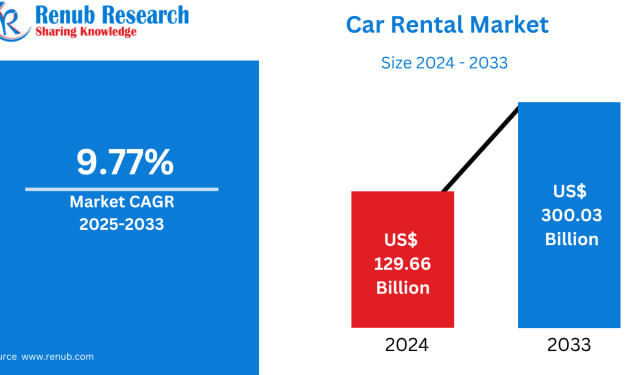
Global Car Rental Market Overview The Global Car Rental Market was valued at USD 129.66 billion in 2024 and is projected to surge to USD 300.03 billion by 2033, growing at a robust CAGR of 9.77% during the forecast period. This impressive growth reflects a structural shift in how consumers and businesses approach transportation—moving away from ownership toward flexible, on-demand mobility solutions.
By Sushant. Renub Research3 days ago in Trader



Comments
There are no comments for this story
Be the first to respond and start the conversation.