
Global Car Rental Market Size and Forecast 2025–2033: The Future of Flexible Mobility
How tourism recovery, digital platforms, and changing urban lifestyles are driving the global car rental industry toward a USD 300 billion milestone

Global Car Rental Market Overview
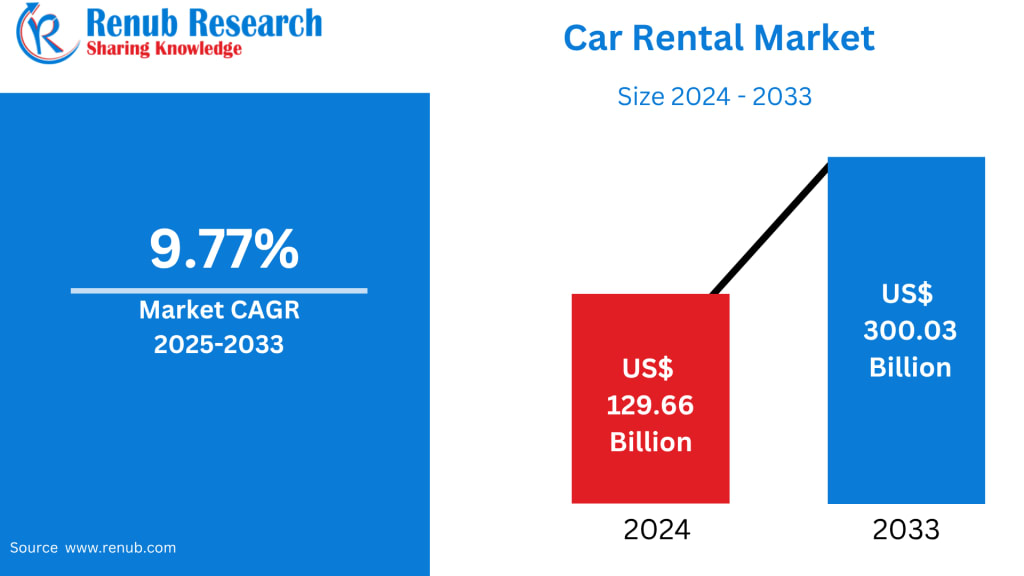
The Global Car Rental Market was valued at USD 129.66 billion in 2024 and is projected to surge to USD 300.03 billion by 2033, growing at a robust CAGR of 9.77% during the forecast period. This impressive growth reflects a structural shift in how consumers and businesses approach transportation—moving away from ownership toward flexible, on-demand mobility solutions.
Car rental services allow individuals and organizations to hire vehicles for a limited time, ranging from hourly and daily use to long-term subscriptions. The market now extends far beyond traditional airport counters, evolving into a digitally driven ecosystem that includes self-drive rentals, luxury vehicles, chauffeur-driven services, and app-based car sharing platforms.
With tourism rebounding strongly, urbanization accelerating, and digital convenience becoming non-negotiable, the car rental industry is positioned at the intersection of travel, technology, and modern lifestyle trends.
Global Car Rental Market Outlook
The modern car rental industry has transformed into a comprehensive mobility service offering convenience, affordability, and flexibility. Customers today can choose from economy hatchbacks to luxury sedans, SUVs, and electric vehicles, depending on their travel needs and budgets. Whether it’s a business trip, weekend getaway, or temporary replacement vehicle, car rentals have become an essential part of daily transportation systems worldwide.
The rapid adoption of mobile apps, contactless check-ins, digital payments, and AI-powered fleet management systems has dramatically improved user experience. These innovations are making rentals faster, easier, and more reliable, fueling higher adoption rates in both developed and emerging economies.
Key Growth Drivers of the Global Car Rental Market
1. Surge in Tourism and Business Travel
The global recovery in travel has been one of the strongest tailwinds for car rental demand. Tourists and business travelers increasingly prefer rental cars for privacy, convenience, and independence compared to public transport or taxis.
According to the United Nations Tourism Agency, international tourist arrivals reached 98% of pre-pandemic levels during January–September 2024, while tourism export earnings touched USD 1.8 trillion in 2023, nearly matching 2019 levels. As airports, hotels, and resorts witness higher footfall, car rentals remain the preferred mode of last-mile connectivity.
2. Urbanization and Declining Car Ownership
As global cities grow denser and parking costs soar, urban residents—especially Millennials and Gen Z—are increasingly choosing mobility-as-a-service (MaaS) over vehicle ownership. Car rentals provide flexibility without long-term financial burdens such as insurance, maintenance, and depreciation.
This shift is particularly visible in megacities, where short-term rentals and car-sharing models are replacing private car ownership as the smarter mobility choice.
3. Technology and App-Based Booking Platforms
Digitalization has redefined the car rental experience. Customers can now browse vehicles, compare prices, book instantly, and unlock cars via mobile apps. Features such as keyless entry, GPS tracking, contactless returns, and real-time availability are becoming standard.
In March 2023, IndusGo, an Indian self-drive rental company, raised USD 11.75 million to expand its fleet and enhance its technology platform, highlighting how digital investment is becoming a competitive necessity across the industry.
Challenges in the Global Car Rental Industry
Rising Operating and Maintenance Costs
Car rental operators face increasing costs related to vehicle procurement, maintenance, insurance, and fuel. Semiconductor shortages and supply chain disruptions have pushed vehicle prices higher, impacting fleet expansion plans and profitability. Smaller operators, in particular, struggle to balance cost efficiency with service quality.
Regulatory and Liability Pressures
Operating across multiple countries exposes companies to varying insurance laws, emission regulations, and tax policies. Environmental regulations are also forcing operators to invest in electric and hybrid fleets, requiring charging infrastructure, staff training, and higher upfront capital.
Global Online Car Rental Market
The online car rental segment is one of the fastest-growing areas of the industry. Digital-first platforms such as Hertz, Avis, Enterprise, Turo, and Zoomcar have transformed customer expectations with transparent pricing, flexible cancellations, and instant bookings.
As mobile payments and smartphone adoption continue to rise, online rentals are expected to dominate future bookings, particularly among younger and tech-savvy travelers.
Global Short-Term Car Rental Market
Short-term rentals remain the backbone of the industry, driven by airport bookings, city travel, and weekend getaways. Hourly and daily rentals are especially popular in urban centers, supported by the growth of peer-to-peer sharing models and flexible pricing structures.
With remote work enabling spontaneous travel, demand for short-term rentals continues to climb globally.
Global Luxury Car Rental Market
Luxury rentals cater to high-end customers seeking premium experiences for weddings, corporate events, VIP transport, and leisure travel. Brands such as Mercedes-Benz, BMW, Audi, and Tesla dominate this segment.
The rise of luxury tourism, influencer culture, and electric luxury vehicles is accelerating growth, particularly in metro cities and resort destinations.
Global Economy Car Rental Market
Economy rentals form the largest volume segment due to affordability and fuel efficiency. These vehicles are widely used by budget travelers, families, and business users, making them a critical entry point for first-time renters.
With inflationary pressures impacting consumer spending, the economy segment remains highly resilient.
Leisure and Tourism Segment: A Major Growth Engine
Car rentals are integral to the tourism experience, offering travelers freedom to explore destinations at their own pace. In regions such as Europe, North America, and Southeast Asia, rental packages are often bundled with hotels and travel deals, driving higher utilization.
As travelers seek customized and immersive experiences, the leisure rental segment is set to remain a long-term growth driver.
Chauffeur-Driven Rental Market
Chauffeur-driven services are gaining popularity in corporate travel, weddings, airport transfers, and VIP events. These rentals provide convenience, safety, and premium comfort, particularly in unfamiliar cities.
Demand is strongest in Asia, the Middle East, and Europe, where luxury travel and professional mobility services are expanding rapidly.
Regional Market Insights
United States Car Rental Market
The U.S. remains the world’s largest car rental market, supported by high travel volumes, strong road infrastructure, and a mature rental ecosystem. Leading players such as Enterprise, Hertz, and Avis dominate, while EV adoption and digital booking platforms are reshaping the competitive landscape.
In April 2022, Sixt expanded operations across the U.S. East Coast, reflecting continued investment in regional growth.
Germany Car Rental Market
Germany’s market benefits from strong tourism, business travel, and a deep-rooted automotive culture. Sustainability initiatives are accelerating EV adoption, while premium service expectations keep competition high.
In April 2022, Hylane GmbH launched climate-neutral hydrogen truck rentals, signaling Germany’s leadership in green mobility solutions.
China Car Rental Market
China is one of the fastest-growing rental markets due to urbanization, rising incomes, and domestic tourism. App-based self-drive rentals dominate urban areas, while government incentives push electric fleets forward.
In May 2025, Baidu Apollo partnered with Car Inc to introduce autonomous driving rental services—marking a new era in mobility innovation.
Saudi Arabia Car Rental Market
Saudi Arabia’s rental industry is expanding rapidly under Vision 2030, with growing tourism, infrastructure investment, and rising domestic travel. Demand for luxury and SUV rentals is particularly strong.
In August 2022, Udrive launched operations in the kingdom, reflecting increasing competition and long-term growth potential.
Market Segmentation Overview
By Booking Type:
Online
Offline
By Rental Length:
Short-Term
Long-Term
By Vehicle Type:
Economy
Executive
Luxury
SUVs
Others
By Application:
Leisure/Tourism
Business
By End-User:
Self-Driven
Chauffeur-Driven
By Region:
North America, Europe, Asia Pacific, Latin America, Middle East & Africa
Key Players in the Global Car Rental Market
Major companies are analyzed across overview, key personnel, recent developments, SWOT, and revenue performance:
Avis Budget Group, Inc.
Carzonrent India Private Limited
Eco Rent A Car
Enterprise Holdings Inc.
Enterprise Rent-A-Car
Europcar
Localiza
Sixt SE
The Hertz Corporation
Final Thoughts
The global car rental industry is no longer just about vehicles—it’s about freedom, flexibility, and smart mobility. As digital platforms evolve, sustainability becomes central, and travel continues to rebound, the market is entering a golden decade of expansion.
With a forecasted value of USD 300.03 billion by 2033, the car rental market is set to play a pivotal role in shaping the future of transportation, tourism, and urban mobility worldwide.
About the Creator
Sushant. Renub Research
I’m Sushanta Halder, Digital Marketing Manager at Renub Research with 15+ years in SEO, content, PPC & lead generation. Passionate about data-driven growth strategies.
Keep reading
More stories from Sushant. Renub Research and writers in Trader and other communities.
Global Footwear Market Size and Forecast 2025–2033: Fashion, Performance, and Sustainability Reshape a US$492 Billion Industry
Global Footwear Market Outlook The global footwear market continues to evolve as one of the most dynamic segments of the consumer goods industry, driven by fashion trends, lifestyle changes, and technological innovation. According to Renub Research, the global footwear market was valued at US$ 350.62 billion in 2024 and is expected to expand to US$ 492.60 billion by 2033, growing at a compound annual growth rate (CAGR) of 3.85% from 2025 to 2033.
By Sushant. Renub Researchabout 5 hours ago in Trader
DECLINE OF THE DOW JONES AND S&P 500 AS THE DOLLAR WEAKENS AMID GREENLAND THREATS AND TARIFF FEARS
DECLINE OF THE DOW JONES AND S&P 500 AS THE DOLLAR WEAKENS AMID GREENLAND THREATS AND TARIFF FEARS Financial markets have entered a period of heightened volatility as major U.S. stock indexes, including the Dow Jones Industrial Average and the S&P 500, moved sharply lower. At the same time, the U.S. dollar has shown noticeable weakness. This shift in market sentiment has been driven by rising geopolitical tensions linked to Greenland and renewed concerns over trade tariffs, creating uncertainty that has unsettled investors across global markets.
By America today 2 days ago in Trader


Comments
There are no comments for this story
Be the first to respond and start the conversation.