
Meal Kit Market Trends & Summary: The Future of Smart, Convenient Home Cooking
How Convenience, Health Trends, and Digital Platforms Are Transforming the Global Meal Kit Industry (2025–2033)

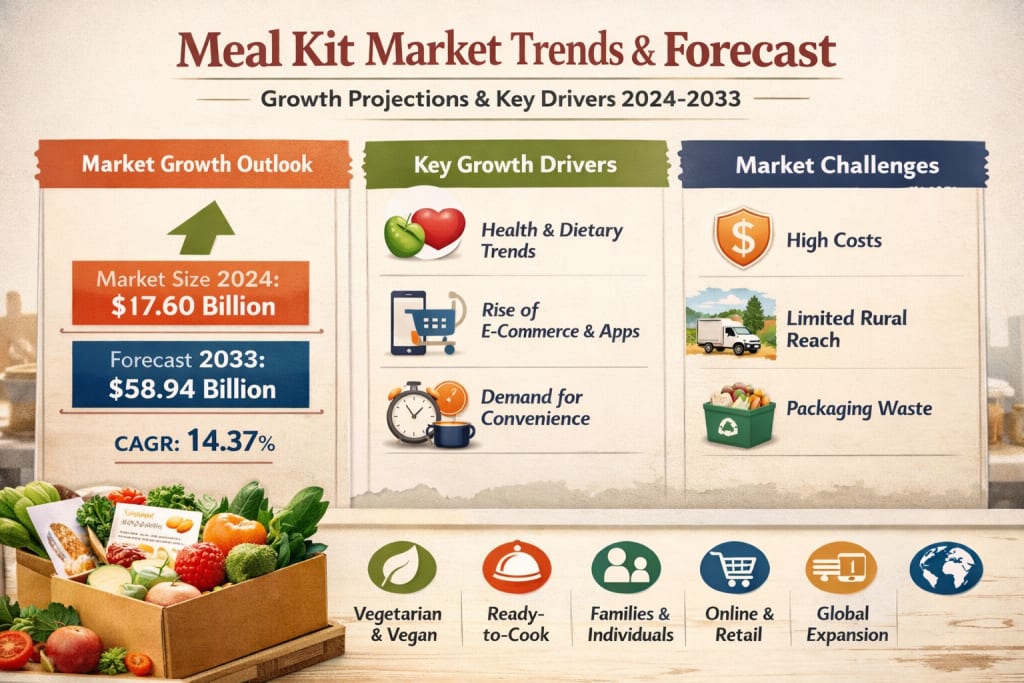
Global Meal Kit Market at a Glance
The global Meal Kit Market is entering a powerful growth phase, driven by changing consumer lifestyles, rising health awareness, and the rapid expansion of e-commerce and smartphone usage. According to Renub Research, the Meal Kit Market is expected to reach US$ 58.94 billion by 2033, up from US$ 17.60 billion in 2024, growing at a strong CAGR of 14.37% from 2025 to 2033.
This impressive expansion reflects a broader shift in how people approach food. Modern consumers want meals that are convenient, healthy, time-saving, and customizable—without sacrificing taste or quality. Meal kits, which provide pre-portioned ingredients and easy-to-follow recipes delivered directly to the doorstep, have emerged as a practical solution to these evolving needs.
What began as a niche service for busy urban professionals has now grown into a global food movement. From families seeking stress-free weeknight dinners to individuals experimenting with new cuisines and diets, meal kits are reshaping everyday cooking habits across multiple regions.
Global Meal Kit Industry Overview
The worldwide meal kit industry has witnessed rapid growth in recent years, fueled by a combination of health-conscious behavior, time constraints, and digital convenience. Consumers increasingly prefer solutions that simplify daily routines, and meal kits fit perfectly into this lifestyle shift by eliminating grocery shopping, reducing food waste, and streamlining meal preparation.
Another key driver is the rising popularity of home cooking, especially after recent global disruptions that changed how people think about food, budgeting, and health. Meal kits allow consumers to enjoy home-cooked meals without the hassle of planning, portioning, or sourcing ingredients. This has made them especially attractive to young professionals, working couples, and families with limited time.
At the same time, the industry has benefited from the subscription economy. Many leading brands offer flexible weekly or monthly plans, giving users control over their meals while ensuring predictable demand for companies. The integration of mobile apps and user-friendly platforms has further improved customer experience, making ordering, customization, and scheduling easier than ever.
However, the market is not without challenges. High costs compared to traditional grocery shopping, concerns about packaging waste, and logistical complexities in delivering fresh ingredients remain important hurdles. Despite this, the long-term outlook remains highly positive as companies invest in sustainability, supply chain efficiency, and product innovation.
Recent Industry Developments
The competitive landscape of the meal kit market continues to evolve through product innovation and strategic launches. For instance, Albertsons Companies introduced new meal options in January 2024 as supermarkets increasingly aim to compete with restaurants by focusing on convenient meal occasions.
Similarly, Blue Apron announced the launch of two easy meal packages in June 2023 featuring new ingredients, designed specifically for festive gatherings and summer get-togethers. These limited-edition offerings, created to serve up to eight people, highlight how meal kit companies are expanding beyond everyday dinners into social and occasion-based dining solutions.
Such developments show that the industry is no longer just about convenience—it is also about experience, variety, and lifestyle alignment.
Key Growth Drivers for the Meal Kit Market
1. Increasing Dietary and Health Trends
Health and wellness have become central to consumer purchasing decisions. More people are actively seeking meals that align with specific dietary preferences such as vegan, vegetarian, gluten-free, keto, and low-calorie diets. Meal kit companies are capitalizing on this trend by offering portion-controlled, nutritionally balanced, and clearly labeled meals.
Surveys among nutrition professionals indicate that consumers are increasingly mindful of what they eat, how often they eat, and how their food choices affect long-term health. This shift has created strong demand for transparent, curated, and health-focused meal solutions, giving meal kits a significant advantage over traditional ready-to-eat or fast-food options.
2. Important Developments in Technology
Technology has played a crucial role in scaling the meal kit industry. Modern platforms and mobile apps allow customers to customize menus, manage subscriptions, track deliveries, and access thousands of recipes with ease.
For example, Albertsons Companies introduced enhanced digital features in September 2023 for its shoppable Meal Plans and Recipes service. These upgrades included a budget tracker, an expanded recipe library, shoppable ingredient lists, and step-by-step cooking modes. Such innovations improve user engagement, boost retention, and make meal planning more interactive and efficient.
3. Growing Demand for Convenience
Convenience remains one of the strongest drivers of the meal kit market. Busy lifestyles, long working hours, and urban commuting patterns have reduced the time people can spend on meal planning and grocery shopping. Meal kits solve this problem by delivering pre-measured, ready-to-cook ingredients straight to the consumer’s home.
While home cooking has slightly declined from its peak in earlier years, a significant portion of consumers still prefer to eat at home for budget control, health reasons, and family time. Meal kits bridge the gap between convenience and home cooking, offering a solution that is both practical and satisfying.
Challenges in the Meal Kit Market
1. High Cost of Meal Kits
One of the biggest barriers to wider adoption is the relatively high price of meal kits compared to traditional grocery shopping. Premium ingredients, specialized packaging, cold-chain logistics, and delivery costs all contribute to higher prices.
For budget-conscious consumers, especially in price-sensitive markets, this cost difference can be a deal-breaker. While many users appreciate the convenience, they may still prefer bulk grocery shopping for long-term savings. This price factor limits market penetration, particularly among lower-income households.
2. Limited Reach in Rural Areas
Most meal kit companies are heavily focused on urban and suburban markets, where demand, infrastructure, and purchasing power are stronger. Expanding into rural areas presents logistical challenges such as longer delivery times, higher shipping costs, and risks to ingredient freshness.
Lower population density also makes it harder to justify the investment required to build efficient delivery networks in these regions. As a result, rural market penetration remains limited, restricting the industry’s overall reach.
Regional Market Insights
United States Meal Kit Market
The United States remains one of the largest and most mature markets for meal kits. The popularity of brands like Blue Apron, HelloFresh, and Sun Basket reflects strong consumer demand for convenience, healthier eating, and home cooking experiences.
Busy lifestyles, especially among millennials and working families, continue to drive adoption. At the same time, challenges such as high customer acquisition costs, packaging waste concerns, and customer retention persist. Despite these issues, the U.S. market is expected to maintain steady growth due to ongoing innovation and strong consumer interest in convenient, health-focused meals.
Belgium Meal Kit Market
In Belgium, the meal kit market is expanding as consumers seek time-saving, home-cooked meal solutions. Companies like HelloFresh have gained popularity by offering diverse menu options, including vegetarian and balanced meal plans.
However, higher prices compared to traditional grocery shopping and concerns about packaging waste remain obstacles. Even so, as sustainability and convenience become more important to Belgian consumers, demand for meal kits is expected to rise further.
China Meal Kit Market
China’s meal kit market is driven by urbanization, busy work schedules, and growing health awareness, especially among millennials and young professionals. Both international and local brands are adapting menus to suit regional tastes and dietary preferences.
Logistical challenges and higher costs compared to traditional markets still limit broader adoption, particularly in rural areas. Nevertheless, as digital commerce and home delivery services continue to expand in China, the meal kit market is expected to see strong long-term growth.
United Arab Emirates Meal Kit Market
In the UAE, the meal kit industry is benefiting from high internet penetration, strong delivery infrastructure, and a diverse, health-conscious population. Consumers are increasingly interested in convenient, high-quality meal solutions that fit into fast-paced urban lifestyles.
While pricing and packaging sustainability remain concerns, the growing focus on premium convenience and healthy living is likely to support continued market expansion in the region.
Meal Kit Market Segmentation
By Meal Type
Vegetarian
Non-Vegetarian
Vegan
By Offering Type
Heat and Eat
Cook and Eat
Ready to Eat
By End User
Individuals
Families
By Distribution Channel
Online
Hypermarket/Supermarket
Convenience Store
Others
By Geography (25 Countries)
North America: United States, Canada
Europe: France, Germany, Italy, Spain, United Kingdom, Belgium, Netherlands, Turkey
Asia Pacific: China, Japan, India, Australia, South Korea, Thailand, Malaysia, Indonesia, New Zealand
Latin America: Brazil, Mexico, Argentina
Middle East & Africa: South Africa, Saudi Arabia, United Arab Emirates
Company Landscape and Competitive Insights
The global meal kit market features a mix of established food companies and specialized meal kit startups. Key players include:
Blue Apron Holdings
Tyson Foods
Nestlé
Gobble Inc
Gousto
HelloFresh
SimplyCook Ltd.
Albertsons Companies, Inc.
Fresh n’ Lean
Hungryroot
These companies compete on menu variety, pricing models, dietary customization, delivery reliability, and user experience. Ongoing investments in technology, supply chain optimization, and sustainable packaging are shaping the next phase of competition in this market.
Final Thoughts
The global meal kit market is clearly on a strong growth trajectory, supported by changing lifestyles, rising health awareness, digital innovation, and the growing demand for convenience. With the market projected to grow from US$ 17.60 billion in 2024 to US$ 58.94 billion by 2033, the industry represents one of the most dynamic segments within the broader food and beverage sector.
While challenges such as high costs, packaging concerns, and limited rural reach remain, ongoing innovation and sustainability efforts are likely to address many of these issues over time. As consumers continue to prioritize health, time efficiency, and personalized food experiences, meal kits are well-positioned to become a long-term staple in modern households around the world.
About the Creator
Ethereum (ETH-USD) Outlook: $2,000 Support, $2,700 Resistance in Focus
Ethereum (ETH-USD), the second-largest cryptocurrency by market capitalization, is once again at a critical technical and psychological crossroads. As market volatility remains elevated across digital assets, Ethereum is currently trading within a defined range, with $2,000 acting as a key support level and $2,700 emerging as a major resistance zone. Investors and traders are closely monitoring these levels to assess Ethereum’s next directional move.
By Hammad Nawaza day ago in Trader
Philippines Petroleum Market 2026: Fuel Demand, Energy Security & Infrastructure Development
Philippines Petroleum Market Overview The Philippines petroleum market remains a critical pillar of the country’s energy system, supplying fuels that power transportation, industrial operations, power generation and household consumption. Despite gradual progress toward renewable energy adoption, petroleum products continue to account for a significant share of the national energy mix due to their reliability, established infrastructure and wide applicability. The market includes refined products such as gasoline, diesel, aviation turbine fuel, liquefied petroleum gas (LPG), fuel oil and other derivatives used across multiple sectors.
By Manisha Dixit8 days ago in Trader
Our Song
Evening has given way to night. Gently, I settle next to you on the comfortable, old love seat and reach for your hand. You snatch it away, again. It cuts me to the quick, but I hide the pain, understanding that the reaction is but part of your demented state. Since the accident, your presence here in our cozy home has been clouded by a haze I can't see. Nevertheless, I feel the frigidity of your expressions and it serves as an excruciating reminder of the immeasurable distance between us.
By Dana Crandell7 days ago in Fiction




Comments
There are no comments for this story
Be the first to respond and start the conversation.