
Rate Cuts are Bad for Stock Investments
Especially in a recession where stock market decreases are the largest


The financial world is going to see a big pivot soon with respect to short-term interest rates. Is that good or bad for stock investments?
On Friday, August 23rd, 2024 Federal Reserve Board Chairman Jerome Powell gave a speech at the annual Jackson Hole Economic Symposium where he strongly signaled that interest rates are going to be cut:
"The time has come for policy to adjust. The direction of travel is clear, and the timing and pace of rate cuts will depend on incoming data, the evolving outlook, and the balance of risks," - Chair Powell quoted in What Powell's Jackson Hole comments mean for mortgage rates
Expectations for a September rate cut are now locked in by Wall Street, with a not insignificant probability of a 0.50% rate cut instead of the traditional 0.25% cut. On the day that Chair Powell spoke, the stock market took off and saw a large gain as lower interest rates should mean higher stock prices. Or does it??? Will stock prices go up as interest rates are cut?
What impact do rate cuts have on stock markets?
History shows that rate cuts are actually bad for stock markets. The following chart from Nick Maggiulli in How Stocks Perform After the Fed Cuts Rates shows that, on average, the S&P500 decreases after Fed rate cuts. The data shows how the stock market performed after the 29 rate cuts since 1994.
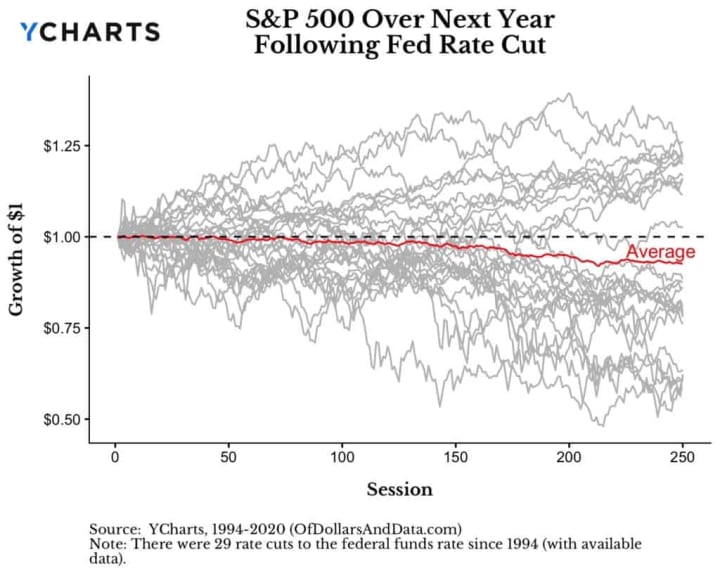
Of course, while the average is negative, you can see that there a number of instances where the market actually increased. So, how does one determine what could happen to the market following the upcoming rate cuts?
The worst returns happen around recessions
The next chart from Mr. Maggiulli shows the magnitude of drawdowns for the S&P across time.

As you can see in the chart, there were two time periods where the majority of rate cuts cluster and the drawdowns were the deepest. These two time periods were during the last two major recessions (not including Covid): Dot-com recession and the Great Financial Crisis.
In these recessions, the stock market decrease started after the rate cuts started and the Fed kept cutting through the entire downturn. Other instances of rate cuts, outside of recession, did not see many rate cuts and the market actually increased after the cuts.
So, understanding whether there is a recession can help provide insight into whether stock market returns are more likely to be negative and decrease at a more significant rate.
Is a recession likely?
There are a number of current indicators which have historically had a very strong ability to predict recessions with minimal false positives. For example, an inverted yield curve or negative Leading Economic Indicators (LEI), so conditions have been ripe for a recession for a while. Recently, another indicator which hasn't had any false positives was also triggered: the Sahm Rule.
What is the Sahm Rule?
There is a great Investopedia article which provides details on this indicator: The Sahm Rule Recession Indicator Definition and How It's Calculated
According to the Sahm Rule, the early stages of a recession is signaled when the three-month moving average of the U.S. unemployment rate is half a percentage point or more above the lowest three-month moving average unemployment rate over the previous 12 months.
It's a pretty simple calculation that has been very accurate in showing when we are already in a recession. Earlier this month, the latest unemployment report showed an unemployment rate which has officially triggered the Sahm Rule.
As I have shared in my articles before, one data point doesn't guarantee a specific outcome is going to happen. However, when there are multiple indicators pointing to the same outcome, in particular when each of those indicators have individually had high rates of predictive ability, I put a lot of faith in the combination of them. Thus, to me, there is a very high probability that we will have (or already are in) a recession. And, based on the data I have shared in this article, there is a high likelihood of a large stock market drawdown.
What is the Sahm Rule?
There is a great Investopedia article which provides details on this indicator: The Sahm Rule Recession Indicator Definition and How It's Calculated
According to the Sahm Rule, the early stages of a recession is signaled when the three-month moving average of the U.S. unemployment rate is half a percentage point or more above the lowest three-month moving average unemployment rate over the previous 12 months.
It's a pretty simple calculation that has been very accurate in showing when we are already in a recession. Earlier this month, the latest unemployment report showed an unemployment rate which has officially triggered the Sahm Rule.
As I have shared in my articles before, one data point doesn't guarantee a specific outcome is going to happen. However, when there are multiple indicators pointing to the same outcome, in particular when each of those indicators have individually had high rates of predictive ability, I put a lot of faith in the combination of them. Thus, to me, there is a very high probability that we will have (or already are in) a recession. And, based on the data I have shared in this article, there is a high likelihood of a large stock market drawdown.
So, what now?
When I have a high degree of confidence that there will be a recession and stock market drawdown as I do now, I been reducing my allocation to stocks. By moving monies into cash and shorter-term treasury bonds - where I can still earn a positive return - I am setting up my family with the dry powder that enables the inevitable bargains available during large stock market drawdowns.
This completes today’s post on Rate Cuts are Bad for Stock Investments. The practical steps you can start taking from today’s post are:
- Recognize that rate cuts are typically precipitated by an issue with the economy: History shows that central banks don't change monetary policy without a reason. Chair Powell very clearly stated in his speech that the driver for rate cuts is increasing employment.
- Rising unemployment is a harbinger of economic recession and stock returns are deeply negative in recessions: Increases in the unemployment rate have historically been trustworthy indicators of an impending economic recession. Once unemployment increases by levels consistent with triggering the Sahm rule, as we currently see, we are already in a recession. In recessions, we see significant falls in stock market values.
- Review your stock portfolio and pare back your exposure to the most speculative investments: Relook through the valuations of your holdings and ask yourself the hard question of why you have that asset. Unless your original thesis when you purchased it still holds, reduce or get rid of that investment.
- Hold that cash as dry powder and wait for the inevitable bargains that will come up as the stock market drawdown unfolds: You will be able to redeploy the monies you've pulled out now at much lower prices once the drawdown has run its course.
Please also note that I am not a financial advisor and I share what I do for information and educational purposes only: Do your own due diligence before you make any investment decisions.
Thank you for joining me on my journey to build financial literacy for young adults and their families. Please share any comments or questions that you have in the comments section. If you are interested in reading more of my posts, please access my author page (https://shopping-feedback.today/authors/sudhir-sahay) where you can see all the posts I’ve published. Also, if there are any topics you’re interested in my broaching in future posts, please let me know. In addition to the comments section, I can be reached at [email protected].
About the Creator
Sudhir Sahay
Sudhir Sahay is a Sales and Marketing executive and a father of two young men. Sudhir hopes to share his journey building basic financial literacy for his children and providing savings and investing advice to their friends and peers.
Keep reading
More stories from Sudhir Sahay and writers in Trader and other communities.
Investments Don't Go Up or Down in a Straight Line
I recently saw a very interesting chart that has gotten me thinking about short-term vs. long-term investing. The chart shows the tremendous volatility that one of the commodities I have been investing in - uranium - experienced in its last bull run:
By Sudhir Sahay2 years ago in Trader
Mexico E-Commerce Platform Market Growth, Trends, and Future Opportunities 2026-2034
Mexico E-Commerce Platform Market Growth, Trends, and Future Opportunities The Mexico e-commerce platform market is undergoing a major transformation as digital technologies reshape how consumers shop and businesses sell online. Rapid internet penetration, widespread smartphone adoption, and improving logistics infrastructure are accelerating the shift toward digital commerce across the country. As online shopping becomes increasingly convenient and accessible, e-commerce platforms are emerging as a critical component of Mexico’s retail ecosystem.
By Kim Soo hyun6 days ago in Trader




Comments
There are no comments for this story
Be the first to respond and start the conversation.