
Investments Don't Go Up or Down in a Straight Line
Have patience through cycles and Ride the Wave to maximize your investment earnings


I recently saw a very interesting chart that has gotten me thinking about short-term vs. long-term investing. The chart shows the tremendous volatility that one of the commodities I have been investing in - uranium - experienced in its last bull run:
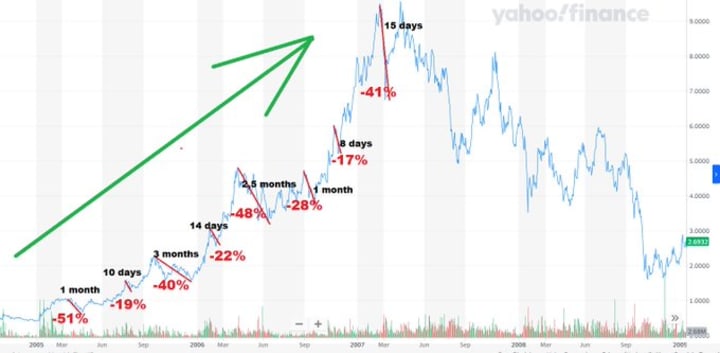
As you can see, over the 2.5 year period from 2005-2007 when the uranium price went up more than 10-fold, there were eight different times when the price fell by double digit percentages. So, the question for me has been: how does one find a way to earn the majority of the 10+-fold increase without getting caught in either a short-term downdraft or overstaying my welcome and riding the market back down as started in mid-2007?
Fundamentals and human emotions
When looking at these "bull markets", I focus on two criteria to best understand how to maximize my returns. Of course, the same applies in the opposite manner in an industry going through a "bear market".
Fundamentals
The starting point is the industry's fundamentals. Is there a real reason why its constituent companies are going to go up? As we all know, the value of a stock over the long term is based on the sum of its cash flows which are provided to the equity holder either as dividends, debt repayment or investments which will drive further cash flows. If the industry doesn't exhibit fundamental drivers, then it's not worth investing in.
For uranium, I see the following fundamental drivers:
- Increasing demand: In recent months, there have been a number of new nuclear reactor builds, reactor life extensions and announcements of new products such as Small Modular Reactors. In addition, a number of countries have announced their support for nuclear, for example the EU announcing that nuclear now counts as a green investment
- Demand exceeds supply: Nuclear fuel demand is significantly (~20% depending on the data source you look at) higher than supply. In addition, inventories which had been used to meet the supply / demand gap are now depleted
- Constrained supply growth: It takes a very long time for a new uranium mine to be licensed, built and launched. In addition, today's pricing isn't significant enough to incent the very risky investment into developing a new mine
As you can see above, the industry's fundamentals are strong. If and when the factors listed above change, then I will reevaluate the investing thesis. However, for now, there is every reason to expect increased pricing power and profitability in this industry in the near- to medium-term.
Human emotions
Cycles are a natural part of life. They show repeating patterns across time and can be used to identify investing opportunities. I wrote an article earlier this year that talks about cycles if you're interested in reading more:
Although I didn't mention this in my previous article, there are also cycles of human behavior, driven by emotions such as greed or fear. As the market goes through these emotional cycles, the pricing of assets in that industry fluctuate around the fundamental value of those assets. The key emotions which impact pricing are:
- Greed: When an asset appreciates, more and more buyers who see that it's going up flock to that asset because they also want a piece of that appreciation. As more and more people jump into the asset, pricing goes significantly, faster than fundamentals would support
- Fear: Once the price has gone up a lot, those who have made money start worrying about losing what they've gained. This fear leads to some of them selling, which builds upon itself as the price goes down and other people start worrying about losing their money. This typically leads to pricing going down below fundamentals
- Desire for simplicity and quick riches: While this isn't an emotion per se, people are always looking for easy ways to make money. This desire leads to simple heuristics that people use to determine whether they're going to jump into an investment. For example, when an asset's price goes above a round number like $100, more people jump into it. Similarly, if an asset approaches a previous high, people sell. However, once it breaks through that previous high, people buy
When will I make my exit and stop riding the wave?
Given the two big factors - fundamentals and human emotions - around pricing, here's the plan that I have laid out for my uranium investment:
- Reevaluate the fundamentals in the industry every 2-3 months. If the fundamentals remain positive, go to the next step. If the fundamentals have turned negative, start scaling out of my investments
- Get a read on the emotions playing out in the industry: Ignore the fluctuations around fundamental value, but focus on the desire for simplicity and quick riches. If and when the price breaks through the previous high of $136 / lb seen in June, 2007 (which is equal to ~$204 today after accounting for inflation), start scaling down my investments as that is one of those triggers where greedy people start jumping in. The scaling down I will do is to sell tranches of 10% of my holdings for every $10 increment in price. Once the price reaches the inflation-adjusted price level, increase the tranche size to 15%
This completes today’s post on Investments Don't Go Up or Down in a Straight Line. The practical steps you can start taking from today’s post are:
- Recognize that there are cycles which impact the investing world: Like all different aspects of life, there are patterns that repeat, including in the investing world. Understanding the current situation relative to the cycle provides significant insights into what comes next.
- Do your due diligence on the fundamental value in the industry: If the fundamentals suggest that asset-price appreciation is warranted, go ahead and invest or hold if you've already investment (or sell if the fundamentals do not warrant investment). Update your determination of fundamental value regularly
- Keep tabs on the emotions driving pricing in the industry: In particular look at round numbers and other triggers for rapid appreciation where people use simple heuristics to carry through on their greed and/or fear
- Conduct a deep dive into key companies within the industries you've identified: Identifying industries which are poised for an upturn is just the first step in the process. As a next step, do a deep dive into key companies within the industry. I focus on the largest and most prominent companies as those provide a level of safety and are likely to be the initial beneficiaries of an industry upturn.
Please also note that I am not a financial advisor and I share what I do for information and educational purposes only: Do your own due diligence before you make any investment decisions.
Thank you for joining me on my journey to build financial literacy for young adults and their families. Please share any comments or questions that you have in the comments section. If you are interested in reading more of my posts, please access my author page (https://shopping-feedback.today/authors/sudhir-sahay) where you can see all the posts I’ve published. Also, if there are any topics you’re interested in my broaching in future posts, please let me know. In addition to the comments section, I can be reached at [email protected].
About the Creator
Sudhir Sahay
Sudhir Sahay is a Sales and Marketing executive and a father of two young men. Sudhir hopes to share his journey building basic financial literacy for his children and providing savings and investing advice to their friends and peers.
Reader insights
Nice work
Very well written. Keep up the good work!
Top insights
Compelling and original writing
Creative use of language & vocab
Easy to read and follow
Well-structured & engaging content
Masterful proofreading
Zero grammar & spelling mistakes
On-point and relevant
Writing reflected the title & theme
Keep reading
More stories from Sudhir Sahay and writers in Trader and other communities.
Transformers Market Size and Forecast 2025–2033
Introduction Electricity is the backbone of modern civilization. From powering homes and factories to supporting digital infrastructure and transportation, reliable electricity distribution is essential for economic growth and technological advancement. At the heart of this complex electrical ecosystem lies one of the most critical components of power systems: the transformer.
By Sakshi Sharmaa day ago in Trader


Comments (1)
I really love your content and how it's crafted , I love it and happily subscribed , you can check out my content and subscribe to me also , thanks for this beautiful one