
Hair Transplant Market Size and Forecast 2026–2034: Technology, Aesthetics, and the New Age of Hair Restoration
Global Hair Transplant Market to Reach US$ 14.83 Billion by 2034, Driven by Rising Alopecia Cases, Robotic FUE, and Growing Medical Tourism

Hair Transplant Market Overview
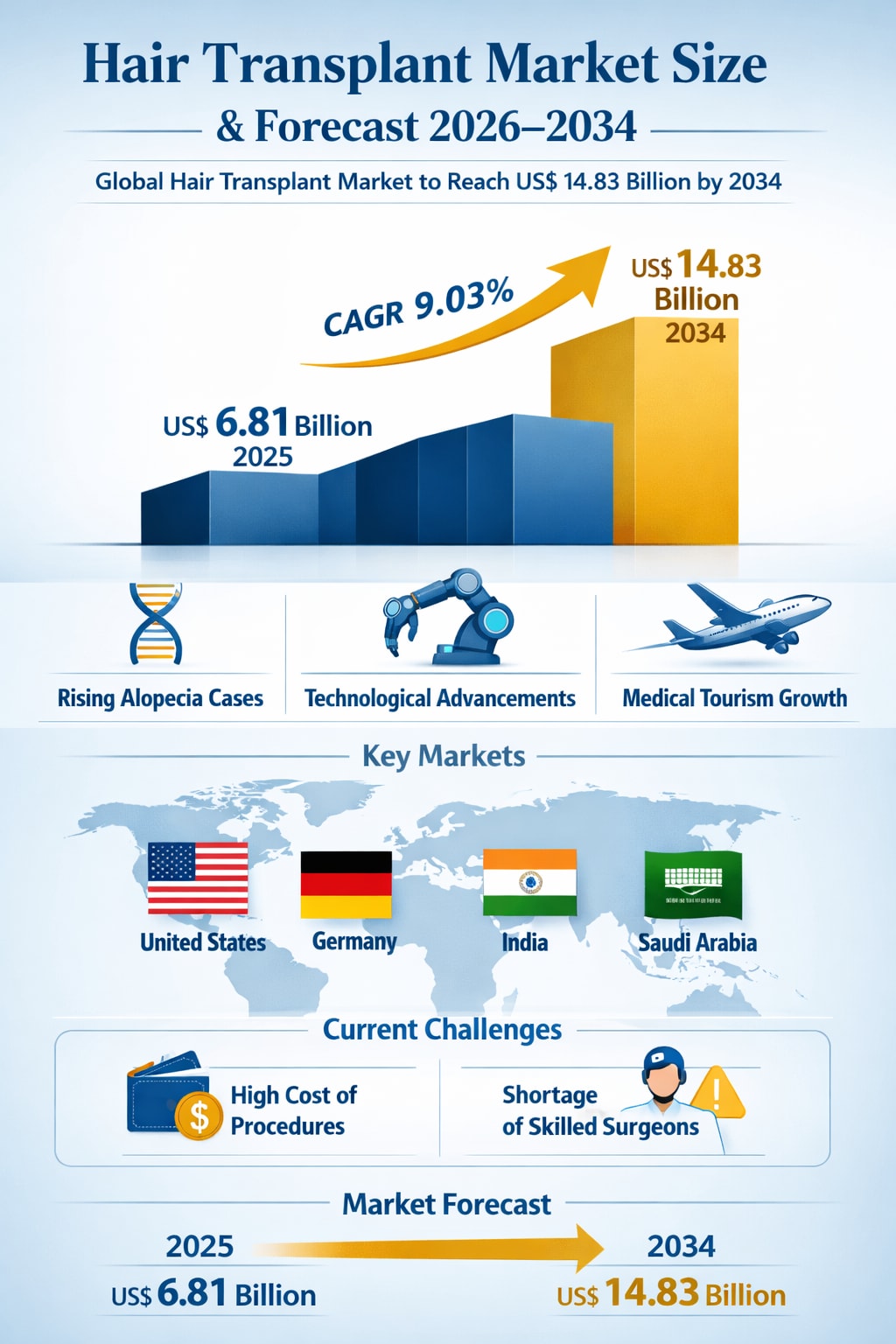
The global hair transplant market is entering a phase of accelerated growth, fueled by rising aesthetic awareness, technological innovation, and the increasing prevalence of hair loss among both men and women. According to Renub Research, the Hair Transplant Market is expected to reach US$ 14.83 billion by 2034, up from US$ 6.81 billion in 2025, growing at a CAGR of 9.03% from 2026 to 2034. This strong expansion reflects not only the growing demand for cosmetic procedures but also the transformation of hair transplantation into a sophisticated, technology-driven medical service.
A hair transplant is a surgical procedure that relocates hair follicles from a donor area—usually the back or sides of the scalp—to regions affected by thinning or baldness. Over the years, techniques such as Follicular Unit Transplantation (FUT) and Follicular Unit Extraction (FUE) have evolved to deliver more natural-looking results, reduced scarring, and faster recovery times. Today’s procedures emphasize minimally invasive approaches, higher graft survival rates, and improved patient comfort, making hair transplantation more accessible and socially acceptable than ever before.
Hair transplants are commonly used to treat androgenic alopecia, scarring alopecia, and hair loss caused by trauma or medical treatments. With increasing influence from social media, celebrity culture, and workplace aesthetics, more individuals are seeking long-term solutions for hair restoration rather than temporary treatments such as medications or topical products. As a result, the hair transplant industry is shifting from a niche cosmetic service into a mainstream segment of the global healthcare and aesthetics market.
Hair Transplant Industry in a Changing Aesthetic Landscape
The modern hair transplant industry sits at the intersection of healthcare, beauty, and technology. What was once considered a luxury cosmetic procedure is now viewed by many as an investment in personal confidence, professional image, and psychological well-being. This shift in perception is a critical factor behind the market’s strong growth trajectory.
Technological advancements have played a central role in this transformation. Robotic-assisted FUE systems, sapphire blade techniques, AI-guided graft placement, and refined micrografting methods have significantly improved surgical precision and aesthetic outcomes. These innovations have reduced complications, minimized visible scarring, and shortened recovery periods, making the procedure more appealing to a wider demographic.
At the same time, regenerative medicine has begun to influence hair restoration practices. Supportive treatments such as Platelet-Rich Plasma (PRP), exosome therapy, and stem-cell–based enhancements are increasingly being used alongside traditional transplantation methods to improve graft survival and stimulate natural hair growth. This integration of surgical and regenerative approaches is reshaping the competitive landscape of the industry and expanding the range of services offered by specialized clinics.
Growth Drivers for the Hair Transplant Market
Rising Prevalence of Androgenic Alopecia and Lifestyle-Related Hair Loss
One of the strongest drivers of the global hair transplant market is the increasing prevalence of androgenic alopecia among both men and women. Factors such as genetics, hormonal imbalances, chronic stress, poor nutrition, environmental pollution, and unhealthy lifestyles are contributing to earlier and more widespread hair thinning and pattern baldness. In many regions, hair loss is now being reported at younger ages, which expands the potential patient pool for hair restoration procedures.
Unlike temporary solutions such as medications, shampoos, or topical treatments, hair transplantation offers a permanent and natural-looking solution. As awareness grows and social stigma around cosmetic procedures continues to decline, more individuals are choosing surgical intervention to address hair loss. Aging populations in many countries further reinforce this trend, as age-related hair thinning becomes more common and socially visible.
Technological Advancements and Improved Clinical Outcomes
Technology is one of the most powerful catalysts behind the market’s rapid growth. Modern hair transplant procedures benefit from robotic assistance, high-resolution imaging, AI-supported planning tools, and ultra-precise surgical instruments. These innovations have improved graft placement accuracy, increased graft survival rates, and enhanced overall aesthetic results.
Minimally invasive FUE techniques, in particular, have gained widespread acceptance due to their reduced scarring and quicker recovery times compared to traditional methods. In addition, advances in anesthesia, donor area management, and post-operative care have made procedures safer and more predictable. As outcomes continue to improve, patient confidence in hair transplantation rises, driving higher adoption across different age groups and demographics.
Growth of Medical Tourism and Expansion of Specialized Clinics
Medical tourism has emerged as a major growth engine for the hair transplant market. Countries such as Turkey, India, Thailand, and Mexico have become global hubs for hair restoration, offering high-quality procedures at significantly lower costs than many Western nations. Competitive pricing, experienced surgeons, and comprehensive treatment packages have attracted a steady flow of international patients.
At the same time, the global expansion of specialized hair restoration clinics has improved accessibility and awareness. Many clinics now offer financing options, multilingual support, and personalized treatment plans, making procedures more convenient and appealing to a broader audience. Social media marketing and highly visible before-and-after results have further amplified global demand, reinforcing the role of medical tourism as a key market driver.
Challenges in the Hair Transplant Market
High Cost of Procedures and Limited Insurance Coverage
Despite strong demand, the high cost of hair transplant procedures remains a significant barrier. Advanced FUE techniques, robotic systems, and regenerative add-ons can substantially increase total treatment expenses. Since hair transplantation is typically classified as a cosmetic procedure, insurance coverage is rare, leaving patients to pay out of pocket.
This limits market penetration in price-sensitive regions and among middle- and lower-income populations. For clinics, the cost of maintaining advanced equipment and continuous surgeon training also contributes to higher pricing. As a result, affordability remains a key challenge for the industry, even as demand continues to grow.
Shortage of Skilled Surgeons and Quality Variability
Hair transplantation is both a medical and artistic procedure, requiring technical precision and aesthetic judgment. However, there is a shortage of highly skilled and experienced surgeons in many regions, particularly in emerging markets. This skills gap can lead to inconsistent results, higher complication rates, and patient dissatisfaction.
The rise of low-cost clinics with insufficiently trained staff has further increased quality variability across the market. In some cases, patients require costly corrective procedures due to poor initial outcomes. Inconsistent regulatory standards across countries also contribute to uneven quality of care, posing a challenge to the industry’s long-term reputation and sustainable growth.
Regional Market Insights
United States Hair Transplant Market
The United States represents one of the largest and most mature hair transplant markets globally. High levels of aesthetic awareness, widespread access to advanced medical technologies, and the presence of leading hair restoration specialists support strong market demand. The adoption of robotic FUE systems and regenerative therapies such as PRP and exosomes is increasing, reflecting the country’s focus on innovation and premium treatment options.
Strong marketing, celebrity influence, and social media visibility further drive consumer interest. However, high procedure costs and limited insurance coverage can restrict accessibility for some patients, although financing options are becoming more common.
Germany Hair Transplant Market
Germany’s hair transplant market is growing steadily, supported by a strong healthcare infrastructure, strict regulatory standards, and high-quality medical services. German clinics emphasize safety, precision, and advanced surgical techniques, attracting both domestic and international patients. Rising interest in minimally invasive cosmetic procedures and supportive treatments such as PRP and mesotherapy continues to fuel demand.
While procedural costs are generally higher than in medical tourism destinations, Germany maintains a strong reputation for quality-driven and reliable hair restoration services, making it a key market within Europe.
India Hair Transplant Market
India is one of the fastest-growing hair transplant markets, driven by rising cases of androgenic alopecia, increasing aesthetic awareness, and highly competitive pricing. The country has become a major medical tourism destination, attracting patients from Asia, the Middle East, Africa, and Europe.
India’s expanding network of specialized clinics is rapidly adopting advanced technologies and regenerative treatments. A notable industry development occurred in August 2023, when Levo Spa and Salon partnered with Australia’s Evolved Hair Restoration to launch an advanced hair transplant clinic in Gurgaon, introducing next-generation restoration solutions. This reflects India’s shift toward more premium, globally aligned hair restoration services.
Saudi Arabia Hair Transplant Market
Saudi Arabia’s hair transplant market is growing as cosmetic procedures gain wider cultural acceptance, particularly among younger men. Rising disposable incomes, increased prevalence of male-pattern baldness, and expanding private healthcare facilities are key growth factors. Clinics are increasingly offering FUE, sapphire FUE, and PRP-based regenerative treatments.
Medical tourism within the GCC region also supports demand, although high equipment costs and reliance on imported technologies remain challenges. Nevertheless, ongoing investment and rising awareness point to strong long-term growth potential.
Recent Developments in the Hair Transplant Market
In April 2025, Asli Tarcan Clinic introduced a robotic DHI protocol optimized for Afro-textured hair, expanding inclusivity and improving treatment precision for diverse patient groups.
In February 2025, several Istanbul providers reduced their prices in response to European hospitals offering low-cost hair transplant bundles, intensifying competition and accelerating regional price convergence.
In February 2023, HairClub expanded its network beyond 120 centers across North America and Puerto Rico by opening a new facility in Wildwood, Florida, strengthening its geographic reach and revenue base.
Market Segmentation
By Service Provider:
Hospital
Clinic
Surgical Centers
Others
By Procedure:
Follicular Unit Transplantation (FUT)
Follicular Unit Extraction (FUE)
Combination of FUT and FUE
Others
By Type:
Head Hair Transplant
Eyebrow Transplant
Frontal Hairline Lowering
Other Types
By Countries:
North America: United States, Canada
Europe: France, Germany, Italy, Spain, United Kingdom, Belgium, Netherlands, Turkey
Asia Pacific: China, Japan, India, South Korea, Thailand, Malaysia, Indonesia, Australia, New Zealand
Latin America: Brazil, Mexico, Argentina
Middle East & Africa: Saudi Arabia, UAE, South Africa
Competitive Landscape
All key players have been analyzed from five viewpoints: Business Overview, Key Persons, Recent Developments, SWOT Analysis, and Sales Analysis. Major companies include:
Venus Concept
Sisram Medical Ltd
Cutera Inc
Allergan PLC
These players continue to invest in technology, product innovation, and global expansion to strengthen their positions in an increasingly competitive market.
Final Thoughts
The global hair transplant market is no longer just about cosmetic enhancement—it is about confidence, technology, and long-term personal investment. With the market projected by Renub Research to grow from US$ 6.81 billion in 2025 to US$ 14.83 billion by 2034 at a CAGR of 9.03%, the industry is clearly on a strong upward trajectory.
Technological innovation, medical tourism, and changing social attitudes toward aesthetic procedures are reshaping the future of hair restoration. While challenges such as high costs and skill shortages remain, continued advancements in surgical techniques and regenerative medicine are likely to expand access and improve outcomes worldwide. For patients, providers, and investors alike, the hair transplant market represents one of the most dynamic and fast-evolving segments of the global aesthetic healthcare industry.
About the Creator
Dividend Investing Guide: Building Passive Income Through Stocks
Dividend investing is a popular strategy among investors who want to generate steady income while still benefiting from long-term capital growth. Instead of relying solely on rising stock prices, dividend investors earn regular cash payments from the companies they own. Over time, this approach can create a reliable income stream and support long-term wealth creation.
By Hammad Nawaz6 days ago in Trader
Laundry Detergent Market: Innovation, Sustainability, and the Future of Fabric Care
Laundry Detergent Market Overview Laundry detergents are cleaning agents specifically formulated to remove dirt, stains, and odors from fabrics. They are available in various formats including powder, liquid, gel, pods, and sheets. Each format caters to specific consumer preferences and washing machine technologies.
By James Smith4 days ago in Trader



Comments
There are no comments for this story
Be the first to respond and start the conversation.