
Power Equipment Market Trends & Summary: The Backbone of the Global Energy Transition
From grid modernization to renewable integration, the global power equipment industry is quietly building the world’s energy future

Introduction: Why Power Equipment Matters More Than Ever
The global energy system is in the middle of its most dramatic transformation in a century. From the electrification of transport and industry to the rapid rise of renewable energy, the world’s dependence on reliable, efficient, and intelligent power infrastructure has never been higher. At the heart of this transformation sits the power equipment market—a vast and often underappreciated industry that supplies the hardware making modern electricity systems possible.
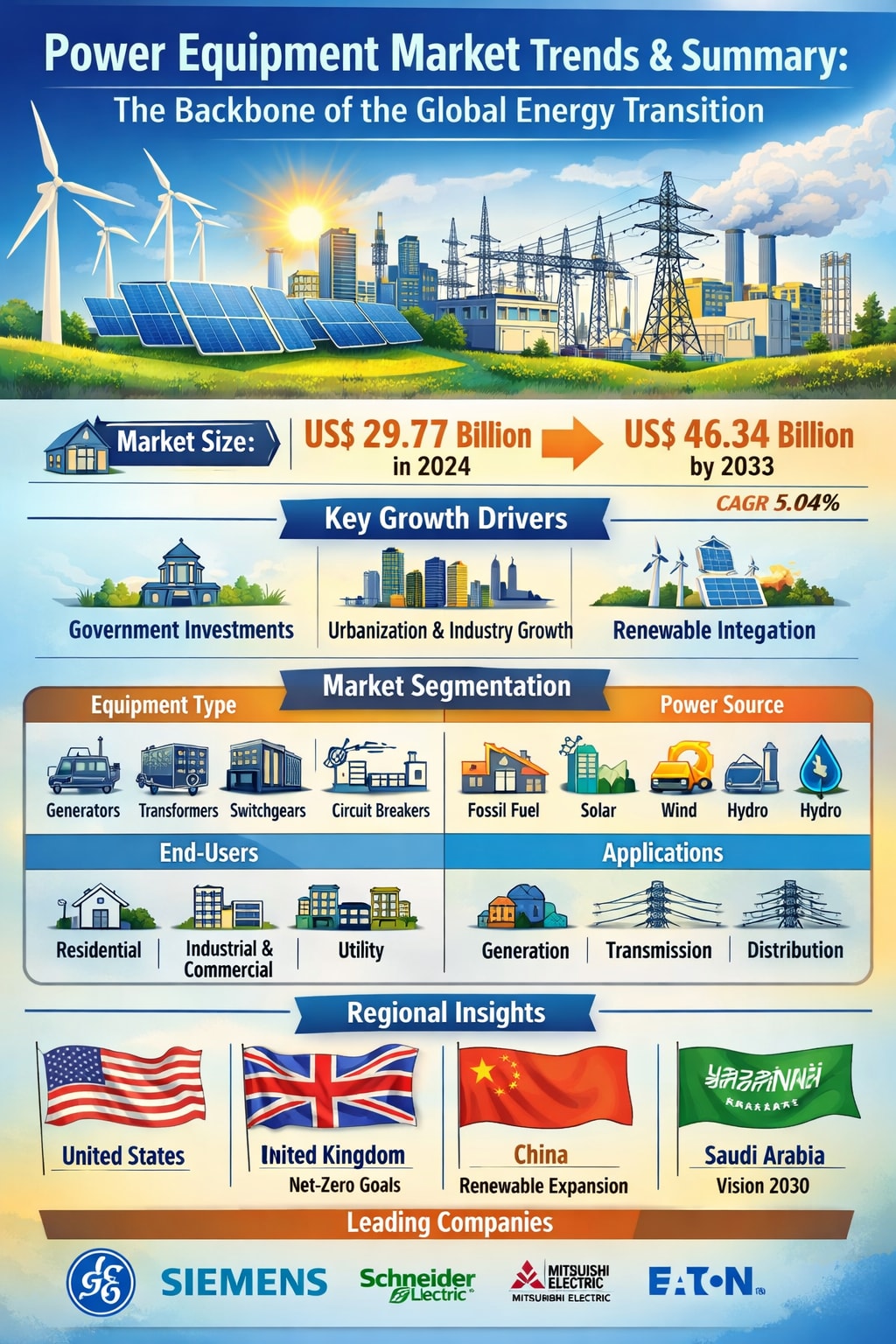
According to Renub Research, the Power Equipment Market is expected to grow from US$ 29.77 billion in 2024 to US$ 46.34 billion by 2033, registering a CAGR of 5.04% from 2025 to 2033. This growth is being fueled by a powerful combination of renewable energy expansion, infrastructure development, grid modernization, electrification of end-use sectors, and rapid technological innovation.
Power equipment is not just about big machines and heavy engineering. It is about energy security, economic growth, climate goals, and digital transformation. Transformers, generators, switchgears, circuit breakers, and power cables form the nervous system of the global electricity network, ensuring that power generated in one place can be transmitted, distributed, and used safely and efficiently somewhere else.
As countries race to upgrade aging grids and integrate cleaner energy sources, the power equipment industry is stepping into a central role—quietly but decisively shaping the future of global energy.
Global Power Equipment Industry Overview
The global power equipment industry covers a wide range of critical components used across power generation, transmission, and distribution. Core equipment includes generators, transformers, switchgears, circuit breakers, power cables, and various auxiliary systems that ensure stability, safety, and reliability across electricity networks.
Several structural trends are reshaping this market:
First, rising electricity demand driven by urbanization, industrialization, and digitalization is pushing utilities and governments to expand and modernize their grids. Data centers, electric vehicles, smart cities, and advanced manufacturing facilities all require stable and high-quality power supply, which in turn increases demand for advanced power equipment.
Second, the global shift toward renewable energy is changing the technical requirements of power systems. Unlike traditional fossil-fuel plants, solar and wind power are intermittent and decentralized. This creates a strong need for flexible, intelligent, and resilient grid infrastructure, supported by modern transformers, switchgear, and digital monitoring systems.
Third, technological innovation is transforming how power equipment is designed, deployed, and maintained. Smart grids, IoT-enabled devices, AI-driven predictive maintenance, and digital substations are no longer future concepts—they are becoming industry standards. These technologies improve operational efficiency, reduce downtime, and enhance grid reliability.
Emerging economies in Asia, Africa, and Latin America are investing heavily in new power infrastructure to support economic growth and improve energy access. Meanwhile, developed markets are focusing on replacing aging equipment, improving grid resilience, and supporting decarbonization goals.
Despite challenges such as supply chain disruptions, regulatory complexity, and skills shortages, the long-term outlook remains strong. The global push for energy sustainability, resilience, and efficiency continues to position the power equipment industry as a cornerstone of the modern economy.
Regional Momentum: Spotlight on Latin America
Latin America offers a compelling example of how infrastructure development and energy transition are boosting demand for power equipment. Countries such as Brazil, Argentina, Mexico, Chile, and Colombia are expanding their transmission and distribution networks to bridge the gap between rising electricity demand and supply.
Colombia, for instance, recorded a 5% rise in electricity generation between 2022 and 2023, outpacing its decade average growth rate of 3%. Brazil’s energy consumption is projected to exceed 590 TWh by 2027, requiring significant investments in grid infrastructure, substations, transformers, and transmission lines.
The region is also seeing strong momentum in wind energy. ACCIONA Energía commissioned the 135.7 MW San Juan de Marcona wind farm in Peru, while Mingyang Smart Energy secured a 240 MW preferred supplier agreement for an onshore wind project in Brazil. These developments underline how renewable projects are directly driving demand for advanced power equipment.
Strategic procurement deals further highlight this trend. In June 2024, Electrobras Furnas purchased power transformers from WEG for the construction of the West Zone Substation in Rio de Janeiro, reinforcing the region’s commitment to grid modernization.
Key Growth Drivers of the Power Equipment Market
1. Government Investments and Policy Support
Public policy is one of the strongest catalysts for power equipment demand. Across the world, governments are rolling out ambitious energy transition plans, grid modernization programs, and renewable energy targets.
In Colombia, regulations aim to increase the share of unconventional renewable energy from 1% to 12% by 2030, supported by projects such as Enel’s USD 300 million IFC-backed transmission and distribution investment. Ecuador’s electrical master plan targets 1.4 GW of new renewable capacity by 2031, backed by more than USD 580 million in grid upgrades since 2022. Chile’s goal of sourcing 70% of its electricity from renewables by 2030 is also accelerating investments in power infrastructure, with more than 5 GW of new capacity expected to be added annually until 2025.
Such policy-driven initiatives create sustained, long-term demand for transformers, switchgears, circuit breakers, and grid automation systems.
2. Urbanization and Industrial Expansion
Rapid urban growth and industrial development are significantly increasing electricity consumption, especially in emerging markets. New factories, commercial complexes, hospitals, data centers, and transport systems all require robust and reliable power infrastructure.
Examples include Freudenberg Medical’s USD 25 million investment in a new facility in Costa Rica and Amazon Web Services’ USD 205 million data center in Santiago, Chile—both highlighting the growing need for high-quality power equipment.
The construction sector also plays a major role. With around 44,000 building projects in 2022—a 9.2% increase—demand for transformers, distribution systems, and backup power solutions continues to rise. Large-scale infrastructure projects, such as Panama’s USD 3 billion port development plan through 2040, further reinforce the need for heavy-duty and mission-critical power equipment.
3. Renewable Energy Integration and Grid Modernization
The global energy transition is fundamentally reshaping power networks. As renewable capacity continues to grow—reaching 3,371.8 GW in 2022—grids must become more flexible, digital, and resilient.
Projects like the 240 MW wind farm in Brazil by Mingyang Smart Energy illustrate how advanced equipment is essential for integrating renewable power into existing networks. Meanwhile, initiatives such as the May 2024 collaboration between Centrosur and Gridspertise in Ecuador to deploy smart metering and digital distribution systems show how grid modernization is accelerating.
In Chile, ENGIE’s authorized transmission project in Rengo reflects rising investment in robust, future-ready infrastructure designed to handle variable renewable generation while maintaining grid stability.
Challenges Facing the Power Equipment Market
Skilled Labor Shortages
One of the most pressing challenges is the shortage of skilled professionals. As power systems become more digital and complex, the industry needs engineers, technicians, and specialists trained in smart grids, automation, and advanced power electronics. However, the supply of qualified talent is not keeping pace with demand, especially in developing regions. This skills gap can delay projects, increase costs, and affect system reliability.
Environmental and Social Concerns
Large power infrastructure projects often face environmental, regulatory, and social challenges. Land use, ecological impact, community displacement, and lengthy approval processes can slow down or complicate development. To maintain long-term growth, companies must adopt sustainable construction practices, transparent stakeholder engagement, and strong social responsibility frameworks.
Regional Market Insights
United States
The U.S. power equipment market is driven by grid modernization, renewable integration, and electrification of transport and industry. Investments in smart grids, energy storage, and digital monitoring tools are reshaping the sector. Government incentives and private capital continue to support resilient and sustainable infrastructure, keeping the U.S. at the forefront of technological adoption.
United Kingdom
The UK’s commitment to net-zero emissions by 2050 is fueling strong demand for power equipment. The National Infrastructure and Construction Pipeline, with an estimated USD 740 billion budget over 10 years, allocates significant resources to the energy sector. Offshore wind, EV charging infrastructure, and smart grids are key growth areas, although supply chain constraints and skills shortages remain challenges.
China
China leads the global power equipment market through massive infrastructure development, strong policy support, and industrial scale. Its rapid expansion of solar and wind capacity is driving demand for advanced grids, energy storage, and high-efficiency equipment. While challenges such as overcapacity and trade tensions exist, China remains a central force in shaping global supply chains.
Saudi Arabia
Saudi Arabia’s Vision 2030 and net-zero target by 2060 are transforming its energy landscape. Large-scale solar, wind, and advanced gas projects are boosting demand for modern power equipment. At the same time, strict efficiency standards and regulatory frameworks are pushing manufacturers to deliver higher-performance, compliant solutions.
Power Equipment Market Segmentation
By Equipment Type:
Generator
Transformer
Switchgears
Circuit Breakers
Power Cable
Other Equipment Types
By Power Generation Source:
Fossil Fuel Based
Solar
Wind
Nuclear
Hydro
By End-User:
Residential
Industrial and Commercial
Utility
By Application:
Power Generation
Transmission
Distribution
By Country (25+ markets):
North America (United States, Canada), Europe (France, Germany, Italy, Spain, UK, Belgium, Netherlands, Turkey), Asia Pacific (China, Japan, India, Australia, South Korea, Thailand, Malaysia, Indonesia, New Zealand), Latin America (Brazil, Mexico, Argentina), Middle East & Africa (South Africa, Saudi Arabia, UAE).
Competitive Landscape
Key players shaping the global power equipment market include:
General Electric Company
Siemens AG
Schneider Electric SE
Mitsubishi Electric Corporation
Eaton Corporation plc
Honeywell International Inc.
Bharat Heavy Electricals Limited
Crompton Greaves Ltd.
Rockwell Automation, Inc.
These companies compete on technology, reliability, digital capabilities, and global reach, while continuously investing in R&D and strategic partnerships.
Final Thoughts: Powering the Next Decade
The power equipment market is no longer just a supporting industry—it is a strategic enabler of the global energy transition. With the market projected to grow from US$ 29.77 billion in 2024 to US$ 46.34 billion by 2033, the sector stands at the intersection of technology, sustainability, and infrastructure development.
As countries modernize grids, scale renewable energy, and electrify economies, demand for advanced, efficient, and intelligent power equipment will only intensify. While challenges such as skills shortages and regulatory complexity remain, the long-term fundamentals are strong.
In many ways, the future of clean, reliable, and resilient energy will be built not just by power plants and policies—but by the quiet, critical machinery of the power equipment industry that keeps the world switched on.
About the Creator
Sakshi Sharma
Content Writer with 7+ years of experience crafting SEO-driven blogs, web copy & research reports. Skilled in creating engaging, audience-focused content across diverse industries.
Keep reading
More stories from Sakshi Sharma and writers in Trader and other communities.
Sodium-ion Battery Market Trends & Summary (2025–2033)
Global Sodium-ion Battery Market: Big Growth Ahead The global Sodium-ion Battery Market is gaining strong momentum as the world searches for safer, cheaper, and more sustainable alternatives to lithium-ion technology. According to Renub Research, the market is expected to grow from US$ 183.8 million in 2024 to US$ 405.83 million by 2033, registering a CAGR of 9.20% during 2025–2033.
By Sakshi Sharma2 days ago in Trader
Airbus Share Price: Understanding Market Performance
Airbus Share Price represents the market valuation of Airbus SE, a leading European aerospace and defense company. Airbus designs and manufactures commercial aircraft, defense systems, and space technologies. Investors closely monitor Airbus Share Price to assess the company’s financial health, global market trends, and the broader aerospace industry.
By Hammad Nawazabout 23 hours ago in Trader
Exchange-Traded Funds (ETFs): A Beginner’s Guide to Investing
Introduction Exchange-Traded Funds (ETFs) have become one of the most popular investment options for both beginners and experienced investors. ETFs are investment funds that trade on stock exchanges, combining the diversification of mutual funds with the flexibility of stocks.
By Hammad Nawaz2 days ago in Trader


Comments
There are no comments for this story
Be the first to respond and start the conversation.